Test -Research methods
LECTURE 1. Introduction to research perspectives, research objective and research
questions
Students are able to identify current and complex public health challenges
- List of current public health issues
o Climate crisis/ environmental impact on health
o Making health care fairer
o Access to medicine
o Opioid crisis
o Health care delivery in areas of conflict and crisis
o Preparing for epidemics
o Anti-microbial resistance
o Public trust (social media misinformation/disinformation)
o Ethical and social implications of new technologies
o Data modernization and privacy
o Food insecurity and food deserts
o Public health workforce shortage
- Are these current issues also complex ?
o Across all disciplines, at all levels, and throughout the world, health care
is becoming more complex
o In order to understand and address these complex problems in Health
sciences we need a range of methods, methodologies, theoretical
perspectives and epistemologies
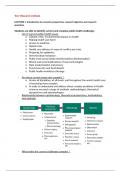
- Relationship between epistemology, theoretical perspectives, methodology
and methods
-
- What make the current challenges complex ?
, o Globalization ‘a world that is becoming increasingly integrated and
interdependent’.
o Fuzzy, instead of rigid boundaries
o Internalised rules drive action
o Agents within the system change
o Systems are embedded in other systems and co-evolve
Students are able to explain different epistemological stances (e.g., objectivism,
constructivism), theoretical perspectives (e.g., positivism, interpretivism) and the
relationship between them
- Epistemology
= the study of knowledge = In other words, it is the study of what
constitutes valid knowledge
- Positionality and your theory of knowledge
o For example based on your gender, language, skin colour.. etc
- Why is epistemology important?
o Knowledge of research philosophy will help the researcher to recognize
which designs will work for a given set of objectives and which will not
o It can help to clarify issues of research design (but also
misunderstandings/tensions) especially in interdisciplinary teams while
working on complex problems.
- Three different epistemological stances
o Objectivism
= reality exist independently of consciousness – in other words,
there is an objective reality ‘out there’. Research is bout
discovering this objective truth. Researchers should strive not to
include their own feelings and values.
Connected to theoretical perspective Positivism: there is only
one reality/truth. Reality can be measured. Knowledge can be
formulated into laws.
This view has been challenged. Post-positivism: we can only
approximate the truth.
o Constructivism
= Truth and meaning do not exist in some external world, but are
created by the subject’s interactions with the world. Meaning is
constructed not discovered. Subjects construct their own meaning
in different ways, even in relation to the same phenomenon.
Connected to theoretical perspective ‘Interpretivism’: multiple,
contradictory but equally valid accounts of the world can exist.
Knowledge is contextual.
Example (Phenomena): Rise of Ebola in a community
Discovers truth A
o How many people are infected ?
o What behaviour did Ebola infected persons
perform?
, Quantitative research methods
(post) positivism
Constructs reality B
o Why did infected persons perform this behaviour?
(motives, beliefs, values..)
Qualitative research methods
Interpretivism
o Subjectivism
Meaning is imposed by the subject on the object. Subjects do
constructs meaning, but do so from within collective
unconsciousness, form cultural and religious, belief, etc..
Postmodernism can be taken as an example of a theoretical
perspective linked to subjectivism. Postmodernism emphasis
multiplicity, ambiguity, ambivalence and fragmentation
How are they connected?
- Other theoretical perspectives
o Positivism/ post-positivism
o Interpretivism
o Postmodernism
o Critical inquiry: This critical form of research is a meta-process of
investigation, which questions currently held values and assumptions
and challenges conventional social structures. The critical inquiry
perspective is not content to interpret the world but also seeks to
change it. The assumptions that lie beneath critical inquiry are that:
Ideas are mediated by power relations in society.
o Feminism: feminist epistemologies tale the view that what a person
knows is largely determined by their social position.
Students can define and give examples of epistemic injustice in health sciences
, - Epistemic injustice
o = how people from marginalized groups are denied opportunities to create
knowledge and derive meaning from their experiences
o Like gaslighting, that is on microlevel (individual). Epistemic injustice takes
place on a systemic level.
o Injustice related to knowledge examples are: exclusion, silencing,
misrepresentation, undervaluing.
o In the field of global health /health sciences there still is the tendency to
disregards local (indigenous) knowledge, and which refuses to learn from
people often deemed to be ‘’lesser’’.
Students can reflect on their own positionality
….
Students are able to formulate an objective and research questions
- How to get a research topic
o Own previous research
o Experiences from fieldwork
o Donor informed
o Patient /patient organisation informed
o Interviewing experts and develop a new research agenda
- Avoid research disasters
o Too big
o Too trivial
o Lack in resources, material and people
o Dependent on the completion of another project
o Unethical
- From topic to the objective and research questions
o What is the broad area of research
o What is known/done about it
o (why is it a problem)
o Therefore, the aim of this is… (I am going to make known about it) = Objective
o Research questions (+ hypothesis)
Format for an introduction
From topic to objective = Research topic -> contributes to -> Understanding and/or
problem solving -> has practical and/or theoretical relevance -> Research objective
- Formulate research objective
o Informative (indication of knowledge to be gathered)
o Useful (relevant according to parties involved)
o Realistic (likelihood of contributing to solving the problem)
o Feasible (feasibility – time and resources) (Haalbaarheid)
o Clear (specify contribution)