

Escrito por estudiantes que aprobaron Inmediatamente disponible después del pago Leer en línea o como PDF ¿Documento equivocado? Cámbialo gratis 4,6 TrustPilot
logo-home
Document preview thumbnail
Vista previa 4 fuera de 333 páginas
Examen

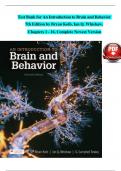
TEST BANK For An Introduction to Brain and Behavior, 7th Edition by Bryan Kolb, Ian Q. Whishaw, Verified Chapters 1 - 16, Complete Newest Version

Document preview thumbnail
Vista previa 4 fuera de 333 páginas

TEST BANK For An Introduction to Brain and Behavior, 7th Edition by Bryan Kolb, Ian Q. Whishaw, Verified Chapters 1 - 16, Complete Newest Version TEST BANK For An Introduction to Brain and Behavior, 7th Edition by Bryan Kolb, Ian Q. Whishaw, Verified Chapters 1 - 16, Complete Newest Version TEST BANK For An Introduction to Brain and Behavior, 7th Edition by Bryan Kolb, Ian Q. Whishaw, Verified Chapters 1 - 16, Complete Newest Version TEST BANK For An Introduction to Brain and Behavior, 7th Edition by Bryan Kolb, Ian Q. Whishaw Chapters 1 - 16, pdf An Introduction to Brain and Behavior, 7th Edition by Bryan Kolb, Ian Q. Whishaw Chapters 1 - 16, pdf An Introduction to Brain and Behavior, 7th Edition by Bryan Kolb, Ian Q. Whishaw Chapters An Introduction to Brain and Behavior, 7th Edition by Bryan Kolb, Ian Q. Whishaw pdf An Introduction to Brain and Behavior, 7th Edition by Bryan Kolb, Ian Q. Whishaw Chapters 1 - 16, pdf Test bank and solution manual pdf Test bank and solution manual pdf free download Test bank and solution manual pdf download Test bank and solution manual free download Test Bank solutions Test bank nursing Test Bank PDF Test bank questions and answers Test bank and study guide pdf Test bank nursing Download test banks for free Test bank questions and answers pdf Test Bank PDF Test bank pdf notes Test bank pdf free download Test bank questions and answers pdf Chemistry test bank pdf Download test banks for free Free test banks online Test bank practice test Test bank website Test Bank PDF Test bank quizlet Test bank questions Download test banks for free Test bank nursing Free test banks online Test bank practice test Test Bank book Solution manual pdf free download Solution manual pdf download Solution manual for textbooks free Solution manuals Free solution manual website Popov Solution Manual pdf How to download solution manual of any book Test Bank for An Introduction to Brain and Behavior 7th Edition by Bryan Kolb, Ian Q. Whishaw, Chapters 1 - 16, Complete Newest Version ,Table of Contents Chapter 1 What Are the Origins of Brain and Behavior? Chapter 2 What Is the Nervous System’s Functional Anatomy? Chapter 3 What Are the Nervous System’s Functional Units? Chapter 4 How Do Neurons Use Electrical Signals to Transmit Information? Chapter 5 How Do Neurons Communicate and Adapt? Chapter 6 How Do Drugs and Hormones Influence the Brain and Behavior? Chapter 7 How Do We Study the Brain’s Structures and Functions? Chapter 8 How Does the Nervous System Develop and Adapt? Chapter 9 How Do We Sense, Perceive, and See the World? Chapter 10 How Do We Hear, Speak, and Make Music? Chapter 11 How Does the Nervous System Respond to Stimulation and Produce Movement? Chapter 12 What Causes Emotional and Motivated Behavior? Chapter 13 Why Do We Sleep and Dream? Chapter 14 How Do We Learn and Remember? Chapter 15 How Does the Brain Think? Chapter 16 What Happens When the Brain Misbehaves? ,Chapter 1 – What are the origins of Brain and Behaviour? 1. Brain abnormalities can be related to: A) 500 disorders. B) 1000 disorders. C) 1500 disorders. D) more than 2,000 disorders. 2. All the nerve processes radiating out beyond the brain and spinal cord as well as all the neurons outside the brain and spinal cord constitute the: A) nervous system. B) central nervous system. C) peripheral nervous system. D) external nervous system. 3. Which is NOT part of the peripheral nervous system? A) sensory receptors in the skin B) connections to motor neurons C) sensory and motor connections to internal organs (e.g., the stomach) D) the spinal cord 4. The set of brain structures responsible for most of our unconscious behaviors is called: A) the cerebral hemisphere. B) the brainstem. C) the cerebrum. D) the cerebellum. 5. The postulation that we make subliminal movements of our larynx and muscles when we imagine was expounded by: A) D. O. Hebb. B) Edmond Jacobson. C) Irenäus Eibl-Eibesfeldt. Page 1 , D) Fred Linge. 6. “Behavior consists of patterns in time” is a definition of behavior expounded by: A) D. O. Hebb. B) Edmond Jacobson. C) Irenäus Eibl-Eibesfeldt. D) Fred Linge. 7. Patterns in time can be made up of: A) movements. B) thinking. C) both movements and thinking. D) neither movements nor thinking. 8. Animals with smaller brains and simpler nervous systems have mostly behaviors, whereas animals with larger brains and more complex nervous systems have mostly behaviors. A) learned; inherited B) inherited; learned C) innate; inherited D) learned; innate 9. Crossbill birds have a beak that is designed to eat pine cones. If we trim the beak, the behavior disappears. This example illustrates: A) fixed behavior. B) flexible behavior. C) learned behavior. D) adaptive behavior. 10. The sucking response observed in newborn human infants is an example of a(n): A) learned response. Page 2 , B) inherited response. C) flexible response. D) adaptive response 11. Which statement is the MOST accurate? A) Nonhuman animals have mostly inherited behavior and are little influenced by learning. B) Humans share many inherited behaviors but are mostly influenced by learning. C) Unlike nonhuman animals, humans share very few inherited behaviors and are mostly influenced by learning. D) Unlike nonhuman animals, humans' behavior is totally learned. 12. The hypothesis that the psyche is responsible for behavior was expounded by: A) Charles Darwin. B) René Descartes. C) Aristotle. D) Socrates. 13. Mentalism is: A) the study of the mind. B) mental imagery. C) the notion that the mind is responsible for behavior. D) another word for mindfulness. 14. The is a nonmaterial entity that is responsible for intelligence, attention, awareness, and consciousness. A) brain B) heart C) mind D) conscience Page 3 ,15. The notion that the mind resides in the pineal body comes from: A) Charles Darwin. B) René Descartes. C) Aristotle. D) Socrates. 16. According to the philosophy of dualism: A) the body influences the mind. B) the pineal body is the mind. C) the pineal body influences the body by directing fluids from the ventricles to the muscles. D) the pineal body is the mind and influences the body by directing fluids from the ventricles to the muscles. 17. Subsequent research indicated that the pineal body was responsible for rather than controlling human behavior. A) vision B) problem solving C) movement D) biological rhythms 18. The difficulty in explaining how a nonmaterial mind can influence a material body is called: A) the mind problem. B) the mind-body problem. C) the brain problem. D) the psyche problem 19. Descartes's followers would argue that: A) the mind and the body are separate at birth. B) humans and very few other animals have minds. C) young children do not have minds. Page 4 , D) the mentally ill have minds. 20. The notion that all behavior can be explained by the workings of the brain is commonly referred to as: A) psychology. B) experimentalism. C) materialism. D) dualism. 21. The notion that all living things are related was put forward by: A) Charles Darwin. B) Alfred Russel Wallace. C) neither Charles Darwin nor Alfred Russel Wallace. D) both Charles Darwin and Alfred Russel Wallace. 22. The notion that differential success in the reproduction of characteristics results from interactions between organisms and their environment is known as: A) natural selection. B) genetic theory. C) biological theory. D) innate behavior. 23. Images of blood flow in the brain in monkeys have demonstrated that: A) humans and monkeys use different brain areas for language. B) humans and monkeys use the same brain areas for language. C) monkeys show no brain activation for language because they cannot understand language. D) None of the answers is correct. 24. Individual variation in plants and animals was first explained by: A) Charles Darwin. Page 5 , B) Gregor Mendel . C) neither Charles Darwin nor Gregor Mendel. D) both Charles Darwin and Gregor Mendel. 25. The study of how genetic expression is related to the environment and experience is known as: A) genotyping. B) phenotyping. C) epigenetics. D) environmental genetics. 26. Neuroscientists study the nervous systems of other animals such as slugs, snails, fruit flies, rats and monkeys because: A) if all animals are related then all nervous systems are related and we can learn about the human brain by studying other animals. B) all animals' nervous systems are different, which means that we need to study each animal separately in order to understand how their specific nervous system works. C) the mind and the body are separate which means that we need to study a variety of different animals to see how their minds work. D) None of the answers is correct. 27. Inherited behavior: A) is demonstrated only by animal instincts. B) includes emotional expressions in humans. C) cannot include emotional expressions in humans because the behavior is learned. D) includes emotional expression in animals but not in humans. 28. Of the 100,000 people in the United States who may become comatose in a given year, how many recover consciousness? A) 5 percent B) 20 percent C) 30 percent D) 50 percent Page 6 , 29. A person who can display some rudimentary behaviors such as smiling or blinking but is otherwise not conscious is described as being: A) in a coma. B) in a persistent vegetative state. C) in a minimally conscious state. D) brain dead. 30. In a study with a patient in a minimally conscious state, Schiff and colleagues found that led to dramatic improvements in the patient's behavior. A) deep brain stimulation B) reading to the patient C) music therapy D) gene therapy 31. The first humanlike brain evolved: A) 700 million years ago. B) 250 million years ago. C) 6 million years ago. D) 100,000 to 200,000 years ago. 32. The first brain evolved approximately: A) 100,000 to 200,000 years ago. B) 3 million to 4 million years ago. C) 250 million years ago. D) 700 million years ago. 33. Humans are of the order and the family . A) mammals; primates B) primates; mammals C) primates; great apes

Vista previa del contenido

Test Bank for An Introduction to Brain and Behavior
7th Edition by Bryan Kolb, Ian Q. Whishaw,
Chapters 1 - 16, Complete Newest Version

,Table7of7Contents
Chapter717 What7Are7the7Origins7of7Brain7and7Behavior?7Chapter

27 What7Is7the7Nervous7System’s7Functional7Anatomy?7Chapter7
7


37 What7Are7the7Nervous7System’s7Functional7Units?

Chapter747 How7Do7Neurons7Use7Electrical7Signals7to7Transmit7Information?7Chapte

r757 How7Do7Neurons7Communicate7and7Adapt?

Chapter767How7Do7Drugs7and7Hormones7Influence7the7Brain7and7Behavior?7Chapter7

77 How7Do7We7Study7the7Brain’s7Structures7and7Functions?

Chapter787 How7Does7the7Nervous7System7Develop7and7Adapt?7C

hapter797 How7Do7We7Sense,7Perceive,7and7See7the7World?

Chapter7107How7Do7We7Hear,7Speak,7and7Make7Music?

Chapter7117How7Does7the7Nervous7System7Respond7to7Stimulation7and7Produce7Movement?7

Chapter7127What7Causes7Emotional7and7Motivated7Behavior?

Chapter7137Why7Do7We7Sleep7and7Dream?7Cha

pter7147How7Do7We7Learn7and7Remember?7Cha

pter7157How7Does7the7Brain7Think?

Chapter7167What7Happens7When7the7Brain7Misbehaves?

,Chapter 1 – What are the origins of Brain and Behaviour?
7 7 7 7 7 7 7 7 7 7


1. Brain7abnormalities7can7be7related7to:
A) 5007disorders.
B) 10007disorders.
C) 15007disorders.
D) more7than72,0007disorders.


2. All7the7nerve7processes7radiating7out7beyond7the7brain7and7spinal7cord7as7well7as7all7the7n
eurons7outside7the7brain7and7spinal7cord7constitute7the:
A) nervous7system.
B) central7nervous7system.
C) peripheral7nervous7system.
D) external7nervous7system.


3. Which7is7NOT7part7of7the7peripheral7nervous7system?
A) sensory7receptors7in7the7skin
B) connections7to7motor7neurons
C) sensory7and7motor7connections7to7internal7organs7(e.g.,7the7stomach)
D) the7spinal7cord


4. The7set7of7brain7structures7responsible7for7most7of7our7unconscious7behaviors7is7called:
A) the7cerebral7hemisphere.
B) the7brainstem.
C) the7cerebrum.
D) the7cerebellum.


5. The7postulation7that7we7make7subliminal7movements7of7our7larynx7and7muscles7when7
we7imagine7was7expounded7by:
A) D.7O.7Hebb.
B) Edmond7Jacobson.
C) Irenäus7Eibl-Eibesfeldt.


Page71

, D) Fred7Linge.


6. ―Behavior7consists7of7patterns7in7time‖7is7a7definition7of7behavior7expounded7by:
A) D.7O.7Hebb.
B) Edmond7Jacobson.
C) Irenäus7Eibl-Eibesfeldt.
D) Fred7Linge.


7. Patterns7in7time7can7be7made7up7of:
A) movements.
B) thinking.
C) both7movements7and7thinking.
D) neither7movements7nor7thinking.


8. Animals7with7smaller7brains7and7simpler7nervous7systems7have7mostly
behaviors,7whereas7animals7with7larger7brains7and7more7complex7nervous7systems7have7m
ostly
7 behaviors.
A) learned;7inherited
B) inherited;7learned
C) innate;7inherited
D) learned;7innate


9. Crossbill7birds7have7a7beak7that7is7designed7to7eat7pine7cones.7If7we7trim7the7beak,7the7b
ehavior7disappears.7This7example7illustrates:
A) fixed7behavior.
B) flexible7behavior.
C) learned7behavior.
D) adaptive7behavior.


10. The7sucking7response7observed7in7newborn7human7infants7is7an7example7of7a(n):
A) learned7response.


Page72

Información del documento

Subido en
15 de octubre de 2024
Número de páginas
333
Escrito en
2024/2025
Tipo
Examen
Contiene
Preguntas y respuestas
$18.49

¿Documento equivocado? Cámbialo gratis Dentro de los 14 días posteriores a la compra y antes de descargarlo, puedes elegir otro documento. Puedes gastar el importe de nuevo.
Escrito por estudiantes que aprobaron
Inmediatamente disponible después del pago
Leer en línea o como PDF

Seller avatar
Los indicadores de reputación están sujetos a la cantidad de artículos vendidos por una tarifa y las reseñas que ha recibido por esos documentos. Hay tres niveles: Bronce, Plata y Oro. Cuanto mayor reputación, más podrás confiar en la calidad del trabajo del vendedor.
Vendido
15
Seguidores
3
Artículos
195
Última venta
3 meses hace


Por qué los estudiantes eligen Stuvia

Creado por compañeros estudiantes, verificado por reseñas

Calidad en la que puedes confiar: escrito por estudiantes que aprobaron y evaluado por otros que han usado estos resúmenes.

¿No estás satisfecho? Elige otro documento

¡No te preocupes! Puedes elegir directamente otro documento que se ajuste mejor a lo que buscas.

Paga como quieras, empieza a estudiar al instante

Sin suscripción, sin compromisos. Paga como estés acostumbrado con tarjeta de crédito y descarga tu documento PDF inmediatamente.

Student with book image

“Comprado, descargado y aprobado. Así de fácil puede ser.”

Alisha Student

Preguntas frecuentes
