

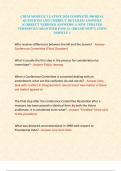
CDFM MODULE 1 LATEST 2024 COMPLETE 500 REAL
QUESTIONS AND CORRECT DETAILED ANSWERS
(CORRECT VERIFIED ANSWERS) A NEW UPDATED
VERSION |GUARANTEED PASS A+ (BRAND NEW!!) CDFM
MODULE 1
Who resolves differences between the HR and the Senate? - Answer-
Conference Committee (Third Chamber)
What is usually the first step in the process for consideration by
committee? - Answer-Public Hearing
When a Conference Committee is convened dealing with an
amendment, what can the conferees do and not do? - Answer-Only
deal with matters in disagreement; cannot insert new matter or leave
out matter agreed on
The final step after the Conference Committee Resolution after a
measure has been passed in identical form by both the House
andSenate, it is considered to be what? - Answer-"Enrolled" (then sent
to the president)
What was declared unconstitutional in 1998 with respect to
Presidential Veto? - Answer-Line Item Veto
,If the President Veto a Bill, it is returned to the house of original acting
first. If the Bill does not receive 2/3 vote, it is sustained and the bill fails
to become law. If it receives the required 2/3 vote, an endorsement to
the effect is made on the back of the bill and it is then transmitted, with
the accompany message, the to the second house for its action. What
has to happen for the Bill to become Law? - Answer-The next house has
to pass it with a 2/3 vote to become law.
What prevents Congress and the President from unilaterally making
laws and treaties? - Answer-Separation of Power
What give Congress the authority to make laws? - Answer-Article 1,
Section 8 of the Constitution
Who reviews the constitution for interpretation of the constitution? -
Answer-Supreme Court
Who has the power to raise taxes given in Article 1 of the Constitution?
- Answer-Congress (Legislative Branch)
What does the Congress of the US consist of? - Answer-Senate (6 yrs);
House (2 yrs)
All bills for raising Revenue shall originate where? But the Senate may
propose or concur with Amendments as on other Bills. - Answer-House
of Representative
,To be able to override a presidential veto, the House has to have a
majority to pass the bill; and if approved, then goes to the Senate for a
vote to pass the bill. If approved, the Bill becomes Law. What is the
percentage the vote has to pass by in both the House & Senate? -
Answer-2/3 and 2/3
If any Bill shall not be returned by the President after it has been
presented to him, the Same shall be a law. How many days? - Answer-
10 Days
Who has the power to lay and collect taxes, duties, imposts and Excises
to pay the debts and provide for the common defense and general
welfare of the United States. - Answer-Congress
Article 1, Section 8 of the Constitution allows for what? - Answer-1)
borrow money on credit 2) regulate commerce; 3) Coin money; 4)
Constitute Tribunals; 5) Declare War; 6) Raise and support Armies; 7)
provide and maintain Navy; 8) Make Rules for Government Regulation
of land and naval forces; 9) Provide for calling forth Militia; 10) to make
all laws
No money shall be drawn from the Treasury, but in the Consequence of
Appropriations made by law. - Answer-Article 1, Section 9
, Once the money officially and legally gets into the Treasury, to be able
to use the money, what does Congress have to do? - Answer-Write a
Law
Gives executive power to the President to be the Commander in Chief
and to execute the laws - Answer-Article 2 Executive Branch
The President has the power to nominate and with the advice and
consent of the Senate, shall appoint these officials. Name 2? - Answer-
Ambassadors & Supreme Court Judges
How often does the President give to Congress the State of the Union
(Jan/Feb) time frame. - Answer-Once year
Who and what branch is responsibly for faithfully executing the laws
enacted by Congress (Legislative Branch)? - Answer-President
(Executive Branch)
The Supreme Court does not deal in the matter of what? - Answer-State
Laws
A new Congress convenes for two years following the November
general elections, it consists of how many sessions, and each in what
duration? - Answer-2 sessions; 1 year duration
QUESTIONS AND CORRECT DETAILED ANSWERS
(CORRECT VERIFIED ANSWERS) A NEW UPDATED
VERSION |GUARANTEED PASS A+ (BRAND NEW!!) CDFM
MODULE 1
Who resolves differences between the HR and the Senate? - Answer-
Conference Committee (Third Chamber)
What is usually the first step in the process for consideration by
committee? - Answer-Public Hearing
When a Conference Committee is convened dealing with an
amendment, what can the conferees do and not do? - Answer-Only
deal with matters in disagreement; cannot insert new matter or leave
out matter agreed on
The final step after the Conference Committee Resolution after a
measure has been passed in identical form by both the House
andSenate, it is considered to be what? - Answer-"Enrolled" (then sent
to the president)
What was declared unconstitutional in 1998 with respect to
Presidential Veto? - Answer-Line Item Veto
,If the President Veto a Bill, it is returned to the house of original acting
first. If the Bill does not receive 2/3 vote, it is sustained and the bill fails
to become law. If it receives the required 2/3 vote, an endorsement to
the effect is made on the back of the bill and it is then transmitted, with
the accompany message, the to the second house for its action. What
has to happen for the Bill to become Law? - Answer-The next house has
to pass it with a 2/3 vote to become law.
What prevents Congress and the President from unilaterally making
laws and treaties? - Answer-Separation of Power
What give Congress the authority to make laws? - Answer-Article 1,
Section 8 of the Constitution
Who reviews the constitution for interpretation of the constitution? -
Answer-Supreme Court
Who has the power to raise taxes given in Article 1 of the Constitution?
- Answer-Congress (Legislative Branch)
What does the Congress of the US consist of? - Answer-Senate (6 yrs);
House (2 yrs)
All bills for raising Revenue shall originate where? But the Senate may
propose or concur with Amendments as on other Bills. - Answer-House
of Representative
,To be able to override a presidential veto, the House has to have a
majority to pass the bill; and if approved, then goes to the Senate for a
vote to pass the bill. If approved, the Bill becomes Law. What is the
percentage the vote has to pass by in both the House & Senate? -
Answer-2/3 and 2/3
If any Bill shall not be returned by the President after it has been
presented to him, the Same shall be a law. How many days? - Answer-
10 Days
Who has the power to lay and collect taxes, duties, imposts and Excises
to pay the debts and provide for the common defense and general
welfare of the United States. - Answer-Congress
Article 1, Section 8 of the Constitution allows for what? - Answer-1)
borrow money on credit 2) regulate commerce; 3) Coin money; 4)
Constitute Tribunals; 5) Declare War; 6) Raise and support Armies; 7)
provide and maintain Navy; 8) Make Rules for Government Regulation
of land and naval forces; 9) Provide for calling forth Militia; 10) to make
all laws
No money shall be drawn from the Treasury, but in the Consequence of
Appropriations made by law. - Answer-Article 1, Section 9
, Once the money officially and legally gets into the Treasury, to be able
to use the money, what does Congress have to do? - Answer-Write a
Law
Gives executive power to the President to be the Commander in Chief
and to execute the laws - Answer-Article 2 Executive Branch
The President has the power to nominate and with the advice and
consent of the Senate, shall appoint these officials. Name 2? - Answer-
Ambassadors & Supreme Court Judges
How often does the President give to Congress the State of the Union
(Jan/Feb) time frame. - Answer-Once year
Who and what branch is responsibly for faithfully executing the laws
enacted by Congress (Legislative Branch)? - Answer-President
(Executive Branch)
The Supreme Court does not deal in the matter of what? - Answer-State
Laws
A new Congress convenes for two years following the November
general elections, it consists of how many sessions, and each in what
duration? - Answer-2 sessions; 1 year duration

