

Escrito por estudiantes que aprobaron Inmediatamente disponible después del pago Leer en línea o como PDF ¿Documento equivocado? Cámbialo gratis 4,6 TrustPilot
logo-home
Document preview thumbnail
Vista previa 2 fuera de 9 páginas
Examen

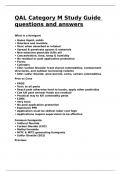
QAL Category M Study Guide questions and answers.

Document preview thumbnail
Vista previa 2 fuera de 9 páginas

What is a fumigant • Gases liquid, solids • Odorless and invisible • Toxic when absorbed or inhaled • Spread & penetrate spaces & materials • Non-selective pesticide (kills all) • Concentration, time, temp & humidity • No residual or post application protection • Forms • Cylinders • CO2: Carbon Dioxide: treat stored commodities, containment structures, and outdoor burrowing rodents • SO2: sulfur dioxide: wine barrels, corks, certain commodities Pros vs Cons • PROS • Toxic to all pests • Reach pest otherwise hard to locate, apply other pesticides • Can kill pest on/near foods w/o residual • Practical way to kill commodity pests • CONS • Very toxic • No post application protection • Expensive PPE • Applicators must be skilled: labor cost high • Applications require supervision to be effective Common fumigants: • Sulfuryl fluoride • Carbon Dioxide (CO2) • Methyl bromide • MITC & MITC generating fumigants • Sulfur Dioxide (SO2) Previous Play Next Rewind 10 seconds Move forward 10 seconds Unmute 0:00 / 0:15 Full screen Brainpower Read More Fumigant distribution in a space • Molecular weight: measure of the weight of the atoms that forma particular substance • Specific gravity: ratio of the density of a substance to the density of a standard • Standard for gas = 1 • Greater then 1 = heavier than air, sinks • Less then 1 = lighter than air, rises • MW and SG: tell you • SF = 3.52 • Labeled required fans to evenly distribute AI Volatility & Vapor pressure • Volatility: describes how a substance turns to vapor • Vapor: measurement of the push against the atmosphere • Vapor pressure: pressure stabilize at a constant value • Higher vapor pressure = more concentrated = better fumigant Solubility, Flammability, Reactivity • Solubility: measure of how gas will dissolve into other materials • Highly soluble fumes will dissolve in high moisture/oil content commodities • Flammability: capacity to catch fire • Reactivity: reaction with products • Methyl Bromide: sulfur products: foul odor hard to eliminate • Phosphine: copper: corrosion, flammable Sorption: Absorption & Desorption • Absorption: gas stick to surfaces, penetrate material • Desorption: release of gas • More surface area (rice) = more absorptive • Inert surfaces (metal) = less absorptive • ** Aeration must be long enough for fumigant to desorb • Not enough time= tainted commodities: toxic residues, off taste and odors Phosphine, AP, MP • Restrictive use materials, permits required • Reactive with moisture = toxic gas • Warmth and humidity increase reaction rate • May be pure or mixed with CO2 • Can not be re-used, product or metal flask • Precautions • Fire risk is produced quickly, mixed with CO2 not flammable • Explosive above 18,000 ppm • AP cannot be used within 100 feet of structure Sulfuryl fluoride • Properties • Colorless, odorless, non-flammable • Corrosive in presence of open flames • Desorbs quickly • Effective on larva & adults not eggs • Fans use to distribute gas • Chloropicrin: warning agent CO2 • Colorless, odorless, non-flammable, no residue • Naturally occurring • Commodities, burrowing rodent control MB: Methyl bromide • Colorless, odorless gas, pressured liquid cylinders • Heavier than air = must use fans to distribute • Green house gas, use phasing out • Never: use near open flames, salt, damages seeds • Avoid use around rubber products and PPE MITC (metam sodium, Dichlobenil) • Metam is a MITC gas generator: upon exposure degrades to form MITC gas • Metam sodium: non-selective herbicide • Dichlobenil: growth inhibitor • uses: wood preservation, utility poles, leather processing, cane/sugar, antimicrobial treatments, water purification, herbicide in sewers SO2: Sulfur Dioxide • Non-flammable smelly, liquid or gas • Uses: • Post harvest grapes held in cold storage, control gray mold disease, sanitize corks/barrels • Liquid SO2: • Overdose barrels • Cause respiratory hazard • Acute respiratory toxin • 20 psi or less = replace cylinder Pest factors & Resistance • Pest life stage • Adults breath in more fumigant = metabolism effected by temperatures • Too cold or packed = don't breath as much • Resistance • Phosphine resistance: red & confused flour beetles, leer grain borer, almond moth, cog beetle, IMMM, rusty grain beetle, sawtooth grain beetle • Management: • Practice IPM • Fumigant only when necessary • Rotate chemistry

Vista previa del contenido

QAL Category M Study Guide
questions and answers
What is a fumigant
• Gases liquid, solids
• Odorless and invisible
• Toxic when absorbed or inhaled
• Spread & penetrate spaces & materials
• Non-selective pesticide (kills all)
• Concentration, time, temp & humidity
• No residual or post application protection
• Forms
• Cylinders
• CO2: Carbon Dioxide: treat stored commodities, containment
structures, and outdoor burrowing rodents
• SO2: sulfur dioxide: wine barrels, corks, certain commodities
Pros vs Cons
• PROS
• Toxic to all pests
• Reach pest otherwise hard to locate, apply other pesticides
• Can kill pest on/near foods w/o residual
• Practical way to kill commodity pests
• CONS
• Very toxic
• No post application protection
• Expensive PPE
• Applicators must be skilled: labor cost high
• Applications require supervision to be effective

Common fumigants:
• Sulfuryl fluoride
• Carbon Dioxide (CO2)
• Methyl bromide
• MITC & MITC generating fumigants
• Sulfur Dioxide (SO2)
Previous

, Play
Next
Rewind 10 seconds
Move forward 10 seconds
Unmute
0:00
/
0:15
Full screen
Brainpower
Read More
Fumigant distribution in a space
• Molecular weight: measure of the weight of the atoms that forma
particular substance
• Specific gravity: ratio of the density of a substance to the density
of a standard
• Standard for gas = 1
• Greater then 1 = heavier than air, sinks
• Less then 1 = lighter than air, rises
• MW and SG: tell you
• SF = 3.52
• Labeled required fans to evenly distribute AI
Volatility & Vapor pressure
• Volatility: describes how a substance turns to vapor
• Vapor: measurement of the push against the atmosphere
• Vapor pressure: pressure stabilize at a constant value
• Higher vapor pressure = more concentrated = better fumigant
Solubility, Flammability, Reactivity
• Solubility: measure of how gas will dissolve into other materials
• Highly soluble fumes will dissolve in high moisture/oil content
commodities
• Flammability: capacity to catch fire
• Reactivity: reaction with products


Información del documento

Subido en
10 de septiembre de 2024
Número de páginas
9
Escrito en
2024/2025
Tipo
Examen
Contiene
Preguntas y respuestas
$14.99

¿Documento equivocado? Cámbialo gratis Dentro de los 14 días posteriores a la compra y antes de descargarlo, puedes elegir otro documento. Puedes gastar el importe de nuevo.
Escrito por estudiantes que aprobaron
Inmediatamente disponible después del pago
Leer en línea o como PDF

Seller avatar
Los indicadores de reputación están sujetos a la cantidad de artículos vendidos por una tarifa y las reseñas que ha recibido por esos documentos. Hay tres niveles: Bronce, Plata y Oro. Cuanto mayor reputación, más podrás confiar en la calidad del trabajo del vendedor.
BRAINBOOSTERS
4.5
(355)
Vendido
784
Seguidores
257
Artículos
25924
Última venta
3 días hace


Por qué los estudiantes eligen Stuvia

Creado por compañeros estudiantes, verificado por reseñas

Calidad en la que puedes confiar: escrito por estudiantes que aprobaron y evaluado por otros que han usado estos resúmenes.

¿No estás satisfecho? Elige otro documento

¡No te preocupes! Puedes elegir directamente otro documento que se ajuste mejor a lo que buscas.

Paga como quieras, empieza a estudiar al instante

Sin suscripción, sin compromisos. Paga como estés acostumbrado con tarjeta de crédito y descarga tu documento PDF inmediatamente.

Student with book image

“Comprado, descargado y aprobado. Así de fácil puede ser.”

Alisha Student

Preguntas frecuentes