
• ¿Documento equivocado? Cámbialo gratis
  • Escrito por estudiantes que aprobaron
  • Inmediatamente disponible después del pago
  • Leer en línea o como PDF
Vender
¿Dónde estudias?
Tu idioma
Document preview thumbnail
Vista previa 1 fuera de 4 páginas
Examen

AICE Psychology Milgram Study fully solved & updated(100- accuracy).

Document preview thumbnail
Vista previa 1 fuera de 4 páginas

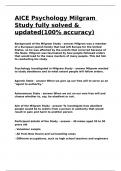
Background of the Milgram Study Milgram was a member of a European Jewish family that had left Europe for the United States, so he was affected by the events that occurred because of the Nazis. Milgram was fascinated by how people followed orders that would lead to the mass murders of many people. This led him to conducting his study. Psychology Investigated in Milgram Study Milgram wanted to study obedience and to what extent people will follow orders. Previous Play Next Rewind 10 seconds Move forward 10 seconds Unmute -- / -- Full screen Brainpower Read More Agentic State When we give up our free will to serve as an "agent to authority." Autonomous State When we act on our own free will and choose whether to, say, be obedient or not. Aim of the Milgram Study To investigate how obedient people would be to orders from a person in authority that would result in pain and harm to another person Participant details of the Study - 40 males aged 20 to 50 years old - Volunteer sample - All from New Haven and surrounding areas - Different occupations, such as high school teachers and engineers - Paid $4.40 for participating, but were to be given this money simply for coming to the laboratory, even if they chose not to take part Sampling Method of the Milgram Study Volunteer Sample Experiment Design of the Milgram Study Laboratory Experiment Procedures of the Milgram Study (write out and number the steps in order) 1. The "teacher" (the real participant) sees the "learner" (the actor) strapped into a chair. 2. The teacher is then taken to a room next door and shown the electric shock machine 3. The number of volts on the machine went from 15v to 450v. The electric shocks were not real, but the participants thought that they were 4. The teacher is told to give an electric shock to the learner every time he makes a mistake on the memory test. 5. Each time, the shock needs to be bigger than the one before. Results of the Milgram Study - 65% of participants delivered the 450-volt shock (prediction 1%) - 14 defiant participants, i.e. stopped early - 26 obedient participants followed orders and would have killed the stooge Conclusions of the Milgram Study By being under control of someone else, you will obey their orders even if they cause you distress Situational Hypothesis The idea that we can explain events by reference to the social processes operating in the situation, rather than the characteristics of the individuals involves. Dispositional Hypothesis Something distinctive about culture or personality leads to high levels of conformity and obedience. IV of the Milgram Experiment "prods" given by researcher DV of the Milgram Experiment Level of Obedience Strengths of the Milgram Study (There are two stated) 1. Experiment was done in a laboratory and was strictly standardized so it can be easily replicated. 2. As there were so many controls, the researcher could conclude with confidence that it was the situation that the participants were place in that caused the obedience levels.

Vista previa del contenido

AICE Psychology Milgram
Study fully solved &
updated(100% accuracy)
Background of the Milgram Study - answer Milgram was a member
of a European Jewish family that had left Europe for the United
States, so he was affected by the events that occurred because of
the Nazis. Milgram was fascinated by how people followed orders
that would lead to the mass murders of many people. This led him
to conducting his study.


Psychology Investigated in Milgram Study - answer Milgram wanted
to study obedience and to what extent people will follow orders.


Agentic State - answer When we give up our free will to serve as an
"agent to authority."


Autonomous State - answer When we act on our own free will and
choose whether to, say, be obedient or not.


Aim of the Milgram Study - answer To investigate how obedient
people would be to orders from a person in authority that would
result in pain and harm to another person


Participant details of the Study - answer - 40 males aged 20 to 50
years old
- Volunteer sample
- All from New Haven and surrounding areas
- Different occupations, such as high school teachers and engineers


Información del documento

Subido en
10 de septiembre de 2024
Número de páginas
4
Escrito en
2024/2025
Tipo
Examen
Contiene
Preguntas y respuestas
$12.99

¿Documento equivocado? Cámbialo gratis Dentro de los 14 días posteriores a la compra y antes de descargarlo, puedes elegir otro documento. Puedes gastar el importe de nuevo.
Escrito por estudiantes que aprobaron
Inmediatamente disponible después del pago
Leer en línea o como PDF

Seller avatar
Los indicadores de reputación están sujetos a la cantidad de artículos vendidos por una tarifa y las reseñas que ha recibido por esos documentos. Hay tres niveles: Bronce, Plata y Oro. Cuanto mayor reputación, más podrás confiar en la calidad del trabajo del vendedor.
BRAINBOOSTERS
4.5
(355)
Vendido
798
Seguidores
258
Artículos
25850
Última venta
3 días hace


Por qué los estudiantes eligen Stuvia

Creado por compañeros estudiantes, verificado por reseñas

Calidad en la que puedes confiar: escrito por estudiantes que aprobaron y evaluado por otros que han usado estos resúmenes.

¿No estás satisfecho? Elige otro documento

¡No te preocupes! Puedes elegir directamente otro documento que se ajuste mejor a lo que buscas.

Paga como quieras, empieza a estudiar al instante

Sin suscripción, sin compromisos. Paga como estés acostumbrado con tarjeta de crédito y descarga tu documento PDF inmediatamente.

Student with book image

“Comprado, descargado y aprobado. Así de fácil puede ser.”

Alisha Student

Preguntas frecuentes