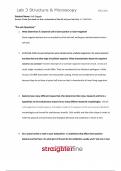
BIO250L Lab 3 Structure & Microscopy
1. What determines if a bacterial cell is Gram-positive or Gram-negative? Gram-negative bacteria are surrounded by a thin cell wall, while gram-positive bacteria lack a cell wall. 2. In this lab, both viruses and prions were introduced as acellular organisms. Do some research and describe one other type of acellular organism. What characteristics about this organism classify it as acellular? Another example of an acellular organism would be viroids. Viroids are small, single- stranded, circular RNAs. They are considered to be infectious pathogens. Unlike viruses, this RNA strand does not have protein coating. Viroids are considered to be acellular, because they do not have a typical cell structure that is characteristic of most living organisms. 3. Bacteria have many different shapes that often determine their class. Research and form a hypothesis on the evolutionary reasons for so many different bacterial morphologies. Like all microorganisms, bacteria grows and adapts based on its response to the environment. Bacterial morphologies are formed for evolutionary benefits. Cells modify and alter their shape in order to meet the physical, environmental and biological demands and conditions in which it lives.
Escuela, estudio y materia
- Institución
- Straighterline
- Grado
- BIO250L (BIO250L)
Información del documento
- Subido en
- 9 de septiembre de 2024
- Número de páginas
- 13
- Escrito en
- 2024/2025
- Tipo
- Examen
- Contiene
- Preguntas y respuestas
Temas
-
bio250l
-
bio 250
-
structure microscopy
-
lab 3 structure microscopy
-
bio250l lab 3 structure microscopy

Documento también disponible en un lote