
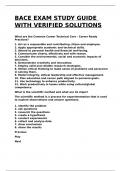
BACE EXAM STUDY GUIDE
WITH VERIFIED SOLUTIONS
What are the Common Career Technical Core - Career Ready
Practices?
1. Act as a responsible and contributing citizen and employee.
2. Apply appropriate academic and technical skills.
3. Attend to personal health and financial well-being.
4. Communicate clearly, effectively and with reason.
5. Consider the environmental, social and economic impacts of
decisions.
6. Demonstrate creativity and innovation.
7. Employ valid and reliable research strategies.
8. Utilize critical thinking to make sense of problems and persevere
in solving them.
9. Model integrity, ethical leadership and effective management.
10. Plan education and career path aligned to personal goals.
11. Use technology to enhance productivity.
12. Work productively in teams while using cultural/global
competence.
What is the scientific method and what are its steps?
The scientific method is a process for experimentation that is used
to explore observations and answer questions.
1. identify the problem
2. ask questions
3. research the questions
4. create a hypothesis
5. conduct experiments
6. collect and analyze data
7. draw conclusions
8. share the results
Previous
Play
Next
, Rewind 10 seconds
Move forward 10 seconds
Unmute
0:00
/
0:15
Full screen
Brainpower
Read More
What is PCR (polymerase chain reaction)?
Polymerase chain reaction, or PCR, is a technique to make many
copies of a specific DNA region in vitro (in a test tube rather than an
organism).
Amplifies a target region quickly & cost effectively
What is used in PCR?
PCR relies on a thermostable DNA polymerase, Taq polymerase, and
requires DNA primers designed specifically for the DNA region of
interest.
How is PCR done?
What are the applications of PCR?
What is the role of the mitochondria?
Where is DNA stored in a eukaryotic cell?
What is the difference between a eukaryotic and a prokaryotic cell?
What is the role of the Golgi apparatus?
Consists of a stack of curved saccules that receives protein and also
lipid-filled vesicles from the ER, packages, processes, and
distributes them within the cell
What is the role of the centrosome?
What is the role of the smooth endoplasmic reticulum?
What is the role of the rough endoplasmic reticulum?

