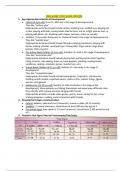
FINAL EXAM STUDY GUIDE FOR PEDS
1. Age Appropriate Activities & Development
• Infants (0-1yrs old): Trust Vs. Mistrust is the stage of development &
They like “solitary play”
(Appropriate activities should include rattles, teething toys, stuffed toys, playing pat
a cake, playing with balls, having books read to them, mirror, bright colored toys, or
playing with block, etc. Anything with shapes, textures, colors or sounds)
• Toddlers (1-3 yrs old): Autonomy Vs. Shame & Doubt Is the stage of development &
They like “parallel play ”
(Appropriate activities should include filling & emptying containers, playing with
blocks, looking at books, push/pull toys, tossing balls, finger paints, large piece
puzzles, thick crayons)
• Pre-School Aged Children (3-6 yrs old): Initiative Vs. Guilt is the stage of development
They like “associative play”
(Appropriate Activities should include playing ball, putting puzzles back together,
riding tricycles, role playing, dress up, hand puppets, painting, reading books,
sandboxes, skating, computer games, musical toys, etc.)
• School-Aged Children (6-12 yrs old): Industry Vs. Inferiority is the stage of
development
They like “competitive play”
(Appropriate Activities should include board games, hopscotch, ride bicycles,
building simple models, organized sports, makes crafts, collects things, jigsaw
puzzles, card games)
• Adolescents (12-20 yrs old): Identity Vs. Role Confusion is the stage of the
development, these patients are finding themselves and experience different roles,
they identify with a group and love hanging with friends
(Appropriate activities include video games, sports, music, caring for pet, career
training programs, reading, social interaction with friends)
2. Development stages communication
• Infants: babbles, baba and coo (3-6months), mama or dada (10-12 months)
• Toddlers: 2-3 word sentences, should have at least 300 word by age of 2
• Pre-School Aged: they speak in 3-5 word sentences, should have 2,100 words by end
of 5
3. Pediatric Vital Signs/ Physical Assessments/Pain Scales
,*BIGGEST THING TO NOTE FOR PHYSICAL ASSESSMENT OF INFANT AND TODDLER IS SAVE THE
INVASIVE PARTS FOR LAST SUCH AS EYES, MOUTH, EARS, OR FACE IN GENERAL ALSO LEAVE
REFLEXS FOR LAST AS WELL*
*MAKE SURE TO DEMONSTRATE ON DOLL OR ITEM BEFOR TO MAKE THEM FEEL MORE
COMFORTABLE WHILE INTRODUCING THEM TO THE BEHAVIOR AND LET THEM LOOK AT
EQUIPMENT IF NEEDED*
Infants: FLACC Scale or cries for pain
Toddlers & Pre-School: FACES or OUCHER for pain
School-Age & Adolescents: Numeric Scale for pain
4. Immunizations
5. Respiratory Distress
• It can be brought on by obstruction, inflammation or respiratory depression
• Early S/S: Tachypnea, Tachycardic, Pallor (pale skin), retractions, nasal flaring,
abdominal breathing, adventitious lung sounds, use of accessory muscles
• Late S/S: Bradypnea, cyanosis, bradycardic, confused, lethargy, stupor (They could
go into complete respiratory arrest)
• Catch symptoms early on
6. Asthma
• Asthma is usually caused by triggers in the environment (such as sea wood, pollen,
detergent, perfume, dust, animals,) which causes hypersensitive immune response
which causes inflammation of bronchioles to occur
• What adventitious lung sound do you hear with asthma? Wheezing
• What type of acid base imbalance am I likely to see in patients with asthma?
Respiratory Acidosis
, • Persistent Asthma needs daily medication to prevent asthma exacerbation which
daily medication for asthma: inhaled corticosteroid 1st line medication (MDI) + LABA
(can never be given by itself)
• RESCUE MEDICATION FOR EMERGENCIES: Albuterol (SABA)
• How does the nurse know how well controlled an asthma patient is? Peak expiratory
flow meter
• Peak expiratory flow meter: Blow very fast and hard, make sure you’re standing
when the test is done, do 3x, best score is your score
• GREEN ZONE: more than 80% which means good
YELLOW ZONE: between 50%-79% which means they could have asthma attack or
may need higher dose of daily regimen or albuterol
RED ZONE: less than 50% which means they need albuterol (SABA) and to go straight
to the hospital
• What happens to chest configuration to a patient with asthma for more than a
decade? Barrell- Chest shape
7. Sudden Infant Death Syndrome (SIDS)
• Place baby in SUPINE position, NO mobiles, NO toys or stuffed animals in crib,
NO bumpers, NO blankets, NO co-sleeping, NO pillows or strings, firm mattress,
pacifier (less than 6 months)
• Breastfeeding is protective against SIDS, reducing exposure to second-hand
smoke
8. Cystic Fibrosis
• Autosomal recessive disorder which means both parents are carriers and have
25% chance of getting the disease (life limiting condition)
• Causes an overproduction of mucus because of overproduction of sodium and
chloride
• S/S in infants: They don’t pass meconium in 48 hrs (meconium ileus), salty skin,
steatorrhea (fatty bulky foul-smelling stools), distended abdomen
• Pilocarpine iontophoresis test (sweat chloride test) to diagnose cystic fibrosis
• Treatment is management of respiratory and GI system
• Respiratory system: we could use Dornase alfa (Pulmozyme) which is a
mucolytic, chest physiotherapy (CPT ), bronchodilators, inhalable prophylactic
antibiotics
• Biggest concern is infection (risk of)
• GI system: give pancreatic enzymes (Pancrelipase)with meals, vitamin
supplementation for A, D, E, K + high protein high fat foods
• If pancreas becomes dysfunctional, it could cause diabetes
9. Epiglottitis
• Inflammation of the epiglottitis (more common in children because their
immune system is prone to inflammation)
• What is the most common cause of epiglottitis? Respiratory bacterial infection
known as haemophilus influenza type b also known as Hib (NOT SEEN OFTEN
BECAUSE OF VACCINATIONS)
1. Age Appropriate Activities & Development
• Infants (0-1yrs old): Trust Vs. Mistrust is the stage of development &
They like “solitary play”
(Appropriate activities should include rattles, teething toys, stuffed toys, playing pat
a cake, playing with balls, having books read to them, mirror, bright colored toys, or
playing with block, etc. Anything with shapes, textures, colors or sounds)
• Toddlers (1-3 yrs old): Autonomy Vs. Shame & Doubt Is the stage of development &
They like “parallel play ”
(Appropriate activities should include filling & emptying containers, playing with
blocks, looking at books, push/pull toys, tossing balls, finger paints, large piece
puzzles, thick crayons)
• Pre-School Aged Children (3-6 yrs old): Initiative Vs. Guilt is the stage of development
They like “associative play”
(Appropriate Activities should include playing ball, putting puzzles back together,
riding tricycles, role playing, dress up, hand puppets, painting, reading books,
sandboxes, skating, computer games, musical toys, etc.)
• School-Aged Children (6-12 yrs old): Industry Vs. Inferiority is the stage of
development
They like “competitive play”
(Appropriate Activities should include board games, hopscotch, ride bicycles,
building simple models, organized sports, makes crafts, collects things, jigsaw
puzzles, card games)
• Adolescents (12-20 yrs old): Identity Vs. Role Confusion is the stage of the
development, these patients are finding themselves and experience different roles,
they identify with a group and love hanging with friends
(Appropriate activities include video games, sports, music, caring for pet, career
training programs, reading, social interaction with friends)
2. Development stages communication
• Infants: babbles, baba and coo (3-6months), mama or dada (10-12 months)
• Toddlers: 2-3 word sentences, should have at least 300 word by age of 2
• Pre-School Aged: they speak in 3-5 word sentences, should have 2,100 words by end
of 5
3. Pediatric Vital Signs/ Physical Assessments/Pain Scales
,*BIGGEST THING TO NOTE FOR PHYSICAL ASSESSMENT OF INFANT AND TODDLER IS SAVE THE
INVASIVE PARTS FOR LAST SUCH AS EYES, MOUTH, EARS, OR FACE IN GENERAL ALSO LEAVE
REFLEXS FOR LAST AS WELL*
*MAKE SURE TO DEMONSTRATE ON DOLL OR ITEM BEFOR TO MAKE THEM FEEL MORE
COMFORTABLE WHILE INTRODUCING THEM TO THE BEHAVIOR AND LET THEM LOOK AT
EQUIPMENT IF NEEDED*
Infants: FLACC Scale or cries for pain
Toddlers & Pre-School: FACES or OUCHER for pain
School-Age & Adolescents: Numeric Scale for pain
4. Immunizations
5. Respiratory Distress
• It can be brought on by obstruction, inflammation or respiratory depression
• Early S/S: Tachypnea, Tachycardic, Pallor (pale skin), retractions, nasal flaring,
abdominal breathing, adventitious lung sounds, use of accessory muscles
• Late S/S: Bradypnea, cyanosis, bradycardic, confused, lethargy, stupor (They could
go into complete respiratory arrest)
• Catch symptoms early on
6. Asthma
• Asthma is usually caused by triggers in the environment (such as sea wood, pollen,
detergent, perfume, dust, animals,) which causes hypersensitive immune response
which causes inflammation of bronchioles to occur
• What adventitious lung sound do you hear with asthma? Wheezing
• What type of acid base imbalance am I likely to see in patients with asthma?
Respiratory Acidosis
, • Persistent Asthma needs daily medication to prevent asthma exacerbation which
daily medication for asthma: inhaled corticosteroid 1st line medication (MDI) + LABA
(can never be given by itself)
• RESCUE MEDICATION FOR EMERGENCIES: Albuterol (SABA)
• How does the nurse know how well controlled an asthma patient is? Peak expiratory
flow meter
• Peak expiratory flow meter: Blow very fast and hard, make sure you’re standing
when the test is done, do 3x, best score is your score
• GREEN ZONE: more than 80% which means good
YELLOW ZONE: between 50%-79% which means they could have asthma attack or
may need higher dose of daily regimen or albuterol
RED ZONE: less than 50% which means they need albuterol (SABA) and to go straight
to the hospital
• What happens to chest configuration to a patient with asthma for more than a
decade? Barrell- Chest shape
7. Sudden Infant Death Syndrome (SIDS)
• Place baby in SUPINE position, NO mobiles, NO toys or stuffed animals in crib,
NO bumpers, NO blankets, NO co-sleeping, NO pillows or strings, firm mattress,
pacifier (less than 6 months)
• Breastfeeding is protective against SIDS, reducing exposure to second-hand
smoke
8. Cystic Fibrosis
• Autosomal recessive disorder which means both parents are carriers and have
25% chance of getting the disease (life limiting condition)
• Causes an overproduction of mucus because of overproduction of sodium and
chloride
• S/S in infants: They don’t pass meconium in 48 hrs (meconium ileus), salty skin,
steatorrhea (fatty bulky foul-smelling stools), distended abdomen
• Pilocarpine iontophoresis test (sweat chloride test) to diagnose cystic fibrosis
• Treatment is management of respiratory and GI system
• Respiratory system: we could use Dornase alfa (Pulmozyme) which is a
mucolytic, chest physiotherapy (CPT ), bronchodilators, inhalable prophylactic
antibiotics
• Biggest concern is infection (risk of)
• GI system: give pancreatic enzymes (Pancrelipase)with meals, vitamin
supplementation for A, D, E, K + high protein high fat foods
• If pancreas becomes dysfunctional, it could cause diabetes
9. Epiglottitis
• Inflammation of the epiglottitis (more common in children because their
immune system is prone to inflammation)
• What is the most common cause of epiglottitis? Respiratory bacterial infection
known as haemophilus influenza type b also known as Hib (NOT SEEN OFTEN
BECAUSE OF VACCINATIONS)