Lecture 1: Introduction
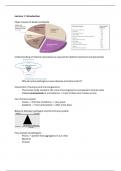
Major causes of death worldwide
Understanding of infection processes is required for (better) treatment and prevention
- Why do some pathogens cause disease and others don’t?
Interaction of humans and microorganisms
- The human body contains 10x more microorganisms compared to human cells
- Called commensals or microbiome -> most of them don’t make us sick
Our immune system
- Innate -> first line of defence -> very quick
- Adaptive -> more specialised -> after a few days
Balance between pathogen and the immune system
Five classes of pathogens
- Prions -> protein that aggregates in our cells
- Bacteria
- Viruses
, - Fungi
- Parasites
o Protozoa -> unicellular
o Worms (helminths) -> multicellular
What are microorganisms?
- Microorganisms are pathogens you cannot see them by naked eye
- Viruses -> not a ‘real’ organism -> they need a host cell to reproduce
- Prions -> are not alive -> just proteins
- DiSerent levels of ‘micro’
- Prokaryote or eukaryote
,Prokaryotic vs. eukaryotic cell
- Prokaryote
o No nucleus
o DNA is one circular chromosome
§ Easy to transfer to diSerent cells -> good for antibiotic resistance for
instance
o Additional DNA as plasmids
o Transcription and translation simultaneously in cytoplasm
o Rigid cell well
- Eukaryote
o DNA in the nucleus as multiple chromosomes
o Nuclear membrane, organelles
o Transcription in nucleus
o Translation in cytoplasm
o Thick cell walls only in fungi and plants
Viruses
- DiSerent shapes
, Bacteria
- Three main shapes
o Cocci
o Bacilli
o Spiral
- Diplococci -> in duos (Neisseria meningitidis)
- Streptococci -> in strings (Streptococcus pyogenes)
- Staphylococci -> in clumps (Staphylococcus aureus)
Gram staining
- The major staining method used to characterise bacteria
- Based on -> thickness of the peptidoglycan layer
- Purple -> Gram+ -> no outer membrane
- Pink -> Gram- -> outer membrane
o Counterstain to give Gram- some colour otherwise you cannot see the
bacteria under the microscope
Definition of infectious diseases
Infection Colonisation and growth of a microorganism within a host
- Does not always cause disease
Disease Damage to the host, which interferes with normal functions of the
host(-cell)
Major causes of death worldwide
Understanding of infection processes is required for (better) treatment and prevention
- Why do some pathogens cause disease and others don’t?
Interaction of humans and microorganisms
- The human body contains 10x more microorganisms compared to human cells
- Called commensals or microbiome -> most of them don’t make us sick
Our immune system
- Innate -> first line of defence -> very quick
- Adaptive -> more specialised -> after a few days
Balance between pathogen and the immune system
Five classes of pathogens
- Prions -> protein that aggregates in our cells
- Bacteria
- Viruses
, - Fungi
- Parasites
o Protozoa -> unicellular
o Worms (helminths) -> multicellular
What are microorganisms?
- Microorganisms are pathogens you cannot see them by naked eye
- Viruses -> not a ‘real’ organism -> they need a host cell to reproduce
- Prions -> are not alive -> just proteins
- DiSerent levels of ‘micro’
- Prokaryote or eukaryote
,Prokaryotic vs. eukaryotic cell
- Prokaryote
o No nucleus
o DNA is one circular chromosome
§ Easy to transfer to diSerent cells -> good for antibiotic resistance for
instance
o Additional DNA as plasmids
o Transcription and translation simultaneously in cytoplasm
o Rigid cell well
- Eukaryote
o DNA in the nucleus as multiple chromosomes
o Nuclear membrane, organelles
o Transcription in nucleus
o Translation in cytoplasm
o Thick cell walls only in fungi and plants
Viruses
- DiSerent shapes
, Bacteria
- Three main shapes
o Cocci
o Bacilli
o Spiral
- Diplococci -> in duos (Neisseria meningitidis)
- Streptococci -> in strings (Streptococcus pyogenes)
- Staphylococci -> in clumps (Staphylococcus aureus)
Gram staining
- The major staining method used to characterise bacteria
- Based on -> thickness of the peptidoglycan layer
- Purple -> Gram+ -> no outer membrane
- Pink -> Gram- -> outer membrane
o Counterstain to give Gram- some colour otherwise you cannot see the
bacteria under the microscope
Definition of infectious diseases
Infection Colonisation and growth of a microorganism within a host
- Does not always cause disease
Disease Damage to the host, which interferes with normal functions of the
host(-cell)