
UCI BioSci D170, Williams Reproductive System
Reading: Chapter 25
What is the common purpose of both the male and female reproductive systems?
To produce offspring!
Describe the differences between primary and accessory sex organs.
The primary sex organs/gonads produce gametes secrete sex hormones. All other
reproductive organs are accessory organs: internal glands and ducts, and the external
genitalia.
What are the gonads in the male reproductive system? What are the major ducts? What are the
accessory organs?
The male gonads are the testes. Sperm travel through major ducts like the duct of the
epididymis, ductus deferens, ejaculatory duct, urethra. Accessory organs include the
seminal glands, prostate, bulbo-urethral glands.
Describe the structure and functions of the testes, noting the following structures:
Testis – a male gonad; sperm-producing.
Scrotum – sac of skin and superficial fascia covering the testes. Hangs inferiorly external
to the abdominopelvic cavity, at the root of penis.
Tunica vaginalis – serous sac (parietal, visceral layers) that partially encloses the testes.
Tunica albuginea – fibrous capsule of the testes. Deep to the tunica vaginalis.
Lobules – wedge-shaped compartments in the testes, made by septal extensions of the
tunica albuginea.
Seminiferous tubules – “sperm factories.” Coiled, 1-4 of these make up the lobules.
Rete testis – network of branching tubes in which the sperm leave the testes. Lies
in dense CT in the posterior testes.
Efferent ductules – many ducts within the epididymis. Sperm exits the rete testis in these.
Spermatogenic cells – cells that are in the process of becoming sperm.
Interstitial cells – make/secrete the male sex hormone called androgens. Lies in the loose
CT b/w the seminiferous tubules.
Describe the gross anatomy and functions of the male reproductive ducts.
Epididymis – comma-shaped organ where sperm matures. Head contains efferent
ductules which empty into the duct of the epididymis.
Ductus (vas) deferens – stores/transports sperm during ejaculation. From the tail of the
epididymis: runs superiorly then along the true pelvis like a belt, and follows the ureter
down to the bladder.
, UCI BioSci D170, Williams Reproductive System
Ampulla of the ductus deferens – expanded, distal end of the vas deferens, posterior to the
bladder.
Ejaculatory duct – where the vas deferens and the duct of the seminal gland join, superior
to the prostate. Empties into the prostatic urethra.
Spermatic cord – tube of fascia that contains the vas deferens, testicular vessels/nerves.
Inguinal canal – obliquely-oriented trough in the anterior abdominal wall; contains the
superior spermatic cord. Inferior to the external oblique muscles.
Urethra – carries sperm from the ejaculatory ducts to outside the body.
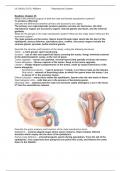
Describe the gross anatomy and function of the male accessory
glands, noting the following structures.
Semen – sperm + secretions of accessory glands/ducts.
Seminal glands (vesicles) – SM layer contracts to secrete
seminal fluid into the ejaculatory duct (where it mixes w/
sperm) during ejaculation. Posterior to bladder. Makes up
60% of the volume of semen; consists of fructose,
prostaglandins, substances that enhance sperm motility.
*Prostate gland – muscle of their stroma contracts to secrete
prostatic fluid into urethra during ejaculation.
*Bulbo-urethral glands – secretes mucus into the spongy
urethra when sexually-aroused; neutralizes acidic urine and
lubricates the urethra.
* = Tubuloalveolar glands.
Describe the structure and function of the penis, noting the
following structures.
Penis – delivers sperm into the female reproductive tract. This
and the scrotum make up the external genitalia.
Root – attached portion of the penis; inferior to the bulbo-
urethral glands.
Body – free portion of the penis.
Glans penis – enlarged tip of penis.
Prepuce (foreskin) – skin covering the glans penis.
Corpus spongiosum – midventral erectile body* surrounding
the spongy urethra.
Corpora cavernosa – dorsal erectile body* that makes up most
of the mass of the penis.
* = Erectile bodies: long cylindrical bodies of erectile tissue.
How does the male reproductive system respond to sympathetic and parasympathetic
innervation?
During sex, parasympathetic innervation dilates the arteries supplying the erectile
bodies; the smooth muscle in said bodies relaxes -> Erection! Sympathetic innervation
induces contraction of SM in reproductive glands/ducts, squeezing semen toward/out the
urethra -> Ejaculation!
Describe the male perineum.
Male perineum contains the scrotum, root of the penis, and the anus. It is the area b/w
the pubic symphysis, the ischial tuberosities, and the coccyx.
Skip section on spermatogenesis.
Reading: Chapter 25
What is the common purpose of both the male and female reproductive systems?
To produce offspring!
Describe the differences between primary and accessory sex organs.
The primary sex organs/gonads produce gametes secrete sex hormones. All other
reproductive organs are accessory organs: internal glands and ducts, and the external
genitalia.
What are the gonads in the male reproductive system? What are the major ducts? What are the
accessory organs?
The male gonads are the testes. Sperm travel through major ducts like the duct of the
epididymis, ductus deferens, ejaculatory duct, urethra. Accessory organs include the
seminal glands, prostate, bulbo-urethral glands.
Describe the structure and functions of the testes, noting the following structures:
Testis – a male gonad; sperm-producing.
Scrotum – sac of skin and superficial fascia covering the testes. Hangs inferiorly external
to the abdominopelvic cavity, at the root of penis.
Tunica vaginalis – serous sac (parietal, visceral layers) that partially encloses the testes.
Tunica albuginea – fibrous capsule of the testes. Deep to the tunica vaginalis.
Lobules – wedge-shaped compartments in the testes, made by septal extensions of the
tunica albuginea.
Seminiferous tubules – “sperm factories.” Coiled, 1-4 of these make up the lobules.
Rete testis – network of branching tubes in which the sperm leave the testes. Lies
in dense CT in the posterior testes.
Efferent ductules – many ducts within the epididymis. Sperm exits the rete testis in these.
Spermatogenic cells – cells that are in the process of becoming sperm.
Interstitial cells – make/secrete the male sex hormone called androgens. Lies in the loose
CT b/w the seminiferous tubules.
Describe the gross anatomy and functions of the male reproductive ducts.
Epididymis – comma-shaped organ where sperm matures. Head contains efferent
ductules which empty into the duct of the epididymis.
Ductus (vas) deferens – stores/transports sperm during ejaculation. From the tail of the
epididymis: runs superiorly then along the true pelvis like a belt, and follows the ureter
down to the bladder.
, UCI BioSci D170, Williams Reproductive System
Ampulla of the ductus deferens – expanded, distal end of the vas deferens, posterior to the
bladder.
Ejaculatory duct – where the vas deferens and the duct of the seminal gland join, superior
to the prostate. Empties into the prostatic urethra.
Spermatic cord – tube of fascia that contains the vas deferens, testicular vessels/nerves.
Inguinal canal – obliquely-oriented trough in the anterior abdominal wall; contains the
superior spermatic cord. Inferior to the external oblique muscles.
Urethra – carries sperm from the ejaculatory ducts to outside the body.
Describe the gross anatomy and function of the male accessory
glands, noting the following structures.
Semen – sperm + secretions of accessory glands/ducts.
Seminal glands (vesicles) – SM layer contracts to secrete
seminal fluid into the ejaculatory duct (where it mixes w/
sperm) during ejaculation. Posterior to bladder. Makes up
60% of the volume of semen; consists of fructose,
prostaglandins, substances that enhance sperm motility.
*Prostate gland – muscle of their stroma contracts to secrete
prostatic fluid into urethra during ejaculation.
*Bulbo-urethral glands – secretes mucus into the spongy
urethra when sexually-aroused; neutralizes acidic urine and
lubricates the urethra.
* = Tubuloalveolar glands.
Describe the structure and function of the penis, noting the
following structures.
Penis – delivers sperm into the female reproductive tract. This
and the scrotum make up the external genitalia.
Root – attached portion of the penis; inferior to the bulbo-
urethral glands.
Body – free portion of the penis.
Glans penis – enlarged tip of penis.
Prepuce (foreskin) – skin covering the glans penis.
Corpus spongiosum – midventral erectile body* surrounding
the spongy urethra.
Corpora cavernosa – dorsal erectile body* that makes up most
of the mass of the penis.
* = Erectile bodies: long cylindrical bodies of erectile tissue.
How does the male reproductive system respond to sympathetic and parasympathetic
innervation?
During sex, parasympathetic innervation dilates the arteries supplying the erectile
bodies; the smooth muscle in said bodies relaxes -> Erection! Sympathetic innervation
induces contraction of SM in reproductive glands/ducts, squeezing semen toward/out the
urethra -> Ejaculation!
Describe the male perineum.
Male perineum contains the scrotum, root of the penis, and the anus. It is the area b/w
the pubic symphysis, the ischial tuberosities, and the coccyx.
Skip section on spermatogenesis.

