
UCI BioSci D170, Williams Muscle Tissue
Read: Chapter 10, beginning of Chapter 11
What are the four properties of muscle tissue? Define the bolded words.
1. Contractility. Muscle tissue contracts forcefully due to myofilaments.
2. Excitability. Stimuli-induced electrical impulses travel along the cells’ plasma
membrane. -> contracting.
3. Extensibility. When one skeletal muscle contracts, it will stretch an opposing muscle.
Also stretched by substances w/in a hollow organ.
4. Elasticity. After stretching, muscle tissue recoils.
What are the four functions of muscle tissue? Give one example of each.
1. Produce movement. A bolus of food in the digestive tract.
2. Open/close body passageways. Sphincter muscles in the digestive and urinary tract.
3. Maintain posture and stabilize joints. Muscle tone-- constant low-level contraction of
muscles.
4. Generate heat. Excess heat generated during exercise.
What are the two characteristics that characterize muscle types? Use to define each:
The presence of light/dark stripes (striation) and whether contraction is voluntary or
involuntary.
● Skeletal: striated muscle w/ voluntary contraction.
● Cardiac: striated muscle w/ involuntary contraction.
● Smooth: non-striated w/ involuntary contraction.
What types of tissues make up skeletal muscles?
Skeletal tissue held together by fibrous connective
tissue.
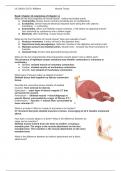
Describe the connective tissue sheaths of skeletal
muscles: from external to internal.
Epimysium – outer layer of dense irregular CT that
surrounds the muscle.
Perimysium – Skeletal muscle -> fascicle(group of
muscle fibers), surrounded by a layer of fibrous CT.^
Endomysium – Fascicle -> muscle fiber surrounded by
loose reticular CT.
What is a tendon? What is it made of and what is its function?
CT structure that joins skeletal muscles to bones. Converging of all 3 sheaths mentioned
above.
How does a muscle attach to a bone? What is the difference between an
origin and an insertion?
Skeletal muscle extend from one bone to another, crossing a
movable joint. The origin is the muscle attachment on the less
movable bone. The insertion is the muscle attachment on the more
movable bone.
What is the difference between an indirect attachment and a direct
attachment?
Read: Chapter 10, beginning of Chapter 11
What are the four properties of muscle tissue? Define the bolded words.
1. Contractility. Muscle tissue contracts forcefully due to myofilaments.
2. Excitability. Stimuli-induced electrical impulses travel along the cells’ plasma
membrane. -> contracting.
3. Extensibility. When one skeletal muscle contracts, it will stretch an opposing muscle.
Also stretched by substances w/in a hollow organ.
4. Elasticity. After stretching, muscle tissue recoils.
What are the four functions of muscle tissue? Give one example of each.
1. Produce movement. A bolus of food in the digestive tract.
2. Open/close body passageways. Sphincter muscles in the digestive and urinary tract.
3. Maintain posture and stabilize joints. Muscle tone-- constant low-level contraction of
muscles.
4. Generate heat. Excess heat generated during exercise.
What are the two characteristics that characterize muscle types? Use to define each:
The presence of light/dark stripes (striation) and whether contraction is voluntary or
involuntary.
● Skeletal: striated muscle w/ voluntary contraction.
● Cardiac: striated muscle w/ involuntary contraction.
● Smooth: non-striated w/ involuntary contraction.
What types of tissues make up skeletal muscles?
Skeletal tissue held together by fibrous connective
tissue.
Describe the connective tissue sheaths of skeletal
muscles: from external to internal.
Epimysium – outer layer of dense irregular CT that
surrounds the muscle.
Perimysium – Skeletal muscle -> fascicle(group of
muscle fibers), surrounded by a layer of fibrous CT.^
Endomysium – Fascicle -> muscle fiber surrounded by
loose reticular CT.
What is a tendon? What is it made of and what is its function?
CT structure that joins skeletal muscles to bones. Converging of all 3 sheaths mentioned
above.
How does a muscle attach to a bone? What is the difference between an
origin and an insertion?
Skeletal muscle extend from one bone to another, crossing a
movable joint. The origin is the muscle attachment on the less
movable bone. The insertion is the muscle attachment on the more
movable bone.
What is the difference between an indirect attachment and a direct
attachment?

