

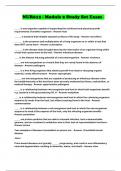
NUR612 - Module 2 Study Set Exam _____ is any organism capable of supporting the nutritional and ph ysical growth requirements of another organism - Answer host ______ is bacteria that inhabits exposed surfaces of the body - Answ er microflora _______ is the presence and multiplication of a living organism on or within a host that does NOT cause harm - Answer colonization _______ is the disease state brought about by the interaction of an o rganism living within a host that causes harm to the hos t - Answer infectious disease ____ is the disease inducing potential of a microbe/organism - Answer virulence _____ are microorganisms so virulent that they are rarely found in the abs ence of disease - Answer pathogens _____ is a free-living organism that obtains growth from dead or de caying organic material, rarely affect humans - Answer saprophytes ______ are microorganisms that are capable of producing an infectio us disease when the health/immunity of the host have been severely weakened by illn ess, malnutrition, or medical therapy - Answer opportunistic pathogens _____ is a relationship between microorganism and host in which bot h organisms benefit e.g. bacteria in the gut producing Vit. K - Answer mutualism ____ is a relationship between microorganism and host in which the col onizing organism acquires its needs from the host, but without causing harm to the host - Answer commensalism _____ is a relationship between a microorganism and host in which the micr oorganism acquires its need at the expense of the host, only the infecting or ganism benefits - Answer parasitism _____ are protein particles that are able to transmit infection, lack a demonstrable genome, and are resistant to antibiotics due to their lack of rep ro/metabolic functions - Answer prions Two examples of diseases transmitted via prions are: - Answer -Creutzfe ldt Jacob disease -Kuru Prion-based diseases are typically ______ progressing, and result in no n-inflammatory neuronal degeneration resulting in dementia, ataxia, and death - Answer slow _______ are the smallest obligate intracellular pathogens, have no orga nized cellular structure, and can be composed of either DNA or RNA, but never both - Answer Viruses Viruses are composed of two parts: the _____ and _______, and require wha t to replicate? - Answer -capsid (protein coat) -nucleic acid core (genome, either DNA or RNA) They require a host cell in which to replicate, replication cannot occur outside of a living cell ____ are bacteria that lack an organized nucleus - Answer prokar yotes _____ are microorganisms that possess a membrane nucleus such as fung i - Answer eukaryotes ______ are a type of fungi that are yeast at one temperature and mold s at another - Answer dimorphic fungi Examples of dimorphic fungi: - Answer -blastomycosis -histoplasmosis -coccidiodomycosis _____ are long filaments utilized by molds - Answer hyphae ___ are single celled fungi that reproduce by budding - Answer yea sts Bacteria are primarily classified by: - Answer -shape/microscopic appea rance -presence of absence of peptidoglycan cell wall (gram+/gram -) ______ = rod bacteria - Answer bacillis _____ = spherical bacteria - Answer cocci _____ = helical bacteria - Answer spirilla _______ bacteria will stain purple in the presence of a primary dye like c rystal violet - Answer gram positive ______ bacteria will not stain purple, but will stain red in the presen ce of a counterstain like safranin - Answer gram negative _____ are single celled animals with defined nuclei and organelles tha t can cause parasitic infection - Answer protozoa ______ are worms, roundworms, flukes, etc. capable of causing parasitic i nfection - Answer helminths _______ are bugs capable of causing parasitic infection - Answer arthrop ods Examples of organisms that combine viral and bacterial characteristic s - Answer -Rickettsiaceae -Anaplasmataceae -Chlamydiaceae -Coxiella Viral: obligate intracellular pathogen Bacterial: cell wall, asexual reproduction via cell division Both: Contain DNA and RNA ___ is a tick born organism capable of producing Rocky Mt spotted fe ver and possibly lyme disease - Answer rickettsiaceae ______ is a directly transmitted organism responsible for the STI chlamydia - Answer Chlamydophila trachomatis _______ is a disease found in a particular geographical region in which th e incidence/prevalence are relatively predictable and stable - An swer endemic disease ______ is an abrupt and unexpected increase in the incidence of disea se over endemic rates - Answer epidemic _____ is the spread of disease beyond continental borders - Answer p andemic criteria used in classifying infectious diseases - Answer -porta l of entry -incidence -source -signs/symptoms -disease course -site of infection -virulence factors Examples of portals of entry - Answer -penetration (physical t rauma to integument system -direct contact (think STIs) -ingestion -inhalation _________ is a form of direct contact in which a pathogen is transmitted from a host to progeny post-gestation - Answer vertical transmission e.g. breast feeding, contact with infected vaginal mucosa during delivery ____ is a form of direct transmission in which a pathogen is transmitted from a host to progeny during gestation - Answer congenital transmission ______ are infections that develop within a hospital patient/settin g - Answer nosocomial _____ are infections acquired outside of healthcare facilities - An swer community-acquired infections _____ is an inanimate object that carries disease - Answer fomite e.g. soil, t oys, doorknobs, etc. A _____ symptom/sign reflects the site of infection e.g. rash, hemorrh age, diarrhea, pneumonia - Answer specific A _____ sign/symptom can be shared by a number of diverse infectious diseas es e.g. headache, myalgia, fever - Answer nonspecific A ____ sign/symptom may require laboratory testing to identify - Answer covert ______ have an abrupt onset with little or no prodrome phase - Answ er fulminant illness _____ have a prolonged prodrome phase e.g. hepatitis B, HIV - Answer insi dious illnesses Insidious illness typically have a prolonged ________, during which the disease replicates without symptoms before reaching a _______, during which the initial appearance of symptoms occurs - Answer incubation period, pro dromal stage During the ____ stage of infection, the host experiences the maximum impacts of the disease process. During this stage, rapid proliferation and disse mination of the infecting agent occurs - Answer acute During the ___ stage of infection, containment and progressive elimi nation of the
Vista previa 4 fuera de 58 páginas
Examen
NUR612 - Module 2 Study Set Exam
Vista previa 4 fuera de 58 páginas
NUR612 - Module 2 Study Set Exam ...
Vista previa del contenido
Información del documento
- Subido en
- 1 de agosto de 2024
- Número de páginas
- 58
- Escrito en
- 2024/2025
- Tipo
- Examen
- Contiene
- Preguntas y respuestas
$10.49
¿Documento equivocado? Cámbialo gratis
Dentro de los 14 días posteriores a la compra y antes de descargarlo, puedes elegir otro documento. Puedes gastar el importe de nuevo.
Escrito por estudiantes que aprobaron
Inmediatamente disponible después del pago
Leer en línea o como PDF

Los indicadores de reputación están sujetos a la cantidad de artículos vendidos por una tarifa y las reseñas que ha recibido por esos documentos. Hay tres niveles: Bronce, Plata y Oro. Cuanto mayor reputación, más podrás confiar en la calidad del trabajo del vendedor.
Disponible en paquete
Package deal
NUR612 PACKAGED EXAMS STUDY GUIDE @ 2024 -2025
