
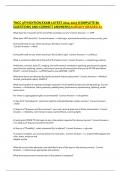
TNCC 9TH EDITION EXAM LATEST |COMPLETE 80 QUESTIONS AND CORRECT ANSWERS| ALREADY GRADED A+
TNCC 9TH EDITION EXAM LATEST |COMPLETE 80 QUESTIONS AND CORRECT ANSWERS| ALREADY GRADED A+ What does the J stand for at the end of the secondary survey?-Correct Answers-- VIPP What does VIPP stand for? -Correct Answers--vital signs, injuries/interventions, primary survey, pain During the head-to-toe, where would you find Grey-Turner's sign? -Correct Answers--flank During the head-to-toe, where would you find Cullen's sign? -Correct Answers--umbilicus What is sometimes deferred at the end of the head-to-toe? -Correct Answers--inspecting posterior Antibiotics, consults, head CT, imaging, law enforcement, mandatory reporting, psychosocial support, social services, splinting, tetanus, and wound care are all interventions that you do AFTER and before WHAT? -Correct Answers--AFTER head-to-toe, BEFORE J (VIPP) What three items are obtained during the pertinent history assessment? -Correct Answers--Medical records, prehospital report, SAMPLE What are examples of nonpharmacologic measures? (must identify at least one during testing) -Correct Answers--Distraction, family presence, padding bony prominences, repositioning, splinting, verbal reassurance For whom is capnography highly recommended? -Correct Answers--all patients In step M of "Get Adjuncts", what else might be indicated besides cardiac monitor? -Correct Answers--EKG In Step 16 of "Exposure and Environment", you must name at least one of these interventions: -Correct Answers--blankets, room temp increase, warmed fluids, warming lights At what point PRIOR TO the head-to-toe is the patient inspected for obvious injuries? -Correct Answers--In Step 15 of "Exposure and Environment" In Step 13 of "Disability", what is assessed if pt is altered? -Correct Answers--glucose To assess circulation, you must do these two main tasks: -Correct Answers--1. Inspect AND palpate skin color, temp, moisture and palpate a pulse What do you do when alterations are identified in any of the steps in the primary survery? -Correct Answers--intervene as appropriate and reassess What three assessments must be done if the patient is intubated? -Correct Answers--1. attach CO2 detector and assess for evidence of exhaled CO2; 2. observe for rise and fall of the chest w/ assisted ventilations; 3. auscultate over epigastrium for gurgling AND lungs for bilateral breath sounds Four of these must be identified to assess breathing effectiveness: -Correct Answers--Breath sounds, depth/pattern/rate, spontaneous breathing, subcutaneous emphysema, increased work of breathing, symmetrical chest rise and fall, tracheal deviation/JVD, open wounds/deformities, skin color What can be applied in step 12 of "Circulation and Control of Hemorrhage" for which credit is given in the LMNOP section? -Correct Answers--cardiac monitor When should 2 IV sites be established? -Correct Answers--During "Circulation" assessment If the patient is intubated and you've already assessed ETT placement, what else needs to be done with the ETT? (step 10) -Correct Answers--assess ETT position by noting the number at teeth/gums AND secure ETT What should you verbalize after completing all ETT assessments? ANSWER-moving patient from assisted ventilation to mechanical During which part of the primary survey would you anticipate the need for a chest tube, intubation and decompression of pneumothorax, oxygen, or BVMs? -Correct Answers--"Breathing and Ventilation" Four of these must be identified to assess patency and protection of the airway: -Correct Answers--bony deformity, loose teeth, edema, inhalation injury, sounds, tongue obstruction, burns, fluids, foreign objects and vocalization During which part of the primary survey would there be anticipation for intubation, insertion of OPA/NPA, removal of any loose teeth or foreign objects, or suctioning? -Correct Answers-- Assessing patency and protection of the airway, Step 7 of "Alertness and Airway with Simultaneous Cervical Spinal Stabilization" If c-spine stabilization is necessary, what need should be stated? ANSWER-the need for a second person to provide manual c- spine stabilization An adult patient who sustained a severe head trauma has been intubated and is being manually ventilated via a bag-mask device at a rate of 18 breaths/minute. The patient has received one intravenous fluid bolus of 500 mL of warmed isotonic crystalloid solution. The PaCO2 is 30 mm Hg (4.0 kPa), and the pulse oximetry is 92%. BP is 142/70 mm Hg. What is the most important intervention to manage the cerebral blood flow? Decrease the rate of manual ventilation. Initiate another fluid bolus. Re -Correct Answers--A.Decrease the rate of manual ventilation. An older adult presents to the emergency department with complaints of dizziness, headache, and nausea. The patient was involved in a motor vehicle collision 10 days ago. There was no loss of consciousness and a hematoma is noted to the forehead. The patient is currently on anticoagulant therapy. What is most likely the cause of their symptoms? A.Intracerebral hemorrhage B.Epidural hematoma C.Diffuse axonal injury D.Post-concussive syndrome -Correct Answers--post-concussive syndrome A patient with a lower extremity fracture complains of severe pain and tightness in his calf, minimally relieved by pain medications. Which of the following is the priority nursing intervention? A.Elevating the leg above the level of the heart B.Repositioning the leg and applying ice C.Elevating the leg to the level of the heart D.Preparing the patient for ultrasound of the leg -Correct Answers-- C.Elevating the leg to the level of the heart A patient involved in a high-speed rollover is complaining of increased difficulty breathing. There is a small penetrating wound to the sixth intercostal space in the left lateral chest. Which finding is most consistent with an injury to the diaphragm? Severe left-sided abdominal pain Bowel sounds heard in the left lower chest Pain radiating to the left shoulder.
Información del documento
- Subido en
- 24 de julio de 2024
- Número de páginas
- 18
- Escrito en
- 2023/2024
- Tipo
- Examen
- Contiene
- Preguntas y respuestas

