Macro Notes
Macroeconomics
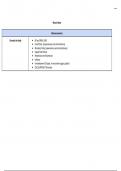
Concepts to study ● AD and SRAS, LRAS
● Fiscal Policy (expansionary and contractionary)
● Monetary Policy (expansionary and contractionary)
● Supply Side Policies
● Neoclassical and Kaynessian
● Inflation
● Unemployment (3 types, in recessionary gaps, graphs)
● CALCULATIONS (*formulas)
, Notes
AD AD is the total value of goods and services demanded by different groups at a given price level in an economy. It is the sum of the expenditure
categories that make up GDP at a specific price level.
Reasons Aggregate Demand is a Negative Slope:
1. The wealth effect: As the average price level falls, the wealth of participants in the economy increases in real terms as their ability to
purchase goods and services improves. The real value of assets, like property or stock, is now higher.
2. The interest rate effect: At lower price levels, interest rates are lower too, giving people more disposable income to spend and with
which to demand higher volumes of output. The incentive to save is also lower.
3. The net balance effect: A lower price level makes goods and services relatively cheaper for foreign countries to buy. Therefore, the
demand for exports rises and the demand for imports
from abroad falls, increasing the net trade balance and leaving it in an overall better position.
Investment:
Such as the stock market, bond market and foreign exchange market.
Consumer Spending:
- Changes in wealth/ income
- Changes in expectation about future income and or future of economy
- Change in interest rates ( as interest goes up, spending decreases, because borrowing money is more expensive
Investment Spending:
- Change in expectations of future sales ( sales increase, investment will increase)
- Improvement in technology = investment increasing
- Changes in business taxes ( Business tax increases, investment decreases)
- More secure = increased investment
- Less secure = decreased investment
AS AS:
Aggregate supply is the total quantity of goods and services produced in an economy (real GDP) over a specific time period at different price
levels
, SRAS
- The length of time during which resource prices stay relatively constant. Firms do not change costs on a daily or weekly basis; this
would be very unstable indeed. There is, therefore, a positive relationship between the output that firms are willing and able to
provide and the selling price of goods and services in the economy.
Determinants:
● Resource prices
● Government intervention
Regulation:
- Governments can choose to increase or decrease the amount of regulation firms in the economy face.
- This allows firms to retain or spend more of their revenue to meet those regulations.
Business Taxes:
● Governments can lower taxes for citizens, which provides them with a greater disposable income. This enables them to consume more
and boost the aggregate demand in an economy.
● Governments can lower taxes for businesses, which allows them to keep a greater share of their profit.
● Government subsidies
● Supply shocks.
● War
● Unfavorable weather
● Natural disasters
Shifts in the curve:
Shifts in short-run aggregate supply will only be caused by changes in the costs of production. These include resource prices, changes in
business taxes, government subsidies and supply shocks.
LRAS:
- Only changes with long term changes in production
- Improvement in technology
- Same as shifting the PPF curve
Macroeconomics
Concepts to study ● AD and SRAS, LRAS
● Fiscal Policy (expansionary and contractionary)
● Monetary Policy (expansionary and contractionary)
● Supply Side Policies
● Neoclassical and Kaynessian
● Inflation
● Unemployment (3 types, in recessionary gaps, graphs)
● CALCULATIONS (*formulas)
, Notes
AD AD is the total value of goods and services demanded by different groups at a given price level in an economy. It is the sum of the expenditure
categories that make up GDP at a specific price level.
Reasons Aggregate Demand is a Negative Slope:
1. The wealth effect: As the average price level falls, the wealth of participants in the economy increases in real terms as their ability to
purchase goods and services improves. The real value of assets, like property or stock, is now higher.
2. The interest rate effect: At lower price levels, interest rates are lower too, giving people more disposable income to spend and with
which to demand higher volumes of output. The incentive to save is also lower.
3. The net balance effect: A lower price level makes goods and services relatively cheaper for foreign countries to buy. Therefore, the
demand for exports rises and the demand for imports
from abroad falls, increasing the net trade balance and leaving it in an overall better position.
Investment:
Such as the stock market, bond market and foreign exchange market.
Consumer Spending:
- Changes in wealth/ income
- Changes in expectation about future income and or future of economy
- Change in interest rates ( as interest goes up, spending decreases, because borrowing money is more expensive
Investment Spending:
- Change in expectations of future sales ( sales increase, investment will increase)
- Improvement in technology = investment increasing
- Changes in business taxes ( Business tax increases, investment decreases)
- More secure = increased investment
- Less secure = decreased investment
AS AS:
Aggregate supply is the total quantity of goods and services produced in an economy (real GDP) over a specific time period at different price
levels
, SRAS
- The length of time during which resource prices stay relatively constant. Firms do not change costs on a daily or weekly basis; this
would be very unstable indeed. There is, therefore, a positive relationship between the output that firms are willing and able to
provide and the selling price of goods and services in the economy.
Determinants:
● Resource prices
● Government intervention
Regulation:
- Governments can choose to increase or decrease the amount of regulation firms in the economy face.
- This allows firms to retain or spend more of their revenue to meet those regulations.
Business Taxes:
● Governments can lower taxes for citizens, which provides them with a greater disposable income. This enables them to consume more
and boost the aggregate demand in an economy.
● Governments can lower taxes for businesses, which allows them to keep a greater share of their profit.
● Government subsidies
● Supply shocks.
● War
● Unfavorable weather
● Natural disasters
Shifts in the curve:
Shifts in short-run aggregate supply will only be caused by changes in the costs of production. These include resource prices, changes in
business taxes, government subsidies and supply shocks.
LRAS:
- Only changes with long term changes in production
- Improvement in technology
- Same as shifting the PPF curve