
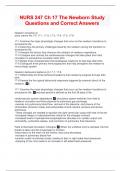
NURS 247 Ch 17 The Newborn Study Questions and Correct Answers Newborn transition to extra uterine life (17) 17 -1, 17 -2, 17 -3, 17 -4, 17 -5, 17 -6 17-1 Examine the major physiologic changes that occur as the newborn transitions to extrauterine life. 17-2 Determine the primary challenges faced by the newborn during the transition to extrauterine life. 17-3 Interpret the factors that influence the initiation of newborn respirations. 17-4 Compare and contrast the cardiovascular changes that take place from fetal circulation to extrauterine circulation after birth. 17-5 Relate three characteristics that predispose newborns to heat loss after birth. 17-6 Distinguish three primary immunoglobulins that help strengthen the newborn's immunologic system Newborn behavioral patterns (4) 17 -7, 17 -8 17-7 Differentiate the three behavioral patterns that newborns progress through after birth. 17-8 Assess the five typical behavioral responses triggered by external stimuli of the newborn. ✅1 17-1 Examine the major physiologic changes that occur as the newborn transitions to extrauterine life. ✅neonatal period is defined as the first 28 days of life. cardiovascular system adaptations ✅-circulatory system switches from fetal to newborn circulation and from placental to pulmonary gas exchange. -requires incr pulmonary blood flow, removal of the placenta, and closure of the intracardiac (foramen ovale) and extracardiac shunts (ductus venosus and ductus arteriosus). -These changes are needed to equalize the right ventricular output with that of the left -increased release of catecholamines critical for the changes involved -increased levels of epinephrine/norepinephrine stimulate incr cardiac output and contractility, surfactant release, and promotion of pulmonary fluid clearance Fetal to Neonatal Circulation Changes ✅-When the umbilical cord is clamped, the first breath is taken and the lungs begin to function. -blood return to the heart via the inferior vena cava decreases -increase in pulmonary blood flow -foramen ovale functionally closes, leading to decr in right sided heart pressures -clamping of the cord, leads to an increase in left -sided heart pressures -The increased left atrial pressure causes the foramen ovale to close, thus allowing the output from the right ventricle to flow entirely to the lungs. With closure of this fetal shunt, oxygenated blood is now separated from nonoxygenated blood. -It closes within a few days after birth, because this shunting is no longer needed as a result of activation of the liver. The activated liver now takes over the functions of the placenta (which was expelled at birth). -closure of the 3 fetal shunts creates a neonatal circulation where deoxygenated blood returns to the heart through the inferior and superior vena cava. -It enters the R atrium to the R ventricle and travels through the pulmonary artery to the pulmonary vascular bed. -Oxygenated blood returns through pulmonary veins to the L atrium, the L ventricle, and through the aorta to the systemic circulation SUMARY Fetal to Neonatal Circulation Changes ✅Clamping umbilical cord at birth eliminates the placenta as a reservoir for blood. Onset of respirations causes a rise in PO2 in the lungs and a decrease in pulmonary vascular resistance, which... Increases pulmonary blood flow and increases pressure in the left atrium, which... Decreases pressure in the right atrium of the heart, which causes closure of the foramen ovale (closes within minutes after birth secondary to a decreased pulmonary vascular resistance and increased left heart pressure). With an increase in oxygen levels after the first breath, an increase in systemic vascular resistance occurs, which... Decreases vena cava return, which reduces blood flow in the umbilical vein (constricts, becomes a ligament with functional closing). Closure of the ductus venosus (becomes a ligament) causes an increase in pressure in the aorta, which forces closure of the ductus arteriosus within 10 to 15 hours after birth. Heart rate ✅-newborn's heart rate is appx 110 -160 bpm. -Thereafter, it begins to decr to an avg of 120 to 130 bpm -usually highest after birth and reaches a plateau within a week after birth -Transient functional cardiac murmurs may be heard during neonatal period -tachycardia found c vol depletion, cardiorespiratory disease, drug withdrawal, and hyperthyroidism. -Bradycardia assc c apnea and is often seen with hypoxia. blood volume ✅-estimated to be 80 to 85 mL/kg of body weight in the term infant -may vary by 25% to 40%, depending on when clamping of the umbilical cord occurs. -Early (bf 30 -40 sec) or late (after 3 min) clamping of the umbilical cord changes circulatory dynamics during transition -cord blood possesses regenerative properties and can grow into different types of cells in the body blood components ✅newborn's red blood cells have a life span of 80 to 100 days, compared with 120 days in adults.
Vista previa 2 fuera de 12 páginas
Examen
NURS 247 Ch 17 The Newborn Study Questions and Correct Answers
Vista previa 2 fuera de 12 páginas
Newborn transition to extra uterine life (17) 17-1, 17-2, 17-3, 17-4, 17-5, 17-6 17-1 Examine the major physiologic changes that occur as the newborn transitions to extrauterine life. 17-2 Determine the primary challenges faced by the newborn during the transition to extrauterine life. 17-3 Interpret the factors that influence the initiation of newborn respirations. 17-4 Compare and contrast the cardiovascular changes that take place from fetal circulation to extrauterine circulation after birth. 17-5 Relate three characteristics that predispose newborns to heat loss after birth. 17-6 Distinguish three primary immunoglobulins that help strengthen the newborn's immunologic system Newborn behavioral patterns (4) 17-7, 17-8 17-7 Differentiate the three behavioral patterns that newborns progress through after birth. 17-8 Assess the five typical behavioral responses triggered by external stimuli of the newborn. 1 17-1 Examine the major physiologic changes that occur as the newborn transitions to extrauterine life. neonatal period is defined as the first 28 days of life. cardiovascular system adaptations -circulatory system switches from fetal to newborn circulation and from placental to pulmonary gas exchange. -requires incr pulmonary blood flow, removal of the placenta, and closure of the intracardiac (foramen ovale) and extracardiac shunts (ductus venosus and ductus arteriosus). -These changes are needed to equalize the right ventricular output with that of the left -increased release of catecholamines critical for the changes involved -increased levels of epinephrine/norepinephrine stimulate incr cardiac output and contractility, surfactant release, and promotion of pulmonary fluid clearance Fetal to Neonatal Circulation Changes -When the umbilical cord is clamped, the first breath is taken and the lungs begin to function. -blood return to the heart via the inferior vena cava decreases -increase in pulmonary blood flow -foramen ovale functionally closes, leading to decr in right sided heart pressures -clamping of the cord, leads to an increase in left-sided heart pressures -The increased left atrial pressure causes the foramen ovale to close, thus allowing the output from the right ventricle to flow entirely to the lungs. With closure of this fetal shunt, oxygenated blood is now separated from nonoxygenated blood. -It closes within a few days after birth, because this shunting is no longer needed as a result of activation of the liver. The activated liver now takes over the functions of the placenta (which was expelled at birth). -closure of the 3 fetal shunts creates a neonatal circulation where deoxygenated blood returns to the heart through the inferior and superior vena cava. -It enters the R atrium to the R ventricle and travels through the pulmonary artery to the pulmonary vascular bed. -Oxygenated blood returns through pulmonar
Vista previa del contenido
Información del documento
- Subido en
- 22 de julio de 2024
- Número de páginas
- 12
- Escrito en
- 2023/2024
- Tipo
- Examen
- Contiene
- Preguntas y respuestas
$10.49
¿Documento equivocado? Cámbialo gratis
Dentro de los 14 días posteriores a la compra y antes de descargarlo, puedes elegir otro documento. Puedes gastar el importe de nuevo.
Escrito por estudiantes que aprobaron
Inmediatamente disponible después del pago
Leer en línea o como PDF

Los indicadores de reputación están sujetos a la cantidad de artículos vendidos por una tarifa y las reseñas que ha recibido por esos documentos. Hay tres niveles: Bronce, Plata y Oro. Cuanto mayor reputación, más podrás confiar en la calidad del trabajo del vendedor.
Disponible en paquete
Package deal
NUR 247 Comprehensive Q&A Exam Bundle
