

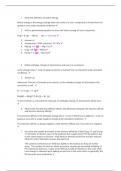
1. Write the definition of lattice energy
lattice energy is the energy change when one mole of a ionic compound is formed from its
gaseous ions under standard conditions ✔
2. Write a generalised equation to show the lattice energy of ionic compound
A (g) + B (g) → AB (s)
+ -
ΔH = -x kJ mol
Ө
latt ✔
-1
3. Answer q1
a. temperature: 298K, pressure: 101 kPa ✔
b. Mg (g) + O (g) → MgO (s) ✔
2+ 2-
c. K (g) + Br (g)→ KBr(s)✔
+ -
d. Na (g) + S (g)→ Na S (s)✔
+ 2-
2
4. Define enthalpy change of atomisation and use it in a sentence
is the change when 1 mole of gaseous atoms is formed from its elements under standard
conditions. ✔
5. Answer q2
a)because Chlorine is formed by two atoms, so the enthalpy change of atomisation (for
one atom) is half. ✔
b) 1/2 O (g)→ O (g)✔
2 2
Ba (gs)→ Ba(g)1/2 Br2 (g)→ Br (g)
c) Since helium is a monatomic molecule, its enthalpy change of atomisation will be zero.
✔
6. What is the first electron affinity? What’s the difference between the electron affinity
and the first electron affinity?
First electron affinity is the enthalpy change when 1 mole of electrons is added to 1 mole of
gaseous ions with a single negative charge under standard conditions. ✔
First electron affinity is always negative, while electron affinity can be positive or negative.
✔
7. Describe and explain the trends in the electron affinities of the Group 16 and Group
17 elements (it doesn’t say it in the textbook but oxygen doesn’t fit the pattern due
to the same reason as fluorine - high electron density around the nucleus reduces
attractive effect between nucleus and electron)
The outermost electrons are held less tightly to the nucleus as they are further
away. The number of electron shells increases, causing an increased shielding of
the outermost electrons. It gets more difficult to add an electron to the outer shell.
Less energy is released upon adding an electron to the outer shell, so generally, the
EA becomes less exothermic ✔
lattice energy is the energy change when one mole of a ionic compound is formed from its
gaseous ions under standard conditions ✔
2. Write a generalised equation to show the lattice energy of ionic compound
A (g) + B (g) → AB (s)
+ -
ΔH = -x kJ mol
Ө
latt ✔
-1
3. Answer q1
a. temperature: 298K, pressure: 101 kPa ✔
b. Mg (g) + O (g) → MgO (s) ✔
2+ 2-
c. K (g) + Br (g)→ KBr(s)✔
+ -
d. Na (g) + S (g)→ Na S (s)✔
+ 2-
2
4. Define enthalpy change of atomisation and use it in a sentence
is the change when 1 mole of gaseous atoms is formed from its elements under standard
conditions. ✔
5. Answer q2
a)because Chlorine is formed by two atoms, so the enthalpy change of atomisation (for
one atom) is half. ✔
b) 1/2 O (g)→ O (g)✔
2 2
Ba (gs)→ Ba(g)1/2 Br2 (g)→ Br (g)
c) Since helium is a monatomic molecule, its enthalpy change of atomisation will be zero.
✔
6. What is the first electron affinity? What’s the difference between the electron affinity
and the first electron affinity?
First electron affinity is the enthalpy change when 1 mole of electrons is added to 1 mole of
gaseous ions with a single negative charge under standard conditions. ✔
First electron affinity is always negative, while electron affinity can be positive or negative.
✔
7. Describe and explain the trends in the electron affinities of the Group 16 and Group
17 elements (it doesn’t say it in the textbook but oxygen doesn’t fit the pattern due
to the same reason as fluorine - high electron density around the nucleus reduces
attractive effect between nucleus and electron)
The outermost electrons are held less tightly to the nucleus as they are further
away. The number of electron shells increases, causing an increased shielding of
the outermost electrons. It gets more difficult to add an electron to the outer shell.
Less energy is released upon adding an electron to the outer shell, so generally, the
EA becomes less exothermic ✔

