
Chapter 1
SETS
vIn these days of conflict between ancient and modern studies; there
must surely be something to be said for a study which did not
begin with Pythagoras and will not end with Einstein; but
is the oldest and the youngest. — G.H. HARDY v
1.1 Introduction
The concept of set serves as a fundamental part of the
present day mathematics. Today this concept is being used
in almost every branch of mathematics. Sets are used to
define the concepts of relations and functions. The study of
geometry, sequences, probability, etc. requires the knowledge
of sets.
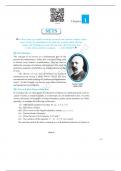
The theory of sets was developed by German
mathematician Georg Cantor (1845-1918). He first
encountered sets while working on “problems on trigonometric
series”. In this Chapter, we discuss some basic definitions
Georg Cantor
and operations involving sets. (1845-1918)
1.2 Sets and their Representations
In everyday life, we often speak of collections of objects of a particular kind, such as,
a pack of cards, a crowd of people, a cricket team, etc. In mathematics also, we come
across collections, for example, of natural numbers, points, prime numbers, etc. More
specially, we examine the following collections:
(i) Odd natural numbers less than 10, i.e., 1, 3, 5, 7, 9
(ii) The rivers of India
(iii) The vowels in the English alphabet, namely, a, e, i, o, u
(iv) Various kinds of triangles
(v) Prime factors of 210, namely, 2,3,5 and 7
(vi) The solution of the equation: x2 – 5x + 6 = 0, viz, 2 and 3.
We note that each of the above example is a well-defined collection of objects in
2024-25
,2 MATHEMATICS
the sense that we can definitely decide whether a given particular object belongs to a
given collection or not. For example, we can say that the river Nile does not belong to
the collection of rivers of India. On the other hand, the river Ganga does belong to this
colleciton.
We give below a few more examples of sets used particularly in mathematics, viz.
N : the set of all natural numbers
Z : the set of all integers
Q : the set of all rational numbers
R : the set of real numbers
Z+ : the set of positive integers
Q+ : the set of positive rational numbers, and
R + : the set of positive real numbers.
The symbols for the special sets given above will be referred to throughout
this text.
Again the collection of five most renowned mathematicians of the world is not
well-defined, because the criterion for determining a mathematician as most renowned
may vary from person to person. Thus, it is not a well-defined collection.
We shall say that a set is a well-defined collection of objects.
The following points may be noted :
(i) Objects, elements and members of a set are synonymous terms.
(ii) Sets are usually denoted by capital letters A, B, C, X, Y, Z, etc.
(iii) The elements of a set are represented by small letters a, b, c, x, y, z, etc.
If a is an element of a set A, we say that “ a belongs to A” the Greek symbol ∈
(epsilon) is used to denote the phrase ‘belongs to’. Thus, we write a ∈ A. If ‘b’ is not
an element of a set A, we write b ∉ A and read “b does not belong to A”.
Thus, in the set V of vowels in the English alphabet, a ∈ V but b ∉ V. In the set
P of prime factors of 30, 3 ∈ P but 15 ∉ P.
There are two methods of representing a set :
(i) Roster or tabular form
(ii) Set-builder form.
(i) In roster form, all the elements of a set are listed, the elements are being separated
by commas and are enclosed within braces { }. For example, the set of all even
positive integers less than 7 is described in roster form as {2, 4, 6}. Some more
examples of representing a set in roster form are given below :
(a) The set of all natural numbers which divide 42 is {1, 2, 3, 6, 7, 14, 21, 42}.
2024-25
, SETS 3
ANote In roster form, the order in which the elements are listed is immaterial.
Thus, the above set can also be represented as {1, 3, 7, 21, 2, 6, 14, 42}.
(b) The set of all vowels in the English alphabet is {a, e, i, o, u}.
(c) The set of odd natural numbers is represented by {1, 3, 5, . . .}. The dots
tell us that the list of odd numbers continue indefinitely.
A Note It may be noted that while writing the set in roster form an element is not
generally repeated, i.e., all the elements are taken as distinct. For example, the set
of letters forming the word ‘SCHOOL’ is { S, C, H, O, L} or {H, O, L, C, S}. Here,
the order of listing elements has no relevance.
(ii) In set-builder form, all the elements of a set possess a single common property
which is not possessed by any element outside the set. For example, in the set
{a, e, i, o, u}, all the elements possess a common property, namely, each of them
is a vowel in the English alphabet, and no other letter possess this property. Denoting
this set by V, we write
V = {x : x is a vowel in English alphabet}
It may be observed that we describe the element of the set by using a symbol x
(any other symbol like the letters y, z, etc. could be used) which is followed by a colon
“ : ”. After the sign of colon, we write the characteristic property possessed by the
elements of the set and then enclose the whole description within braces. The above
description of the set V is read as “the set of all x such that x is a vowel of the English
alphabet”. In this description the braces stand for “the set of all”, the colon stands for
“such that”. For example, the set
A = {x : x is a natural number and 3 < x < 10} is read as “the set of all x such that
x is a natural number and x lies between 3 and 10.” Hence, the numbers 4, 5, 6,
7, 8 and 9 are the elements of the set A.
If we denote the sets described in (a), (b) and (c) above in roster form by A, B,
C, respectively, then A, B, C can also be represented in set-builder form as follows:
A= {x : x is a natural number which divides 42}
B= {y : y is a vowel in the English alphabet}
C= {z : z is an odd natural number}
Example 1 Write the solution set of the equation x2 + x – 2 = 0 in roster form.
Solution The given equation can be written as
(x – 1) (x + 2) = 0, i. e., x = 1, – 2
Therefore, the solution set of the given equation can be written in roster form as {1, – 2}.
Example 2 Write the set {x : x is a positive integer and x2 < 40} in the roster form.
2024-25

