

Summary - e IX Lesson 1. Matter in our surroundings CHAPTER
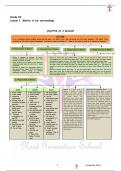
It is a substance which occupies space and has mass. Air, Earth, Fire, Sky and water are five basic elements. ‘The Panch Tatva’ according to the earlier Indian Philosophers. According to them everything i.e., living or non-living is made up of these five elements. 1.Physical Nature of Matter 2. Characteristics of Matter 3. Physical State of Matter 4. Change of State of Matter Matter is composed of particles, All matter constitute minutely small particles, These small particles are known as atoms. These particles are too small so they cannot be visually perceived [seen] by naked eye of simple microscope. Particles of matter are continuously moving as they posses kinetic energy. With the increase in temperature. Kinetic energy of particles additionally increases so particle move faster. Particle of matter have space between them e.g. when, we mix some salt in water and stir it, the salt disappears but the water level remain same. This is because the salt occupies the space between the particle of matter of water. This shows that particles of matter have space between them. Particles of matter are continuously moving. Take water in a jar. Put some water colour in it. Soon the water colour will dissolve and water will change into the desired colour in it. This shows the particles of matter are continuously moving as the particle of water colour diffuse with particle of water. Particles of matter attract each other. To move our hand in liquid. Such as sea water. We have to apply some. Force. But in solids such as wood. We can not move our hand. In air, we can move our hand very easily because of forces of attraction which is practically negligible in gas, moderate in liquids and highest in solid. 3. Physical State of Matter Contd. on next page 2 Created by Pinkz 4. Change of State of Matter Sublimation: It is a process in which solid directly changes into vapour without changing into liquid state. E.g. ,ࡴࡺ ,ࡵ ,camphor Naphthalene can sublime. Solidification: The process of conversion of gas or liquid into solid is called solidification, e.g. water [liquid] solidifies to form ice. Iodine vapours on cooling form iodine solid, Carbon dioxide at high pressure changes into dry ice [ Solid ࡻ( Evaporation: It is a process in which liquid changes into vapours e.g. water changes into vapours if left uncovered. Wet clothes dry up because water gets evaporated. The particles of water collide with each other as well as with particles of gases in atmosphere. After some time, the particles on the surface gain sufficient energy so as to change into vapours. It is a surface phenomenon. Factors Affecting Rate of Diffusion 1. Density : The rate of diffusion depends upon density of liquid. Higher the density, lesser will be the rate of diffusion. 2. Temperature: The rate of diffusion depends upon temperature. [i.e. the rate of diffusion increases with an increase in temperature which can be shown experimentally. 3. Physical State: Solids can diffuse into liquids slowly whereas liquids can diffuse into liquids faster and It is a substance which occupies space and has mass. Air, Earth, Fire, Sky and water are five basic elements. ‘The Panch Tatva’ according to the earlier Indian Philosophers. According to them everything i.e., living or non-living is made up of these five elements. 1.Physical Nature of Matter 2. Characteristics of Matter 3. Physical State of Matter 4. Change of State of Matter Matter is composed of particles, All matter constitute minutely small particles, These small particles are known as atoms. These particles are too small so they cannot be visually perceived [seen] by naked eye of simple microscope. Particles of matter are continuously moving as they posses kinetic energy. With the increase in temperature. Kinetic energy of particles additionally increases so particle move faster. Particle of matter have space between them e.g. when, we mix some salt in water and stir it, the salt disappears but the water level remain same. This is because the salt occupies the space between the particle of matter of water. This shows that particles of matter have space between them. Particles of matter are continuously moving. Take water in a jar. Put some water colour in it. Soon the water colour will dissolve and water will change into the desired colour in it. This shows the particles of matter are continuously moving as the particle of water colour diffuse with particle of water. Particles of matter attract each other. To move our hand in liquid. Such as sea water. We have to apply some. Force. But in solids such as wood. We can not move our hand. In air, we can move our hand very easily because of forces of attraction which is practically negligible in gas, moderate in liquids and highest in solid. 3. Physical State of Matter Contd. on next page 2 Created by Pinkz 4. Change of State of Matter Sublimation: It is a process in which solid directly changes into vapour without changing into liquid state. E.g. ,ࡴࡺ ,ࡵ ,camphor Naphthalene can sublime. Solidification: The process of conversion of gas or liquid into solid is called solidification, e.g. water [liquid] solidifies to form ice. Iodine vapours on cooling form iodine solid, Carbon dioxide at high pressure changes into dry ice [ Solid ࡻ( Evaporation: It is a process in which liquid changes into vapours e.g. water changes into vapours if left uncovered. Wet clothes dry up because water gets evaporated. The particles of water collide with each other as well as with particles of gases in atmosphere. After some time, the particles on the surface gain sufficient energy so as to change into vapours. It is a surface phenomenon. Factors Affecting Rate of Diffusion 1. Density : The rate of diffusion depends upon density of liquid. Higher the density, lesser will be the rate of diffusion. 2. Temperature: The rate of diffusion depends upon temperature. [i.e. the rate of diffusion increases with an increase in temperature which can be shown experimentally. 3. Physical State: Solids can diffuse into liquids slowly whereas liquids can diffuse into liquids faster and
Información del documento
- Subido en
- 16 de julio de 2024
- Número de páginas
- 37
- Escrito en
- 2023/2024
- Tipo
- Resumen

