

Exam (elaborations) .M22058 Course Code: 2410213
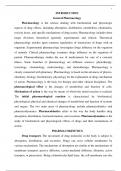
s the science dealing with biochemical and physiologic aspects of drug effects, including absorption, distribution, metabolism, elimination, toxicity doses, and specific mechanisms of drug action. Pharmacology includes three major divisions: theoretical (general), experimental, and clinical. Theoretical pharmacology touches upon common regularities of interactions of drugs with an organism. Experimental pharmacology investigates drugs influence on the organism of animals. Clinical pharmacology examines drugs influence on the organism of patient. Pharmacotherapy studies the use of medicaments for cure of a concrete illness. Some branches of pharmacology are different sciences: phytotherapy, toxicology, vitaminology, endocrinology, and chemotherapy. Pharmacology is closely connected with pharmacy. Pharmacology is based on the advances of physics, chemistry, biology, biochemistry, physiology for the explanation of drugs mechanism of action. Pharmacology is the basis for therapy and other clinical disciplines. The pharmacological effect is the changes of metabolism and function of cells. Mechanism of action is the way by means of which the initial reaction is realized. The initial pharmacological reaction is characterized by biochemical, physiological, physical and chemical changes of metabolism and function of systems and organs. The two main areas of pharmacology include pharmacokinetics and pharmacodynamics. Pharmacokinetics refers to the way the body handles drug absorption, distribution, biotransformation, and excretion. Pharmacodynamics is the study of biochemical and physiological effects of drugs and their mechanisms of action. PHARMACOKINETICS Drug transport. The movement of drug molecules in the body is subject to absorption, distribution, and excretion. Drugs can cross cellular membranes by various mechanisms. The mechanisms of absorption are similar to the mechanisms of membrane transport: passive diffusion, carrier-mediated diffusion, filtration, active transport, or pinocytosis. Being a bimolecular lipid layer, the cell membrane can also
Información del documento
- Subido en
- 10 de julio de 2024
- Número de páginas
- 386
- Escrito en
- 2023/2024
- Tipo
- Examen
- Contiene
- Preguntas y respuestas

