

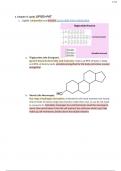
Class notes 1. Lipids: composition and function CLICK HERE FOR
1. Lipids: (Types of lipids is also part of this, but it is detailed at the top of the notes.) ● Dietary recommendations CLICK HERE FOR RESOURCE ○ Recommended that 20-35% of calories come from fat for adults/day ■ Equates to about 44-77 grams of fat for a 2,000 calorie diet ■ One fat serving is 45 calories/5 grams of fat. ■ Suggested percentages of types of fats (see below for more info on types of fatty acids): ● Monounsaturated fat (fatty acid): 15-20% ○ Come from plant sources ○ Food source: olive/canola/peanut oil, nuts, olives, avocado 13 of 36 ■ Calculated by taking weight in kg divided by the square of the height in meters (weight (kg) / height2 (m) ) ■ BMI is a general screening tool to indicate relative health risks from being under or overweight, but it is not 100% accurate or inclusive (ie: an individual can have an “obsese” BMI but be completely healthy because they have a high rate of muscle.) ■ Other ways of calculating BMI (that are more accurate) include: ● using calipers, ● underwater weighing, ● bioelectrical impedance (You may have seen this if you’ve used a machine that you hold out in front of you or a scale that measures your BMI), ● DXA, ● and isotope dilution. ○ Body composition: CLICK HERE FOR RESOURCE ■ Refers to the percentage of fat, bone, water, and muscle in your body ■ This is historically a better indicator of overall health and appropriate weight ratio compared to BMI because it is inclusive and views your body holistically. ■ Methods to determine body composition: ● Hydrostatic Weighing (just for body fat) ● Air Displacement Plethysmography (for fat vs. fat-free) ● DEXA (muscle and fat) ● MRI (total body) ● Bioelectrical impedance analysis (total body) ● The meaning of energy balance: ○ Refers to the balance achieved when the number of calories eaten is equal to the number of calories used. ○ Energy balance can be affected by the following: ■ Physical activity ■ Body size ■ Total body fat or muscle ■ Genetics ● Identify BMI categories and level of risk ○ Underweight: Below 18.5 ○ Healthy Weight: 18.5-24.9 ○ Overweight: 25.0-29.9 ○ Obese (low risk): 30.0-34.9 ■ (moderate risk): 35.0-39.9 ■ (high risk): 40.0
Información del documento
- Subido en
- 9 de julio de 2024
- Número de páginas
- 5
- Escrito en
- 2023/2024
- Tipo
- Notas de lectura
- Profesor(es)
- Leonard
- Contiene
- Todas las clases

