

WGU C168-Critical Thinking & Logic Module 1 Questions And Answers Already passed (latest update 2024/2025)
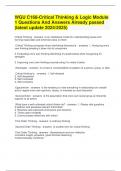
WGU C168-Critical Thinking & Logic Module 1 Questions And Answers Already passed (latest update 2024/2025) Critical Thinking - answers Is an intellectual model for understanding issues and forming reasonable and informed views on them. Critical Thinking composes three interlinking dimensions: - answers 1. Analyzing one's own thinking-breaking it down into its component 2. Evaluating one's own thinking-identifying it's weaknesses while recognizing it's strengths 3. Improving one's own thinking-reconstructing it to make it better Stereotype - answers Is a fixed or oversimplified conception of a person, group, or idea Critical thinking is: - answers 1. Self-directed 2. Self-disciplined 3. Self-motivated 4. Self-corrective Egocentrism - answers Is the tendency to view everything in relationship ton oneself and to regard one's own opinions, values, or interests as most important Sociocentrism - answers Is the assumption that one's own social group is inherently superior to all others What does a well-cultivated critical thinker do? - answers 1. Raises vital questions 2.Gathers and assesses relevant information 3. Reaches well-reasoned conclusions and solutions 4. Thinks open-mindedly 5. Communicates effectively with others First-Order Thinking - answers Is ordinary thinking Second-Order Thinking - answers Is another term for critical thinking First-Order Thinking - answers •Spontaneous and non-reflective •Contains insight, prejudice, good and bad reasoning •Indiscriminately combined Second-Order Thinking - answers First-order thinking that is consciously realized (i.e., analyzed, assessed, and reconstructed) Weak-Sense Critical Thinking - answers Is thinking that does not consider counter viewpoints, that lacks fair-mindedness and that uses critical thinking skills simply to defend current beliefs Weak-Sense Critical Thinkers - answers •Ignore the flaws in their own thinking •Often seek to win an argument through intellectual trickery or deceit. •Lacks key higher-level skills and values of critical thinking •Makes no good faith effort to consider alternative viewpoints. •Lacks fair-mindedness Weak-Sense Critical Thinkers tend to: - answers •Employ lower-level rhetorical skills (making it unreasonable thinking appear reasonable thinking appear unreasonable) •Employ emotionalism and intellectual trickery •Hide or distort evidence Strong-Sense Critical Thinking - answers Is thinking that uses critical thinking skills to evaluate all beliefs, especially one's own, and pursues what is intellectually fair and just Strong-Sense Critical thinkers: - answers •Strive to be ethical •Strive to empathize with others' viewpoints •Will entertain arguments with which they do not agree •Change their views when confronted with superior reasoning •Employ their thinking reasonably rather than manipulatively Fair-minded yields many intellectual virtues it leads us to: - answers •Consider all thinking by the same standards •Expect good reasoning from supporters as well as opponents •Apply the same critical criteria to our own logic as to other's reasoning •Recognize the actual strengths and weaknesses of any reasoning we assess Fair Mindedness - answers Is the commitment to consider all relevant opinions equally without regard to one's own sentiments or selfish interests The mind performs three basic functions - answers 1. Thinking 2. Feeling 3. Wanting Thinking - answers Thinking creates meaning. It sorts events in our lives into categories. It finds patterns in the world around us. Thinking informs us what is going on. Feeling - answers Feeling monitors the meanings created by thinking. It evaluates the degree to which life's events are either positive or negative, given the meaning we assign to them. This function continually informs us how we should respond emotionally to what is happening in our lives. Wanting - answers Wanting allocates energy into action. It does so consistently with how we define what is desirable and possible. Wanting continually tells us what is (or is not) worth seeking or getting. Intellectual Humility (Characterization) - answers Commitment to discovering the extent of one's own ignorance on any issue Recognition that one does not - and cannot know everything Consciousness of one's biases and prejudices Aware of the limitations of one's viewpoint Recognition that one should claim only what one actually knows Awareness that egocentrism is often self deceiving (i.e., convinces the mind that it knows more than it does) Intellectual Humility Relationship to Fair-Mindedness - answers Fair - mindedness requires us to first recognize the ignorance and flaws in our own thinking and to comport ourselves accordingly . It requires self - awareness and a willingness to examine the limitations of one's own point of view Being a fair - minded thinker means habitually applying the standards of reasoning to one's own thinking in an effort to improve it. Intellectual Courage - answers Confronting ideas , viewpoints , or beliefs with fairness , even when doing so is painful Examining fairly beliefs which one has strong negative feelings and toward which one has previously been dismissive Challenging popular belief Leads us to recognize that ideas that society deems dangerous or absurd may hold some truth or justification Fortifies us to confront false or distorted ideas embraced by social groups to which we belong Intellectual Courage Relationship to Fair-Mindedness - answers Critical thinkers don't link their self - identities to their beliefs . They define themselves according to how they arrive at their beliefs ( i.e. , the intellectual process ).
Información del documento
- Subido en
- 30 de junio de 2024
- Número de páginas
- 7
- Escrito en
- 2023/2024
- Tipo
- Examen
- Contiene
- Preguntas y respuestas

