
Oncology Summary
Chapter 9 Metastasis
Metastasis can already be present at the moment of diagnosis
Adjuvant treatment (after removal tumor) is not always effective
Metastasis can lead to physical obstruction and competition with cells for nutrients
and oxygen. Both of these lead to interference in organ function
Organotropism of metastases. Some type of cancers have a main site of metastasis. For
example: breast lungs liver, bones. Why is this organotropism? Proposed: because of the
direction of blood flow. But kidney to thyroid?? Why the brain? It doesn’t answer everything.
Seed and soil hypothesis, the seeds of a plant are carried in all directions: but they can
only live and grow if they fall on congenial soil: thus only if the microenvironment is
appropriate for that cell, it can lead to metastasis.
o Can be a pre-established niche: for example in the bone, has a lot of growth
factors
o Or pre-metastatic niche formation: tumor is sent out to other places and when the
tumor cell arrives there it is suitable.
How do tumors spread?
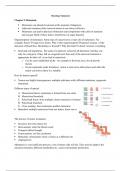
Tumors are highly heterogeneous: multiple subclones with; different mutations, epigenetic
alterations.
Different types of spread:
A. Monoclonal linear: metastasis is formed from one clone
B. Monoclonal branched:
C. Polyclonal linear: from multiple clones metastasis is formed
D. Polyclonal branched:
E. Cross seeding: from metastasis another metastasis
Branched: multiple metastases from one tumor, linear one metastasis from one tumor.
The process of tumor metastasis
Invasion: leave the tumor site
Intravasation: enter the blood vessel
Transport (blood lymph)
Extravasation: exit the circulation
Metastatic colonization: form a colony at a different site
Angiogenesis
Metastasis is very inefficient process: a lot of tumor cells will die. They need to adapt to the
microenvironment, different metabolites etc., and avoid immune destruction.
, 1. Invasion.
It is easier to do this when they undergo epithelial-mesenchymal transition EMT. Tumor cells
will transform in mesenchymal cells. This increases survival in the bloodstream. It is
reversible, on the metastatic site they are found in their epithelial phenotype again (MET).
Signals from the microenvironment, secrete factors and interact with kinase receptors. Will
activate oncogenic transcription factors: snails, lak, zap1, will lead to activating Ncadherins
etc.
Tools of invasion
1. Cell adhesion molecules: cells attached to each other.
Keeps cells in place. Bind cells to each other. E cadherins act as tumor suppressors: keep cells
in place when active. How do we know? Anti-E-Cadherin antibody treatment resulted in
invasive behavior in collagen gels. (they grow detached from each other) . Mutations in the
extracellular domains or gene promotor methylation have been documented in gastric and
prostate carcinomas.
If we overexpress (transfection) of E cadherin cDNA/ORF in metastatic epithelial cells,
noninvasive. Less aggressive behavior.
2. Integrins: attach cells to extracellular matrix (ECM). Are heterodimers. Contain
alpha and beta subunits.
Altered integrin expression in tumor cells can enable mobility and invasion.
Upon ligand binding Beta1, and alpha5beta3 integrins activate FAK (focal adhesion kinase)
and SRC this will activate signaling increase invasion, proliferation and survival of tumor
cells.
Anoikis: apoptosis triggered in response to a lack of ECM ligand binding and loss of cell
adhesion.
In suspended tumor cells unligated integrin Alpha5beta3 signals through SRC independently
of FAK to promote survival. So cells remain alive without cell adhesion.
3. Proteases: ECM degradation.
Tumor cells break free from the tissue and the basement membrane employing matrix Metallo
Proteinases MMP and serine proteases.
Tumor cells can promote metallo proteinases in cells of the microenvironment. Creating a
path where the cells can move out of the stroma. EMMPRN inducer interacts with
fibroblasts, fibroblasts increase MMP and tumor cells can thereby get more invasive.
Chapter 9 Metastasis
Metastasis can already be present at the moment of diagnosis
Adjuvant treatment (after removal tumor) is not always effective
Metastasis can lead to physical obstruction and competition with cells for nutrients
and oxygen. Both of these lead to interference in organ function
Organotropism of metastases. Some type of cancers have a main site of metastasis. For
example: breast lungs liver, bones. Why is this organotropism? Proposed: because of the
direction of blood flow. But kidney to thyroid?? Why the brain? It doesn’t answer everything.
Seed and soil hypothesis, the seeds of a plant are carried in all directions: but they can
only live and grow if they fall on congenial soil: thus only if the microenvironment is
appropriate for that cell, it can lead to metastasis.
o Can be a pre-established niche: for example in the bone, has a lot of growth
factors
o Or pre-metastatic niche formation: tumor is sent out to other places and when the
tumor cell arrives there it is suitable.
How do tumors spread?
Tumors are highly heterogeneous: multiple subclones with; different mutations, epigenetic
alterations.
Different types of spread:
A. Monoclonal linear: metastasis is formed from one clone
B. Monoclonal branched:
C. Polyclonal linear: from multiple clones metastasis is formed
D. Polyclonal branched:
E. Cross seeding: from metastasis another metastasis
Branched: multiple metastases from one tumor, linear one metastasis from one tumor.
The process of tumor metastasis
Invasion: leave the tumor site
Intravasation: enter the blood vessel
Transport (blood lymph)
Extravasation: exit the circulation
Metastatic colonization: form a colony at a different site
Angiogenesis
Metastasis is very inefficient process: a lot of tumor cells will die. They need to adapt to the
microenvironment, different metabolites etc., and avoid immune destruction.
, 1. Invasion.
It is easier to do this when they undergo epithelial-mesenchymal transition EMT. Tumor cells
will transform in mesenchymal cells. This increases survival in the bloodstream. It is
reversible, on the metastatic site they are found in their epithelial phenotype again (MET).
Signals from the microenvironment, secrete factors and interact with kinase receptors. Will
activate oncogenic transcription factors: snails, lak, zap1, will lead to activating Ncadherins
etc.
Tools of invasion
1. Cell adhesion molecules: cells attached to each other.
Keeps cells in place. Bind cells to each other. E cadherins act as tumor suppressors: keep cells
in place when active. How do we know? Anti-E-Cadherin antibody treatment resulted in
invasive behavior in collagen gels. (they grow detached from each other) . Mutations in the
extracellular domains or gene promotor methylation have been documented in gastric and
prostate carcinomas.
If we overexpress (transfection) of E cadherin cDNA/ORF in metastatic epithelial cells,
noninvasive. Less aggressive behavior.
2. Integrins: attach cells to extracellular matrix (ECM). Are heterodimers. Contain
alpha and beta subunits.
Altered integrin expression in tumor cells can enable mobility and invasion.
Upon ligand binding Beta1, and alpha5beta3 integrins activate FAK (focal adhesion kinase)
and SRC this will activate signaling increase invasion, proliferation and survival of tumor
cells.
Anoikis: apoptosis triggered in response to a lack of ECM ligand binding and loss of cell
adhesion.
In suspended tumor cells unligated integrin Alpha5beta3 signals through SRC independently
of FAK to promote survival. So cells remain alive without cell adhesion.
3. Proteases: ECM degradation.
Tumor cells break free from the tissue and the basement membrane employing matrix Metallo
Proteinases MMP and serine proteases.
Tumor cells can promote metallo proteinases in cells of the microenvironment. Creating a
path where the cells can move out of the stroma. EMMPRN inducer interacts with
fibroblasts, fibroblasts increase MMP and tumor cells can thereby get more invasive.

