100% de satisfacción garantizada Inmediatamente disponible después del pago Tanto en línea como en PDF No estas atado a nada 4.2 TrustPilot
logo-home
Examen

CUS3701 Assignment 3 (QUALITY ANSWERS) 2024

Puntuación
4.5
(6)
Vendido
63
Páginas
33
Grado
A+
Subido en
20-06-2024
Escrito en
2023/2024

This document contains workings, explanations and solutions to the CUS3701 Assignment 3 (QUALITY ANSWERS) 2024. For assistance call or us on 0.6.8..8.1.2..0.9.3.4...... QUESTION 1 Read the extract below and answer the questions that follow. MAPHUNGUBWE CULTURAL LANDSCAPE The ancient city of Mapungubwe (meaning “hill of the jackal”) is an Iron Age archaeological site in the Limpopo province on the border between South Africa, Zimbabwe and Botswana, 75 km from Messina. It sits close to the point where the Limpopo and Shashe Rivers meet. One thousand years ago, Mapungubwe appears to have been the centre of the largest known kingdom in the African sub-continent. The civilization thrived as a sophisticated trading centre from around 1200 to 1300 AD, trading gold and ivory with China, India and Egypt. The site was “discovered” on 31 December 1932, when a local informant, Mowena, led E.S.J. van Graan (farmer and prospector), his son and three others to Greefswald farm on Mapungubwe Hill. On the hill, they noticed stone walls and on closer inspection, they recovered gold and iron artifacts, pottery and glass beads. Van Graan's son recognised the academic value of the site and contacted the head of the Department of History at the University of Pretoria, Professor Leo Fouché. As a result of his intervention, the University negotiated with the owner of the property, E.E. Collins. In a legal agreement, the University took ownership of the gold and other artifacts and secured an option and a contract for excavation rights. The University also successfully requested a postponement of prospecting, mining and related activities on Greefswald. In June 1933, Greefswald was bought by the Government and excavation rights were granted to the University of Pretoria. The University established an Archaeological Committee, which from 1933 to 1947 oversaw research and excavations (read more about the excavations). Mapungubwe Hill is 300 m long, broad at one end, tapering at the other. It is only accessible by means of two very steep and narrow paths that twist their way to the summit, and yet 2 000 tons of soil have been artificially transported to the very top by a prehistoric people of unknown identity. Downloaded by Corona Virus () lOMoARcPSD| CUS3701 ASSESSMENT 03/2024 Archaeological enquiry uncovered the remnants of numerous dwellings, which had been built on the ruins of predecessors over many generations, resulting in a series of habitation phases. Radiocarbon dates show that the first buildings were erected below the hill at the beginning of the 11th century AD. But adjacent to Mapungubwe is the sister site of Bambandyanalo, which was settled even earlier. It seems that the centre of the state shifted from Bambandyanalo to Mapungubwe Hill in about 1045 AD, when the town most probably became overcrowded. It was also at about this time that hills and mountains became associated with royalty and the noble classes began to build their structure on high ground. This is an important observation as it provided evidence of the extensive wealth and social differentiation of the people of Mapungubwe; in other words, this ancient civilization was class based. The gold findings are also evidence of early gold smelting. A large number of artifacts from the royal family were discovered at Mapungubwe. The best known of these objects is the golden rhinoceros. All in all, the amount of gold from this burial amounted to 7 503 ounces. Greefswald farm remained the property of the State from the 1930s. Management of the farm was taken over by the provincial Department of Nature Conservation in 1992 and control was transferred to SANParks in 1999. Mapungubwe was declared a World Heritage Site by the United Nations Educational, Scientific and Cultural Organisation (UNESCO) in July 2003. 1.1 Write down the following: • The grade you are going to teach this lesson to. • The teaching strategy or strategies that you will use. 1.2 Design a class test with 10 questions. • The test must count 20 marks. • The questions must meet the criteria for good questioning. • The questions must be set at a variety of the Bloom’s taxonomy levels according to the CAPS requirements. • Only one reproductive (lower order) question may be asked. • Indicate each time on which level of Bloom’s taxonomy the question lies. Downloaded by Corona Virus () lOMoARcPSD| CUS3701 ASSESSMENT 03/2024 • Compile a memorandum, and mark allocation should be indicated. [20] QUESTION 2 2.1 Explain the difference between formative assessment and summative assessment. Give one example for each and include the assessment tool that will be used, for example, self-assessment or group assessment. (6) 2.2 How can teachers understand what makes one assessment good and another bad? (2) 2.3 How do you make choices about what type of assessment to use in your teaching? (2) NB: Explain in your own words; do not copy everything from the textbook. [10] QUESTION 3 In every assessment task, the assessment criteria should be aligned to the learning outcomes. 3.1 Discuss the implications of aligning learning outcomes with assessment criteria on learners. Your answer should be in the form of an essay (introduction, body and conclusion), making use of examples from your own subject. Downloaded by Corona Virus () lOMoARcPSD| CUS3701 ASSESSMENT 03/2024 QUESTION 4 White Paper 6 defines inclusive education inter alia as maximising the participation of all learners in the culture and the curriculum of education institutions and uncovering and minimising barriers to learning. 4.1 In an essay (introduction, body and conclusion), discuss your understanding of barriers to learning and how you will make sure that you address barriers to learning in your specific subject. Assessment criteria We will be assessing the following in your answer: • Discuss the concept ‘barriers to learning’ (don’t copy the textbook word by word). (10) • Elaborate on the goals of White Paper 6. (10) • Address barriers to learning and indicate with YOUR OWN EXAMPLES how you will create a supportive environment and choose assessment tasks to overcome barriers to learning. (10) [30] QUESTION 5 Being a teacher at any level requires a significant amount of knowledge and skill. Paying attention to the core competencies for teachers helps to ensure that all teachers working in a school environment are prepared to make school a positive experience for learners and their families. 5.1 Write an essay in response to the statement above. The essay must contain an introduction, a body and a conclusion. You are required to do research and write a Downloaded by Corona Virus () lOMoARcPSD| CUS3701 ASSESSMENT 03/2024 detailed discussion in your own words. Note that you will not earn marks for simply copying from the textbook or plagiarising (using more than 30%? of the direct words) from any other source.

Mostrar más Leer menos
Institución
Grado


Ups! No podemos cargar tu documento ahora. Inténtalo de nuevo o contacta con soporte.

Libro relacionado

Escuela, estudio y materia

Institución
Grado

Información del documento

Subido en
20 de junio de 2024
Número de páginas
33
Escrito en
2023/2024
Tipo
Examen
Contiene
Preguntas y respuestas

Temas

Vista previa del contenido

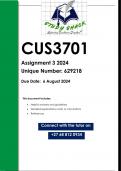
CUS3701
Assignment 3 2024
Unique Number: 629218
Due Date: 6 August 2024


This document includes:

• Helpful answers and guidelines
• Detailed explanations and/ or calculations
• References


Connect with the tutor on

+27 68 812 0934

,© Study Shack 2024. All rights Reserved +27 68 812 0934

, QUESTION 1

1.1.

Grade: 10

Teaching strategy: Lecture, group discussion, and visual aids (e.g. maps,
pictures, and diagrams), followed by Q&A and analysis of the historical and
cultural significance of Mapungubwe.


1.2.

Grade 10 Class Test: Mapungubwe Cultural Landscape

Duration: 60 minutes

Total Marks: 20


Instructions

• Answer all questions below.
• Write clearly and legibly.


QUESTION 1: REMEMBERING (1 Mark)

1. What is the meaning of the name "Mapungubwe"?


[Bloom's Taxonomy: Lower Order - Remembering]


QUESTION 2: UNDERSTANDING (2 Marks)

2. Explain why Mapungubwe is considered to have been a sophisticated
trading center during its time.


[Bloom's Taxonomy: Lower Order - Understanding]


© Study Shack 2024. All rights Reserved +27 68 812 0934

, QUESTION 3: APPLYING (2 Marks)

3. If Mapungubwe traded gold and ivory with China, India, and Egypt, what
can you infer about the transportation methods and trade routes they
might have used?


[Bloom's Taxonomy: Middle Order - Applying]


QUESTION 4: ANALYZING (3 Marks)

4. Analyze the significance of the discovery of stone walls, gold, and iron
artifacts, and other materials at Mapungubwe Hill. What does this tell you
about the culture and technological advancement of the civilization?


[Bloom's Taxonomy: Middle Order - Analyzing]


QUESTION 5: EVALUATING (3 Marks)

5. Evaluate the impact of the University of Pretoria's involvement in the
excavation and preservation of Mapungubwe artifacts.


[Bloom's Taxonomy: Higher Order - Evaluating]


QUESTION 6: CREATING (3 Marks)

6. Design a small exhibition that showcases the cultural and historical
significance of Mapungubwe. What artifacts and information would you
include, and why?


[Bloom's Taxonomy: Higher Order - Creating]


© Study Shack 2024. All rights Reserved +27 68 812 0934

$3.04
Accede al documento completo:
Comprado por 63 estudiantes

100% de satisfacción garantizada
Inmediatamente disponible después del pago
Tanto en línea como en PDF
No estas atado a nada

Reseñas de compradores verificados

Se muestran los 6 comentarios
1 año hace

1 año hace

1 año hace

5 meses hace

1 año hace

1 año hace

4.5

6 reseñas

5
3
4
3
3
0
2
0
1
0
Reseñas confiables sobre Stuvia

Todas las reseñas las realizan usuarios reales de Stuvia después de compras verificadas.

Conoce al vendedor

Seller avatar
Los indicadores de reputación están sujetos a la cantidad de artículos vendidos por una tarifa y las reseñas que ha recibido por esos documentos. Hay tres niveles: Bronce, Plata y Oro. Cuanto mayor reputación, más podrás confiar en la calidad del trabajo del vendedor.
StudyShack Cornerstone College, Pretoria, Gauteng
Seguir Necesitas iniciar sesión para seguir a otros usuarios o asignaturas
Vendido
30694
Miembro desde
9 año
Número de seguidores
13937
Documentos
1800
Última venta
4 semanas hace
Study Guides for Unisa Students

4.1

1778 reseñas

5
970
4
335
3
264
2
80
1
129

Recientemente visto por ti

Por qué los estudiantes eligen Stuvia

Creado por compañeros estudiantes, verificado por reseñas

Calidad en la que puedes confiar: escrito por estudiantes que aprobaron y evaluado por otros que han usado estos resúmenes.

¿No estás satisfecho? Elige otro documento

¡No te preocupes! Puedes elegir directamente otro documento que se ajuste mejor a lo que buscas.

Paga como quieras, empieza a estudiar al instante

Sin suscripción, sin compromisos. Paga como estés acostumbrado con tarjeta de crédito y descarga tu documento PDF inmediatamente.

Student with book image

“Comprado, descargado y aprobado. Así de fácil puede ser.”

Alisha Student

Preguntas frecuentes