EKN 120 - Notes
Chapter 16 - Government and Market Failure
private good - A good or service that is individually consumed and that can be profitably provided by
privately owned firms because they can exclude non-payers from receiving the benefits.
Characteristics:
Rivalry – If I buy, you can’t have
Excludability – I will sell it to those who can afford it
public good - A good or service that is characterized by non-rivalry and non-excludability; a good or
service with these characteristics provided by government.
Characteristics:
Nonrivalry – We can all buy!
Nonexcludability – We can all benefit!
free-rider problem - The inability of potential providers of an economically desirable good or service
to obtain payment from those who benefit, because of non-excludability.
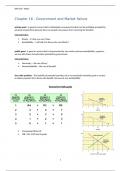
Demand for Public goods
Comparing MB to MC
MB = MC at R5 and 3 goods
1
,EKN 120 - Notes
Majority voting
Majority voting in economics is a decision-making process where participants choose an option by
casting votes, with the option receiving the most votes being implemented. It is commonly used in
corporate governance, public policy, and social choice. However, it can disadvantage minorities, lead
to paradoxes, and be influenced by strategic voting and agenda control, making its applicability
context-dependent.
Inneficient votes
Explaination:
Assume that the Government can provide a public good, say National Defence, at a total expense of
R900. Also assume that there are only 3 individuals, - Bongi, Ben & Clarck – in the society and that
they will share the R900 tax expense equally, each being taxed R300 if the proposed public good is
provided. As shown above, assume that Bongi would receive R700 of benefits, Ben R250 and Clarck
R200.
What will be the result if the majority vote determines whether or not this public goodis provided?
Although people do not always vote strictlyaccording to their own economic interest, it is likely that
Ben and Clarck will vote “no” because the tax they pay > the benefits they will receive. So the
proposal will will be defeated due to the majority vote even though the total benefit of R1150
exceeds the total cost of R900. Too little of this good will be produced.
The opposite effect occurs in the 2nd set of columns.
Avenues for solving voting inneficiencies
Interest groups - Interest groups are organizations formed by individuals with common interests,
and they aim to influence government policies and decisions. In economic terms, these groups may
use majority voting as a method to advocate for their preferred economic policies and principles,
such as tax reform, trade regulations, or industry-specific regulations, by mobilizing support from
their members and influencing policymakers.
2
, EKN 120 - Notes
Logrolling - The trading of votes by legislators to secure favourable outcomes on decisions
concerning the provision of public goods and quasi-public goods.
The voting paradox
paradox of voting - A situation where paired-choice voting by majority rule fails to provide a
consistent ranking of society’s preferences for public goods or services.
e.g:
A, B, and C are the 3 goods and there are 3 voters
Voter 1: 1st choice: A, 2nd choice: B, 3rd choice: C
Voter 2: 1st choice: B, 2nd choice: C, 3rd choice: A
Voter 3: 1st choice: C, 2nd choice: A, 3rd choice: B
Now, let's see how these preferences play out in pairwise majority voting:
1. In a one-on-one comparison, A vs. B:
Voter 1 prefers A over B.
Voter 2 prefers B over A.
Voter 3 prefers A over B. So, A wins against B.
2. In a one-on-one comparison, B vs. C:
Voter 1 prefers C over B.
Voter 2 prefers B over C.
Voter 3 prefers B over C. So, B wins against C.
3. In a one-on-one comparison, C vs. A:
Voter 1 prefers A over C.
Voter 2 prefers C over A.
Voter 3 prefers C over A. So, C wins against A.
Here's the paradox: A wins against B, B wins against C, and C wins against A. This creates a circular
and inconsistent result, making it impossible to determine a clear overall winner. This is the
Condorcet Paradox, which demonstrates that majority voting can lead to intransitive preferences and
an inconclusive outcome, showing that no candidate consistently beats all others in pairwise
comparisons. It highlights the limitations of simple majority voting systems when there are more
than two alternatives and can be a challenge in democratic decision-making.
median-voter model - The theory that under majority rule the median (middle) voter will be in the
dominant position to determine the outcome of an election.
Government Failure
government failure - Inefficiencies in resource allocation caused by problems in the operation of the
public sector (government), specifically, rent-seeking pressure by special-interest groups,
shortsighted political behaviour, limited and bundled choices and bureaucratic inefficiencies.
3
Chapter 16 - Government and Market Failure
private good - A good or service that is individually consumed and that can be profitably provided by
privately owned firms because they can exclude non-payers from receiving the benefits.
Characteristics:
Rivalry – If I buy, you can’t have
Excludability – I will sell it to those who can afford it
public good - A good or service that is characterized by non-rivalry and non-excludability; a good or
service with these characteristics provided by government.
Characteristics:
Nonrivalry – We can all buy!
Nonexcludability – We can all benefit!
free-rider problem - The inability of potential providers of an economically desirable good or service
to obtain payment from those who benefit, because of non-excludability.
Demand for Public goods
Comparing MB to MC
MB = MC at R5 and 3 goods
1
,EKN 120 - Notes
Majority voting
Majority voting in economics is a decision-making process where participants choose an option by
casting votes, with the option receiving the most votes being implemented. It is commonly used in
corporate governance, public policy, and social choice. However, it can disadvantage minorities, lead
to paradoxes, and be influenced by strategic voting and agenda control, making its applicability
context-dependent.
Inneficient votes
Explaination:
Assume that the Government can provide a public good, say National Defence, at a total expense of
R900. Also assume that there are only 3 individuals, - Bongi, Ben & Clarck – in the society and that
they will share the R900 tax expense equally, each being taxed R300 if the proposed public good is
provided. As shown above, assume that Bongi would receive R700 of benefits, Ben R250 and Clarck
R200.
What will be the result if the majority vote determines whether or not this public goodis provided?
Although people do not always vote strictlyaccording to their own economic interest, it is likely that
Ben and Clarck will vote “no” because the tax they pay > the benefits they will receive. So the
proposal will will be defeated due to the majority vote even though the total benefit of R1150
exceeds the total cost of R900. Too little of this good will be produced.
The opposite effect occurs in the 2nd set of columns.
Avenues for solving voting inneficiencies
Interest groups - Interest groups are organizations formed by individuals with common interests,
and they aim to influence government policies and decisions. In economic terms, these groups may
use majority voting as a method to advocate for their preferred economic policies and principles,
such as tax reform, trade regulations, or industry-specific regulations, by mobilizing support from
their members and influencing policymakers.
2
, EKN 120 - Notes
Logrolling - The trading of votes by legislators to secure favourable outcomes on decisions
concerning the provision of public goods and quasi-public goods.
The voting paradox
paradox of voting - A situation where paired-choice voting by majority rule fails to provide a
consistent ranking of society’s preferences for public goods or services.
e.g:
A, B, and C are the 3 goods and there are 3 voters
Voter 1: 1st choice: A, 2nd choice: B, 3rd choice: C
Voter 2: 1st choice: B, 2nd choice: C, 3rd choice: A
Voter 3: 1st choice: C, 2nd choice: A, 3rd choice: B
Now, let's see how these preferences play out in pairwise majority voting:
1. In a one-on-one comparison, A vs. B:
Voter 1 prefers A over B.
Voter 2 prefers B over A.
Voter 3 prefers A over B. So, A wins against B.
2. In a one-on-one comparison, B vs. C:
Voter 1 prefers C over B.
Voter 2 prefers B over C.
Voter 3 prefers B over C. So, B wins against C.
3. In a one-on-one comparison, C vs. A:
Voter 1 prefers A over C.
Voter 2 prefers C over A.
Voter 3 prefers C over A. So, C wins against A.
Here's the paradox: A wins against B, B wins against C, and C wins against A. This creates a circular
and inconsistent result, making it impossible to determine a clear overall winner. This is the
Condorcet Paradox, which demonstrates that majority voting can lead to intransitive preferences and
an inconclusive outcome, showing that no candidate consistently beats all others in pairwise
comparisons. It highlights the limitations of simple majority voting systems when there are more
than two alternatives and can be a challenge in democratic decision-making.
median-voter model - The theory that under majority rule the median (middle) voter will be in the
dominant position to determine the outcome of an election.
Government Failure
government failure - Inefficiencies in resource allocation caused by problems in the operation of the
public sector (government), specifically, rent-seeking pressure by special-interest groups,
shortsighted political behaviour, limited and bundled choices and bureaucratic inefficiencies.
3