
NLN Pax Science Practice Test
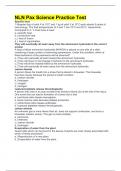
NLN Pax Science Practice Test Specific heat 1 kilogram (kg) of solid X at 10°C and 1 kg of solid Y at 10°C each absorb 5 joules of heat energy. The final temperatures of X and Y are 15°C and 20°C, respectively. Compared to X, Y must have a lower a.) specific heat. b.) conductive heat c.). heat of fusion d.). heat of vaporization. They will eventually all swim away from the ammonium hydroxide is the correct answer A drop of dilute ammonium hydroxide (NH4OH) is placed on one side of a slide containing a large number of swimming paramecium. Under this condition, which of these behaviors of the paramecia will be observed? a.) They will eventually all swim toward the ammonium hydroxide. b.) They will show no net change in behavior to the ammonium hydroxide. c.) They will all be instantly killed by the ammonium hydroxide. d.) They will eventually all swim away from the ammonium hydroxide. carbon dioxide A person blows his breath into a straw that is placed in limewater. The limewater becomes cloudy because the person's breath contains a.) carbon dioxide. b.) hydrogen c.) oxygen. d.) nitrogen. ruptured platelets release thromboplastin A person who was in an auto accident has formed a blood clot at the site of the injury. One event that can lead to formation of a blood clot is that a.) red blood cells release hemoglobin b.) bone marrow cells decrease platelet production c.) white blood cells release antibodies d.) ruptured platelets release thromboplastin. carbon dioxide An unknown gas is more dense than air, does not support combustion, and turns a limewater solution cloudy. This gas is most probably a.) ammonia. b.) methane c.) carbon dioxide d.) hydrogen. Evaporation of water from the plant Guard cells which can be found in the leaves of plants are most closely associated with which of these processes? a.) Reproduction of a new plant b.) Evaporation of water from the plant. c.) Synthesis of organic substances in the plant. d.) Movement of organic and inorganic substances from soil to the plant. 50 - 75%
Información del documento
- Subido en
- 11 de junio de 2024
- Número de páginas
- 18
- Escrito en
- 2023/2024
- Tipo
- Examen
- Contiene
- Preguntas y respuestas

