

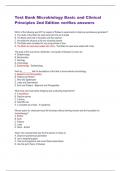
Test Bank Microbiology Basic and Clinical Principles 2nd Edition verifies answers Which of the following was NOT an aspect of Pasteur's experiments to disprove spontaneous generation? A. The necks of the flasks he used were bent into an S -shape B. The flasks were free of microbes until they opened C. He boiled the infusions to kill any microbes present. D. The flasks were incubated for very long periods of time E. The flasks he used were sealed with corks - The flasks he used were sealed with corks The study of the occurrence, distribut ion, and spread of disease is known as: A. Biotechnology B. Biochemistry C. Serology D. Immunology E. Epidemiology - Epidemiology Work by ________ laid the foundations of the field of environmental microbiology. A. Beijerinck and Winogradsky B. Pauling and Woese C. Reid and Spallanzani D. Lister and Semmelweis E. Koch and Pasteur - Beijerinck and Winogradsky What must one have before designing and conducting experiments? A. A hypothesis B. Popular opinion C. A theory D. Scientific law E. A complete set of data - A hypothesis Whose search for chemicals would kill microbes without harming humans was the foundation for chemotherapy? A. Ehrlich B. Koch C. Pasteur D. Lister E. Gram - Ehrlich Antoni van Leeuwenhoek was the first person in h istory to A. Disprove spontaneous generation B. Use a magnifying glass C. View microorganisms and record these observations D. Use the germ theory of disease E. develop a taxonomic system - View microorganisms and record these observations Microorganisms characterized by the absence of a nucleus are called A. Prokaryotes B. Viruses C. Pathogens D. Fungi E. Eukaryotes - Prokaryotes Robert Koch was involved in research on all of the following topics EXCEPT A. The cause of fermentation B. The cause of anthrax C. Techniques for isolating microbes in the laboratory D. The cause of tuberculosis E. Development of a method to determine the cause of an infectious disease - The cause of fermentation The term for the use of microorganisms to re store damaged environments is A. Epidemiology B. Ecology C. Serology D. Chemotherapy E. Bioremediation - Bioremediation Which of the following is an INCORRECT pairing? A. Fungi; cell walls B. Protozoa; multicellular C. Prokaryotes; no nuclei D. Viruses ; acellular parasites E. Algae; aquatic and marine habitats - Protozoa; multicellular The microbes commonly known as ________ are single -felled eukaryotes that are generally motile A. Viruses B. Archaea C. Protozoa D. Fungi E. Bacteria - Protozoa What is the correct order for application of Koch's postulates? I. Inoculate suspect agent into test subject and observe that subject develops disease of interest II. Isolate and culture suspect agent in the laboratory III. Find suspect agent is every case of disease of interest but not in healthy hosts. IV. Recover and isolate suspect agent from test subject. - III, II, I, IV Which of the following scientists provided evidence in favor of the concept of spontaneous generation? A. Needham B. Buchner C. Pas teur
Vista previa 2 fuera de 12 páginas
Examen
Test Bank Microbiology Basic and Clinical Principles 2nd Edition verifies answers
Vista previa 2 fuera de 12 páginas
Test Bank Microbiology Basic and Clinical Principles 2nd Edition verifies answers Which of the following was NOT an aspect of Pasteur's experiments to disprove spontaneous generation? A. The necks of the flasks he used were bent into an S-shape B. The flasks were free of microbes until they opened C. He boiled the infusions to kill any microbes present. D. The flasks were incubated for very long periods of time E. The flasks he used were sealed with corks - The flasks he used were sealed with corks The study of the occurrence, distribution, and spread of disease is known as: A. Biotechnology B. Biochemistry C. Serology D. Immunology E. Epidemiology - Epidemiology Work by ________ laid the foundations of the field of environmental microbiology. A. Beijerinck and Winogradsky B. Pauling and Woese C. Reid and Spallanzani D. Lister and Semmelweis E. Koch and Pasteur - Beijerinck and Winogradsky What must one have before designing and conducting experiments? A. A hypothesis B. Popular opinion C. A theory D. Scientific law E. A complete set of data - A hypothesis Whose search for chemicals would kill microbes without harming humans was the foundation for chemotherapy? A. Ehrlich B. Koch C. Pasteur D. Lister E. Gram - Ehrlich
Vista previa del contenido
Información del documento
- Subido en
- 9 de junio de 2024
- Número de páginas
- 12
- Escrito en
- 2023/2024
- Tipo
- Examen
- Contiene
- Preguntas y respuestas
$28.99
¿Documento equivocado? Cámbialo gratis
Dentro de los 14 días posteriores a la compra y antes de descargarlo, puedes elegir otro documento. Puedes gastar el importe de nuevo.
Escrito por estudiantes que aprobaron
Inmediatamente disponible después del pago
Leer en línea o como PDF

Los indicadores de reputación están sujetos a la cantidad de artículos vendidos por una tarifa y las reseñas que ha recibido por esos documentos. Hay tres niveles: Bronce, Plata y Oro. Cuanto mayor reputación, más podrás confiar en la calidad del trabajo del vendedor.
