FTCE Elementary K-6 Study Guide.
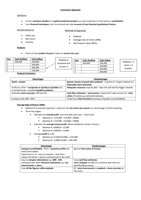
FTCE Elementary K-6 Study Guide. Note: This study guide is meant to assist your study process. Please use it as one of a few resources, and not the only resource you study with! FTCE Elementary K-6 Study Guide Language Arts & Reading Developmental Stages of Reading • Stage 0: Prereading, birth to age 6 • Stage 1: Initial reading, grades 1-2.5 • Stage 2: Confirmation, Fluency, Ungluing from Print, grades 2-3 • Stage 3: Reading for Learning the New, grades 4-8 • Stage 4: Multiple Viewpoints, high school, ages 14-18 • Stage 5: Construction and Reconstruction, college and above, ages 18+ Guided reading An instructional strategy in which the teacher and a group of children, or sometimes an individual child, talk and think and question their way through a book of which they each have a copy. The teacher shows the children what questions to ask of themselves as readers, and the author through the text, so that each child can discover the author's meaning on the first reading. Sight words These are high frequency words which readers need to know automatically when they see them. Many of these words are not decodable. • In kindergarten, instruction begins with an emphasis on oral language and awareness of sounds. Activities include many listening for rhymes, identifying the initial sounds of pictures or spoken words, listening for how many words are in a spoken sentence, and listening for the number of syllables in a word. • Then children learn that letters correspond to speech sounds and that speech can be put into print. Children begin by learning initial sounds. They often represent whole words with just the beginning consonant sound when writing. Final consonant sounds are represented next. Vowel sounds are included last as children begin learning to match speech to print for the purpose of writing and reading. • After students understand simple consonant-vowel-consonant (CVC) patterns, then consonant blends and consonant digraphs can be introduced, so that words like plan and stop or that and she can be added to the words that students can spell and read. • As they become familiar with words in print, readers build a storehouse of common words that they recognize automatically by sight. These words are also called high-frequency words because they appear in text more often than most other words. Words like the, to, a, and, you, am, I and of occur very frequently in text. • In the next stage students work with words built from a similar pattern or word family like the "at" in hat, cat, fat, mat and rat. This knowledge allows them to read many more words. Activities which engage students in manipulating sounds to build words and sort words help reinforce the patterns of spelling in English. • A knowledge of syllables and word parts expands a reader’s capacity to recognize and decode longer words. This concept is often introduced with compound words made up of two smaller words the child might already know –play-ground, sun-shine, or black-board. • Learning about inflectional endings like -ed, -ing, or -s provides additional information about how the meaning of words changes with different endings. These endings can change tense of verbs or create plural nouns. • This is followed by learning about prefixes and suffixes, which impact the meaning of the base word to which they are added. Think of how the meaning of like changes by adding a- to form alike, dis- to form dislike, un- to form unlike, -able to form likeable, or -ness to form likeness. • At the upper end of the continuum, students learn about word parts of Latin and Greek origin. These parts provide meaning cues. At this point, the student is no longer decoding at the individual letter level, but rather by meaningful units called morphemes. The demands of reading content-area textbooks require having skills for recognizing familiar word parts in order to read the text and determine the meaning of the vocabulary. Phonemic awareness This is auditory discrimination of sounds, taught through rhyming, word segmentation, word blending, consonant and/or vowel substitution, picture sorting, etc. Phonics is relating text to a sound 5 Components of Reading 3 Types of Assessment initial instruction immediate intensive intervention Phonemic Awareness Screening Based on Scientific Research Individualized based on assessment. Monitored regularly for progress. Phonics Diagnosis Systematic More intensive instruction of best practices for a longer duration. Fluency Progress Monitoring Explicit Vocabulary Comprehension Phonological awareness includes identifying and manipulating larger parts of spoken language, such as words, syllables, and onsets and rimes--as well as phonemes. It also encompasses awareness of other aspects of sound, such as rhyming, alliteration, and intonation. Phonemic awareness is a subcategory of phonological awareness. The focus of phonemic awareness is narrow--identifying and manipulating the individual sounds in words. The focus of phonological awareness is much broader. Phonemic awareness is the understanding that the sounds of spoken language work together to make words. It does not involve written letters. Phonemic awareness is the ability to notice, think about, and work with the individual sounds in spoken words. Before children learn to read print, they need to become aware of how the sounds in words work. They must understand that words are made up of speech sounds, or phonemes. Children who have phonemic awareness skills are likely to have an easier time learning to read and spell than children who have few or none of these skills. Comes BEFORE Phonics. Phonemes are the smallest parts of sound in a spoken word that make a difference in the word's meaning. Phonemes = sounds; 44 in standard English. For example, changing the first phoneme in the word hat from /h/ to /p/ changes the word from hat to pat Phonics instruction teaches children the relationships between the letters (graphemes) of written language and the individual sounds (phonemes) of spoken language. It teaches children to use these relationships to read and write words. The goal of phonics instruction is to help children learn and use the alphabetic principle – the understanding that there are systematic and predictable relationships between written letters and spoken sounds. Phonics instruction • helps children learn the relationships between the letters of written language and the sounds of spoken language. Phonics instruction is important because • it leads to an understanding of the alphabetic principle--the systematic and predictable relationships between written letters and spoken sounds. Programs of phonics instruction are effective when they are • systematic--the plan of instruction includes a carefully selected set of letter-sound relationships that are organized into a logical sequence. • explicit--the programs provide teachers with precise directions for the teaching of these relationships. • Effective phonics programs provide • ample opportunities for children to apply what they are learning about letters and sounds to the reading of words, sentences, and stories. Systematic and explicit phonics instruction • significantly improves children's word recognition, spelling, and reading comprehension. • is most effective when it begins in kindergarten or first grade Continuum of Phonological Awareness Skills in Increasing Degrees of Difficulty Type Subtype Example Rhyme Recognition • Does cat rhyme with hat? (yes) Production • What rhymes with cat? (hat) Alliteration Recognizing words with the same initial sounds • Daisy duck dances. • Sweet Suzie sits on a soft sofa. Words in sentences Sentence segmentation • How many words are in this sentence? • Mary bakes bread. (3) Syllables Blending • Listen to the two word parts: side…walk. Say the whole word: (sidewalk) • Listen : yes…ter…day Say the whole word: (yesterday) Segmenting • Say the two words in sidewalk: (side….walk) • Listen: yesterday Say each part: yes..ter..day Deletion • Say sidewalk without side: (walk) Onsets and Rimes Blending • What word is this? /c/…./ake/ (cake) /st/ …/and/ (stand) /fl/ /ip/ (flip) Phoneme Matching Initial Sound Isolating Initial Sound • Which words begin with the same sound? Final sounds Medial sounds cake, cat, dog (cake, cat) • What is the first sound in cake? (/c/) • What is the last sound in hat? (/t/) • What is the middle sound in mop? (/o/)
Escuela, estudio y materia
- Institución
- FTCE Elementary K-6
- Grado
- FTCE Elementary K-6
Información del documento
- Subido en
- 6 de junio de 2024
- Número de páginas
- 26
- Escrito en
- 2023/2024
- Tipo
- Examen
- Contiene
- Preguntas y respuestas
Temas
-
ftce elementary k 6 study guide note this study