
Econ 2 Study Guide Test.
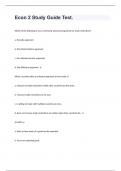
Econ 2 Study Guide Test. Which of the following is not a commonly-advanced argument for trade restrictions? a. the jobs argument b. the infant-industry argument c. the national-security argument d. the efficiency argument - d When a country takes a unilateral approach to free trade, it a. reduces its trade restrictions while other countries do the same. b. removes trade restrictions on its own. c. is willing to trade with multiple countries at once. d. does not remove trade restrictions no matter what other countries do. - b A tariff is a a. limit on how much of a good can be exported. b. tax on an exported good. c. tax on an imported good. d. limit on how much of a good can be imported. - c Some goods can be produced at low cost only if they are produced in large quantities. This phenomenon is called a. economies of production. b. marginal cost of production. c. economies of scale. d. marginal benefit of size. - c The North American Free Trade Agreement a. is an example of the unilateral approach to free trade. b. eliminated tariffs on imports to North America from the rest of the world. c. reduced trade restrictions among Canada, Mexico and the United States. d. All of the above are correct. - c The problem with the protection-as-a-bargaining-chip argument for trade restrictions is a. if it works producer surplus falls. b. if it fails total surplus will increase. c. if it works consumer surplus will decline. d. if it fails the country faces a choice between two bad options. - d The price of a good that prevails in a world market is called the a. absolute price. b. relative price. c. world price. d. comparative price. - c The General Agreement on Tariffs and Trade (GATT) was initiated in response to a. in increase in exports of low-priced goods from developing countries to developed countries. b. high tariffs imposed during the Great Depression of the 1930s. c. the replacement of manufacturing jobs with service jobs in developed countries. d. economic dislocations caused by the North American Free Trade Agreement (NAFTA) in the 1990s. - b A quota is a. a tax on exports to other countries. b. an excess of exports over imports. c. a tax placed on imports. d. a limit on the quantity of imports. - d Economists view the fact that Florida grows oranges, Texas pumps oil, and California makes wine as a. confirmation of the virtues of free trade. b. confirmation that specialization in absolute advantage works. c. confirmation of the infant-industry argument. d. confirmation that free trade agreements are not necessary. - a When a country takes a multilateral approach to free trade, it - reduces its trade restrictions while other countries do the same. GDP a. is not used to monitor the performance of the overall economy but is the single best measure of a society's economic well-being. b. is used to monitor the performance of the overall economy but is not the single best measure of a society's economic well-being.
Información del documento
- Subido en
- 6 de junio de 2024
- Número de páginas
- 26
- Escrito en
- 2023/2024
- Tipo
- Examen
- Contiene
- Preguntas y respuestas

