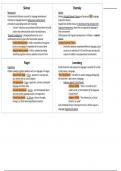
Skinner Chomsky
- Behaviourist - Nativist
- Environmental influence accounts for language development - Heavily criticised Skinner’s theory and proposed LAD (Language
- Child learns language based on behaviourist reinforcement Acquisition Device)
principles by associating words with meanings - Argued that children have an in-built device that activates their
- ‘Correct’ utterances are positively reinforced when the child linguistic development, when they are exposed to language in
realises the communicative value of words/phrases their environment
- ‘Operant Conditioning’ = changing behaviour by use of - LAD proposes that linguistic development in children is a natural
reinforcement which is given after the desired response process
- Positive Reinforcement = child is rewarded by being given - Universal Grammar Theory
praise; encouraging the repetition of the correct form - Similarities between completely different languages; basic
- Negative Reinforcement = child is rewarded by having structure of sentences (S-V-O) and the ways we naturally
something negative remove; repetition of correct form acquire the ability to use grammatical constructions
Piaget Lenneberg
- Cognitivism - Social interaction and exposure to language is essential for a child
- Children develop cognitive abilities such as a language in 4 stages; to fully master a language
- Sensorimotor Stage = 0-2yrs - egocentric, concrete lexis, - ‘The Critical Period’ = the ability to acquire language biologically,
uses senses and can classify objects the ideal time + age to learn a language
- Pre-Operational = 2-6yrs - egocentric, animism, developed - Evidence against Critical Period;
language and motor skills - Aitchison (1989) - “there is no evidence of a
- Concrete Operational = 6-11yrs - can think logically about sudden onset, or final endpoint of the supposed
concrete events, language ceases to be egocentric Critical Period”
- Formal Operational = 11-16+ yrs - abstract thoughts - Singleton (1989) - “the evidence for a Critical
emerge, can think about hypothetical situations Period is too weak”
- Early childhood (0-5yrs) is the best time for a child to acquire a
language (Supported by Genie)
- Behaviourist - Nativist
- Environmental influence accounts for language development - Heavily criticised Skinner’s theory and proposed LAD (Language
- Child learns language based on behaviourist reinforcement Acquisition Device)
principles by associating words with meanings - Argued that children have an in-built device that activates their
- ‘Correct’ utterances are positively reinforced when the child linguistic development, when they are exposed to language in
realises the communicative value of words/phrases their environment
- ‘Operant Conditioning’ = changing behaviour by use of - LAD proposes that linguistic development in children is a natural
reinforcement which is given after the desired response process
- Positive Reinforcement = child is rewarded by being given - Universal Grammar Theory
praise; encouraging the repetition of the correct form - Similarities between completely different languages; basic
- Negative Reinforcement = child is rewarded by having structure of sentences (S-V-O) and the ways we naturally
something negative remove; repetition of correct form acquire the ability to use grammatical constructions
Piaget Lenneberg
- Cognitivism - Social interaction and exposure to language is essential for a child
- Children develop cognitive abilities such as a language in 4 stages; to fully master a language
- Sensorimotor Stage = 0-2yrs - egocentric, concrete lexis, - ‘The Critical Period’ = the ability to acquire language biologically,
uses senses and can classify objects the ideal time + age to learn a language
- Pre-Operational = 2-6yrs - egocentric, animism, developed - Evidence against Critical Period;
language and motor skills - Aitchison (1989) - “there is no evidence of a
- Concrete Operational = 6-11yrs - can think logically about sudden onset, or final endpoint of the supposed
concrete events, language ceases to be egocentric Critical Period”
- Formal Operational = 11-16+ yrs - abstract thoughts - Singleton (1989) - “the evidence for a Critical
emerge, can think about hypothetical situations Period is too weak”
- Early childhood (0-5yrs) is the best time for a child to acquire a
language (Supported by Genie)