Microbiology and Parasitology Test Questions with 100% Complete Solutions Graded to Pass
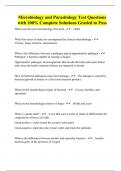
When was the term microbiology first used - 1860s What four areas of study are encompassed by clinical microbiology - Viruses, fungi, bacteria, and parasites What is the difference between a pathogen and an opportunistic pathogen - Pathogen: a bacteria capable of causing a disease Opportunistic pathogen: microorganisms that invade the body and cause illness only when the body's immune defense are impaired or absent How do bacterial pathogens cause host damage - The damage is caused by bacterial growth in tissues or y the toxins bacteria produce What are the morphological types of bacteria - Coccus, bacillus, and spirochete What are the morphological forms of fungi - Molds and yeast What is a gram stain? - A test that uses a series of stains to differentiate the composition of their cell walls Gram positive- violet (retain the crystal violet stain) Gram negative- pink (lose the crystal violet and retain the safranin) What is the difference between aerobic and anaerobic bacteria - Aerobic bacteria grow in the presence of oxygen Anaerobic bacteria grow in the absence or decreased levels of oxygen How are viruses different from microorganisms? Name 3 viral diseases - Viruses are not living cells, and can only replicate by invading a cell, viruses can only contain either a DNA or RNA not both Epstein-Barr virus (mono), rubella, rhinoviruses What type of specimen is used to detect malaria and giardia - Malaria requires blood specimen Giardia requires fecal specimen Five methods used to help identify bacteria - microscopic morphology- coccus, bacillus, spirochete colony morphology- how the colony grows on the plate reactions with Gram stain and other stains, biochemical reactions, gene probes antibody reactions- antibiotic susceptibility testing antibiotic susceptibility testing - can be routine like strep only works for bacteria finding the minimum inhibitory concentration (MIC) to inhibit the bacterial growth fastidious bacteria - bacteria that require special nutritional factors to survive
Información del documento
- Subido en
- 5 de junio de 2024
- Número de páginas
- 8
- Escrito en
- 2023/2024
- Tipo
- Examen
- Contiene
- Preguntas y respuestas