
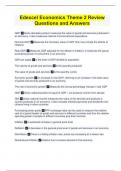
Edexcel Economics Theme 2 Review Questions and Answers GDP ✅Gross domestic product measures the value of goods and services produced in an economy, it also measures national income/national expenditure Nominal GDP ✅Measures the monetary value of GDP (this may include the effects of inflation) Real GDP ✅Measures GDP adjusted for the effects of inflation, it measures the actual purchasing power of consumers in an economy GDP per capita ✅Is the level of GDP divided by population The volume of goods and services ✅Is the quantity produced The value of goods and services ✅Is the quantity x price Economic growth ✅An increase in real GDP, referring to an increase in the total value of goods and services produced in an economy The rate of economic growth ✅Measures the annual percentage change in real GDP GNP ✅Gross national product is equal to GDP + net property income from abroad GNI ✅Gross national income measures the value of the services and products a country produces in an economy, it also includes interest payments and dividends from citizens living in other countries Purchasing power parity ✅PPP exchange rates can be used to measure the relative cost of a typical basket of goods and services in different countries and thus the relative spending power of people in different countries give their incomes Inflation ✅A sustained increase in general price level Deflation ✅A decrease in the general price level of goods and services in an economy Disinflation ✅There is a falling inflation rate, prices are increasing at a slower rate Demand -pull inflation ✅Inflation due to excess demand in the economy Cost- push inflation ✅Inflation due to increases in costs of production Money supply ✅Stock of notes and coins plus bank deposits Velocity of circulation ✅Number of times money changes hands Unemployment ✅People who are willing and able to work but who do not have a job Underemployment ✅Workers that are highly skilled but working in low paying jobs, workers that are highly skilled but work in low skill jobs and part -time workers that would prefer to be full time Economic inactivity ✅This occurs when people are not in the labour force, they are neither in work nor looking for work Claimant count ✅Unemployment statistics which are produced based on the number of people claiming benefits Frictional unemployment ✅Unemployment which reflects job turnover in the labour market, caused by people moving between jobs Structural unemployment ✅This is unemployment due to a mismatch of skills in the labour market, it can be caused by occupational and geographical immobilities Classical/ Real wage unemployment ✅This occurs when wages in a competitive labour market are pushed above the equilibrium Demand deficient/ Cyclical unemployment ✅This occurs when there is insufficient demand in an economy for all workers who wish to work at current wage rates to obtain a job Voluntary unemployment ✅Generous unemployment benefits may encourage people to stay on benefits rather than get work Seasonal unemployment ✅Jobs which are seasonal in nature Full employment ✅When there is no cyclical unemployment, some workers will be fractionally or structurally unemployed even at the full employment level of GDP Balance of payments ✅Records all financial transactions between the UK and the rest of the world, it shows receipts from trade and is equal to the current account added to the capital account
Vista previa 2 fuera de 5 páginas
Examen
Edexcel Economics Theme 2 Review Questions and Answers
Vista previa 2 fuera de 5 páginas
GDP Gross domestic product measures the value of goods and services produced in an economy, it also measures national income/national expenditure Nominal GDP Measures the monetary value of GDP (this may include the effects of inflation) Real GDP Measures GDP adjusted for the effects of inflation, it measures the actual purchasing power of consumers in an economy GDP per capita Is the level of GDP divided by population The volume of goods and services Is the quantity produced The value of goods and services Is the quantity x price Economic growth An increase in real GDP, referring to an increase in the total value of goods and services produced in an economy The rate of economic growth Measures the annual percentage change in real GDP GNP Gross national product is equal to GDP + net property income from abroad GNI Gross national income measures the value of the services and products a country produces in an economy, it also includes interest payments and dividends from citizens living in other countries Purchasing power parity PPP exchange rates can be used to measure the relative cost of a typical basket of goods and services in different countries and thus the relative spending power of people in different countries give their incomes Inflation A sustained increase in general price level
Vista previa del contenido
Información del documento
- Subido en
- 4 de junio de 2024
- Número de páginas
- 5
- Escrito en
- 2023/2024
- Tipo
- Examen
- Contiene
- Preguntas y respuestas
$10.49
¿Documento equivocado? Cámbialo gratis
Dentro de los 14 días posteriores a la compra y antes de descargarlo, puedes elegir otro documento. Puedes gastar el importe de nuevo.
Escrito por estudiantes que aprobaron
Inmediatamente disponible después del pago
Leer en línea o como PDF

