
Edexcel A -level Economics Theme 1 -4 Examination Questions and Answers Economics ✅The study of the allocation of scarce resources. Economic Goods ✅Resources that are scarce. Short Run ✅A time period where at least one factor of production is fixed. Long Run ✅A time period where all factors of production are variable. Productivity ✅The output per unit of input. The Economic Problem ✅Resources are scarce but wants are infinite. Scarcity ✅The world's resources are limited, there are only limited amounts of land, water, oil, food, etc.. Therefore, resources are scarce. Free Goods ✅Goods that are unlimited in supply and therefore have no opportunity cost. Economic Agents ✅Consumer, Business and Governments. Agents involved in Economic transactions. Production Possibility Frontier ✅The maximum potential output of a combination of goods an economy can achieve when all its resources are fully and efficiently employed, given the level of technology. Opportunity Cost ✅The next best alternative foregone. Economic Growth ✅Increase an economy's productive potential. Capital Goods ✅Goods intended for use in production, rather than by consumers. Consumer Goods ✅Goods designed for use by final consumers. Renewable Resources ✅A resource whose stock level can be replenished naturally over a period of time. Non-renewable Resources ✅A resource whose stock level decreases over time as it is consumed. Ceteris Paribus ✅'All other things (factors) remaining the same' The assumption that all other variables within a model remain constant whilst the change is being considered. Positive Statement ✅A statement based on facts which can be tested as true or false and are value -free. Normative Statement ✅A statement based on value judgements which cannot be tested as true or false. Adam Smith ✅The Father of Economics; - The Invisible Hand (workings of the Price Mechanism) - Specialisation - Division of Labour Division of Labour ✅Specialisation of workers on specific tasks in the production process. Specialisation ✅The process of breaking down the production process into steps and then each worker is assigned a step. This would then increase labour productivity (Output per Worker). Barter ✅An exchange of goods/services for other goods/services. - Does not involve money. - Double coincidence of wants. Money ✅Anything which is acceptable to a wide number of people and organisations as payment for goods and services. Free Market Economy ✅Where all resources are privately owned and allocated via the price mechanism. There is minimal government intervention. Command Economy ✅Where there is public ownership of resources and these are allocated by the government. Mixed Economy ✅Where some resources are owned and allocated by the private sector and some by the public sector. Market ✅A channel where goods and services are exchanged. Utility ✅The capacity of a good or service to satisfy some human want. Rational Decision Making ✅Where consumers allocate their expenditure on goods and services to maximize utility, and producers allocate their resources to maximize profits. Demand ✅The quantity of goods or services that will be bought at any given price over a period of time. Demand Curve ✅Shows the quantity of a good or service that would be bought over a range of different price levels in a given period of time. Slopes downward - Price and Quantity have an inverse (negative) relationship. Marginal Utility ✅The additional satisfaction that a consumer gains for consuming one additional unit of a product. Diminishing Marginal Utility ✅As successive units of a good are consumed, the utility gained from each extra unit will fall. % Change ✅y2 - y1 / y1 × 100 Price Elasticity of Demand (PED) ✅The responsiveness of demand to changes in price. The value is always negative. % ∆QD / % ∆P × 100 Unitary Price Elasticity (Ped) ✅Ped = 1 Perfectly Price Inelastic (Ped) ✅Ped = 0 Price Inelastic (Ped) ✅Ped is < 1 Perfectly Price Elastic (Ped) ✅Ped = ∞ Price Elastic (Ped) ✅Ped is > 1 Total Revenue ✅Price × Quantity Income Elasticity of Demand (YED) ✅The responsiveness of demand to changes in income. %∆QD / %∆Y × 100 Negative - Inferior Good (Y increases, QD decreases) Positive - Normal Good (Y increases, QD increases). Negative Income Elasticity of Demand ✅Inferior Good (As income increases, QD decreases) Positive Income Elasticity of Demand ✅Normal Good (As income increases, QD increases) Cross Price Elasticity of Demand (XED) ✅The responsiveness of demand for one good to changes in the price of a related good. (Either substitutes or complements). % ∆ inQD of Good A/ % ∆ in Price of Good B × 100 Negative Value - Complements (The 2 goods are in Joint Demand; as the Price of Good A increases the Demand of Good B decreases). Positive Value - Substitutes (The 2 goods are in Competitive Demand; as the Price of Good A increases, the Demand of Good B increases.) Negative Cross Price Elasticity of Demand ✅Complements (As the Price of one good increases, the Demand for the second good decreases) The 2 goods are in Joint Demand. Positive Cross Price Elasticity of Demand ✅Substitutes (As the Price of one good increases, the Demand for the second good increases) The 2 goods are in Competitive Demand. Supply ✅The quantity of a good or service that firms are willing to sell at a given price over a given period of time. Supply Curve ✅Shows the quantity of a good or service that firms are willing to sell to a market over a range of different price levels in a given period of time. An upward sloping curve - Price and Supply have a direct relationship. Price Elasticity of Supply ✅The responsiveness of supply to changes in price. Pes = %∆QS / %∆P Equilibrium Price ✅The price at which the Quantity Demanded and Quantity Supplied are equal, ceteris paribis. "Market Clearing Price" Excess Supply ✅Where the QS exceeds the QD for a good at the current market price. QS > QD Excess Demand ✅When the QD exceeds the QS for a good at the current market price. QD > QS
Vista previa 4 fuera de 37 páginas
Examen
Edexcel A-level Economics Theme 1-4 Examination Questions and Answers
Vista previa 4 fuera de 37 páginas
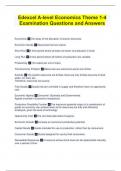
Economics The study of the allocation of scarce resources. Economic Goods Resources that are scarce. Short Run A time period where at least one factor of production is fixed. Long Run A time period where all factors of production are variable. Productivity The output per unit of input. The Economic Problem Resources are scarce but wants are infinite. Scarcity The world's resources are limited, there are only limited amounts of land, water, oil, food, etc.. Therefore, resources are scarce. Free Goods Goods that are unlimited in supply and therefore have no opportunity cost. Economic Agents Consumer, Business and Governments. Agents involved in Economic transactions. Production Possibility Frontier The maximum potential output of a combination of goods an economy can achieve when all its resources are fully and efficiently employed, given the level of technology. Opportunity Cost The next best alternative foregone. Economic Growth Increase an economy's productive potential. Capital Goods Goods intended for use in production, rather than by consumers. Consumer Goods Goods designed for use by final consumers. Renewable Resources A resource whose stock level can be replenished naturally over a period of time.
Vista previa del contenido
Información del documento
- Subido en
- 4 de junio de 2024
- Número de páginas
- 37
- Escrito en
- 2023/2024
- Tipo
- Examen
- Contiene
- Preguntas y respuestas
$17.49
¿Documento equivocado? Cámbialo gratis
Dentro de los 14 días posteriores a la compra y antes de descargarlo, puedes elegir otro documento. Puedes gastar el importe de nuevo.
Escrito por estudiantes que aprobaron
Inmediatamente disponible después del pago
Leer en línea o como PDF

