CPPA Concepts with Complete Solutions
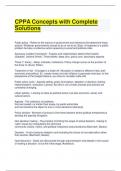
CPPA Concepts with Complete Solutions Public policy - Refers to the actions of government and intentions that determine those actions. Whatever governments choose to do or not to do (Dye). A response to a public problem but also a collective action spawning a social and political order. Advocacy coalition framework - Experts and implementers defend their beliefs (Sabatier, Jenkins-Smith). Three beliefs: deep core, policy core, secondary aspects. Three "I" theory - Ideas, interests, institutions. Policy change occurs at the junction of the three I's (Surel, Palier). Treatment of risk - A budget is a trade-off. Allocation is related to different risks, both economic and political. Ex. create money and risk inflation to generate revenues. In this perspective of the budget balance, you have to consider trade-offs. Public policy cycle - Agenda setting, policy formulation, adoption or decision-making, implementation, evaluation (Jones). But this is not a linear process and policies are constantly changing. Urban politics - Looking at cities as political actors, but also economic, social, and cultural actors. Agenda - The collection of problems that are treated, no matter their scope, by public authorities and are therefore the object of one or more decisions (Garraud). Policy window - Moment of juncture of the three streams where political entrepreneurs develop the agenda (Kingdon). Non-decision making - The practice of limiting the scope of actual decision- making to "safe" issues by manipulating the dominant community values, myths, and political institutions and procedures (Bachrach, Baratz). Decision - A set of actions related to and including the choice of one alternative rather than another (Bachrach, Baratz). Goal discovery - Goals are discovered through argumentation and debate in the course of making a decision, not at the initial stage (Anderson). Avoidance of failures - Decision-makers choose an alternative knowing that it has low probability of success, even if unattractive (Anderson). Implementation - Multiple chains of decisions where policy goals are re-interpreted, enacted, and through which reality is transformed (Pressman, Wildavsky). Street-level bureaucrats - Public service workers who interact directly with citizens in the course of their jobs, and who have substantial discretion in the execution of their work. Policy evaluation - Ex ante, in itinere, or ex post. Participative or expertise. The way you conduct your evaluation, its methodology, matters as much as its results. What should evaluation encompass a measure of? - Outputs: what is produced. Outcomes: actual results being enforced based on the different outputs. Impacts: consequences of outcomes, in the short or long terms. Evaluation crtieria - Pertinence, effectiveness, efficacy, efficiency, sustainability. Digital-era governance - Goes through a reintegration of functions into the govt sphere, a reorganization of the state according to diff clienteles to foster customer oriented reforms, and a digitalization of services and admin processes (Dunleavy). Double loop learning - First loop is the way you conduct PP's and sometimes their goals. Second loop is the assumptions behind the goals and principles of action (Argyris, Schon). Incrementalism - Policies are evolving step by step, process of interaction of the plurality of actors and mutual adaptation of goals instruments and resources (Lindblom). Path dependency - When effects become causes (Pierson). Increasing returns - The more you advance, the more learning and adjustments there are (Palier). Punctuated equilibrium - Radical policy change due to events. Gradual change - Slow changes that accumulate. The state - An autonomous political form. A monopoly of legitimate use of physical force (Weber) and military and fiscal forces. A regulatory system (Majone). Main state competences - Military, monetary and fiscal, police, justice. Modern state dimensions - Territory with borders. Guarantee of safety and well-being. Judicial stable rules. Centralized bureaucracy. Conception of citizenship. State contribution to economic wealth. Modes of claiming legitimacy/authority - Charismatic, traditional, bureaucratic (Weber). Federal - Centralized admin structures. Decentralization - The transfer of powers from central government to lower levels in a political-administrative and territorial hierarchy. Deconcentration - Admin decentralization. Devolution - The transfer of governance responsibility for specified functions to sub-national levels, either publicly or privately owned, that are largely outside the direct control of the central government. Delegation - The transfer of managerial responsibility for specified functions to other public organizations outside normal central government control, whether provincial or local government or parastatal agencies. Government - State that has authority, legal-rational system with norms and rules. Governance - Form of power where the state is an actor among others; multi-level, multi-actor system with multiple scenes and negotiated norms and collaborations. Governmentality - How systems of regulation (public health, education, law, etc.) address the interests of individuals and society at the same time. Institution - Refers to overarching systems of values, traditions, norms, and practices that shape or constrain political behavior (Pierre).
Información del documento
- Subido en
- 3 de junio de 2024
- Número de páginas
- 4
- Escrito en
- 2023/2024
- Tipo
- Examen
- Contiene
- Preguntas y respuestas