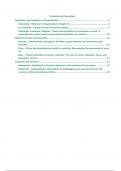
Creativity and Innovation
Innovation and Creativity in Organizations.......................................................................................... 2
Greenberg - Behavior in Organizations Chapter 6.......................................................................2
Jex and Britt - Chapter 5 only innovation section........................................................................ 7
Hülsheger, Anderson, Salgado - Team-level predictors of innovation at work: A
comprehensive meta-analysis spanning three decades of research..................................... 10
Negative Factors and Creativity........................................................................................................... 11
Janssen - Job demands, perceptions of effort reward fairness and innovative work
behavior................................................................................................................................................11
Zhou - When job dissatisfaction leads to creativity: Encouraging the expression of voice.
11
Baas - When prevention promotes creativity: The role of mood, regulatory focus, and
regulatory closure............................................................................................................................. 11
Creativity and Deviance.......................................................................................................................... 11
Mainemelis - Stealing fire: Creative deviance in the evolution of new ideas..................... 11
Globocnik - Organizational antecedents to bootlegging and consequences for the
newness of the innovation portfolio............................................................................................. 12
,Innovation and Creativity in Organizations
Greenberg - Behavior in Organizations Chapter 6
Creativity in Individuals and Teams
Components of Individual and Team Creativity: Creativity is defined as the process by which
individuals or teams produce novel and useful ideas. It is composed of 3 components. When
skills in the task domain, skills in creative thinking, and intrinsic task motivation are high,
people are the most creative. It has been claimed that there is a multiplicative relationship
among these three components. People will not be creative at all if any one of these elements
is at zero.
● Domain-Relevant Skills: Specific skills and abilities are required to perform a task at a
basic level. Those constitute the raw materials needed for creativity to occur. Like
knowing how to play guitar to write a song.
● Creativity-Relevant Skills: Being creative also requires special abilities that help people
approach the thing they do in novel ways. There are several things that can help foster
creativity:
○ Breaking mental sets and taking a new perspective. This involves divergent
thinking which is the process of reframing familiar problems in unique ways,
producing multiple or alternative answers from available information.
○ Understanding complexities.
○ Keeping options open and avoiding premature judgements.
○ Follow creativity heuristics, it helps people approach tasks in novel ways.
○ Use productive forgetting. It is abandoning unproductive ideas and temporarily
putting aside stubborn problems until new approaches can be considered.
● Intrinsic Task Motivation: For someone to be creative they have to be interested in the
task, a high degree of intrinsic task motivation is needed. Intrinsic task motivation is the
doing the task because it is interesting or engaging, and it tends to be high under
several conditions → personal interest in the task, an individual has to perceive that
they have internal reasons to be performing the task.
A Model of the Creative Process:
1. People are at their most creative when they have made suitable preparations, instead of
waiting for ideas to come out of nowhere. This involves gathering relevant info and
concentrating on the problem.
2. Give ideas time to develop and not consciously think about it.
3. The creative idea can get lost if it’s not documented.
4. Assessing the usefulness and quality of an idea requires consciously thinking about it
and verifying it usually with others.
,Promoting Creativity in Organizations
● 2 major approaches to promote creativity.
Training People to be Creative: There are skills that anyone can develop to become more
creative. This training involves 2 key practices.
● Encourage openness to new experiences: Creativity requires openness to experience,
companies try to help this by sending employees to thinking expeditions.
● Take the time to understand the problem-maybe: Creativity can’t occur if we don’t
understand the problem fully. This can take time and the time pressure can either
enhance or decrease creativity. The effect of time pressure on an individual depends on
openness to experience and (organization’s) support for creativity. Moderate time
pressure is the best as long as those dependents are met, inverted U-shape because
low pressure is not stimulating enough, however, high time pressure means that
individuals won’t have enough time to be creative.
, Developing Creative Work Environments
● Provide autonomy: People are creative when they have autonomy and are empowered
to make decisions.
● Provide exposure to other creative people: It is inspirational for other people and they
can learn creativity-relevant skills → creativity. According to a study, this effect depends
on whether an individual is closely monitored by their supervisor. It was shown that the
presence of creative coworkers encouraged creativity when monitoring was low. This
can be due to the reluctance to take chances when being highly monitored.
● Allow ideas to cross-pollinate: People who work on several projects are likely to come
into contact with different people and have a chance of applying to one project an idea
they picked up on another one.
● Make jobs intrinsically interesting.
● Set your own creative goals: Having the freedom to make your own decisions.
● Support creativity at high organizational levels: Supervisors, team leaders, and top
executives must encourage employees to take risks if they are to have any chance of
being creative. At the same time, this involves accepting any failures that result.
● Promote diversity: Companies with ethnically diverse workforces are inclined to have
cultures that allow creativity to flourish. Adjustments for them to work together in
harmony have to be made. Doesn’t ensure creativity, but it can help.
The Process of Innovation
● Innovation is defined as the process of making changes to something already
established by introducing something new. Innovation is the successful implementation
of creative ideas within an organization. Whereas creativity involves coming up with
new ideas, innovation involves putting them into action and successfully implementing
them.
Major Forms of Innovation: It is possible to differentiate among the several forms of innovation
with respect to 3 key factors.
● Impact on existing business: Innovation can either have minor or significant impact on
existing business and they come in the form of “sustaining innovation” or “disruptive
innovation.” Sustaining innovation is a form of innovation that is incremental in nature;
innovation that allows companies to approach their markets in the same manner as
they have done in the past. On the opposite side of the continuum disruptive innovation
is a form of innovation that is so extreme in nature that it changes the market in which
companies operate. Disruptive innovation is desirable for the company that produces it,
but it is disruptive to competitors.
● Degree of uncertainty: Incremental innovation is taking a slow-and-steady approach to
innovation, making small innovations at a time and creating a certain future with it.
Innovation and Creativity in Organizations.......................................................................................... 2
Greenberg - Behavior in Organizations Chapter 6.......................................................................2
Jex and Britt - Chapter 5 only innovation section........................................................................ 7
Hülsheger, Anderson, Salgado - Team-level predictors of innovation at work: A
comprehensive meta-analysis spanning three decades of research..................................... 10
Negative Factors and Creativity........................................................................................................... 11
Janssen - Job demands, perceptions of effort reward fairness and innovative work
behavior................................................................................................................................................11
Zhou - When job dissatisfaction leads to creativity: Encouraging the expression of voice.
11
Baas - When prevention promotes creativity: The role of mood, regulatory focus, and
regulatory closure............................................................................................................................. 11
Creativity and Deviance.......................................................................................................................... 11
Mainemelis - Stealing fire: Creative deviance in the evolution of new ideas..................... 11
Globocnik - Organizational antecedents to bootlegging and consequences for the
newness of the innovation portfolio............................................................................................. 12
,Innovation and Creativity in Organizations
Greenberg - Behavior in Organizations Chapter 6
Creativity in Individuals and Teams
Components of Individual and Team Creativity: Creativity is defined as the process by which
individuals or teams produce novel and useful ideas. It is composed of 3 components. When
skills in the task domain, skills in creative thinking, and intrinsic task motivation are high,
people are the most creative. It has been claimed that there is a multiplicative relationship
among these three components. People will not be creative at all if any one of these elements
is at zero.
● Domain-Relevant Skills: Specific skills and abilities are required to perform a task at a
basic level. Those constitute the raw materials needed for creativity to occur. Like
knowing how to play guitar to write a song.
● Creativity-Relevant Skills: Being creative also requires special abilities that help people
approach the thing they do in novel ways. There are several things that can help foster
creativity:
○ Breaking mental sets and taking a new perspective. This involves divergent
thinking which is the process of reframing familiar problems in unique ways,
producing multiple or alternative answers from available information.
○ Understanding complexities.
○ Keeping options open and avoiding premature judgements.
○ Follow creativity heuristics, it helps people approach tasks in novel ways.
○ Use productive forgetting. It is abandoning unproductive ideas and temporarily
putting aside stubborn problems until new approaches can be considered.
● Intrinsic Task Motivation: For someone to be creative they have to be interested in the
task, a high degree of intrinsic task motivation is needed. Intrinsic task motivation is the
doing the task because it is interesting or engaging, and it tends to be high under
several conditions → personal interest in the task, an individual has to perceive that
they have internal reasons to be performing the task.
A Model of the Creative Process:
1. People are at their most creative when they have made suitable preparations, instead of
waiting for ideas to come out of nowhere. This involves gathering relevant info and
concentrating on the problem.
2. Give ideas time to develop and not consciously think about it.
3. The creative idea can get lost if it’s not documented.
4. Assessing the usefulness and quality of an idea requires consciously thinking about it
and verifying it usually with others.
,Promoting Creativity in Organizations
● 2 major approaches to promote creativity.
Training People to be Creative: There are skills that anyone can develop to become more
creative. This training involves 2 key practices.
● Encourage openness to new experiences: Creativity requires openness to experience,
companies try to help this by sending employees to thinking expeditions.
● Take the time to understand the problem-maybe: Creativity can’t occur if we don’t
understand the problem fully. This can take time and the time pressure can either
enhance or decrease creativity. The effect of time pressure on an individual depends on
openness to experience and (organization’s) support for creativity. Moderate time
pressure is the best as long as those dependents are met, inverted U-shape because
low pressure is not stimulating enough, however, high time pressure means that
individuals won’t have enough time to be creative.
, Developing Creative Work Environments
● Provide autonomy: People are creative when they have autonomy and are empowered
to make decisions.
● Provide exposure to other creative people: It is inspirational for other people and they
can learn creativity-relevant skills → creativity. According to a study, this effect depends
on whether an individual is closely monitored by their supervisor. It was shown that the
presence of creative coworkers encouraged creativity when monitoring was low. This
can be due to the reluctance to take chances when being highly monitored.
● Allow ideas to cross-pollinate: People who work on several projects are likely to come
into contact with different people and have a chance of applying to one project an idea
they picked up on another one.
● Make jobs intrinsically interesting.
● Set your own creative goals: Having the freedom to make your own decisions.
● Support creativity at high organizational levels: Supervisors, team leaders, and top
executives must encourage employees to take risks if they are to have any chance of
being creative. At the same time, this involves accepting any failures that result.
● Promote diversity: Companies with ethnically diverse workforces are inclined to have
cultures that allow creativity to flourish. Adjustments for them to work together in
harmony have to be made. Doesn’t ensure creativity, but it can help.
The Process of Innovation
● Innovation is defined as the process of making changes to something already
established by introducing something new. Innovation is the successful implementation
of creative ideas within an organization. Whereas creativity involves coming up with
new ideas, innovation involves putting them into action and successfully implementing
them.
Major Forms of Innovation: It is possible to differentiate among the several forms of innovation
with respect to 3 key factors.
● Impact on existing business: Innovation can either have minor or significant impact on
existing business and they come in the form of “sustaining innovation” or “disruptive
innovation.” Sustaining innovation is a form of innovation that is incremental in nature;
innovation that allows companies to approach their markets in the same manner as
they have done in the past. On the opposite side of the continuum disruptive innovation
is a form of innovation that is so extreme in nature that it changes the market in which
companies operate. Disruptive innovation is desirable for the company that produces it,
but it is disruptive to competitors.
● Degree of uncertainty: Incremental innovation is taking a slow-and-steady approach to
innovation, making small innovations at a time and creating a certain future with it.