MGT 3620 Midterm Exam Questions And Answers (Verified And Updated)
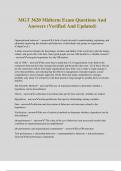
MGT 3620 Midterm Exam Questions And Answers (Verified And Updated) Organizational behavior* - answerA field of study devoted to understanding, explaining, and ultimately improving the attitudes and behaviors of individuals and groups in organizations (Colquitt et al.). A firms resources includes the knowledge, wisdom, and ability of the work force, plus the image, culture, and good will of the firm. Since good people are rare, OB should be a valuable resource* - answerconceptual arguments for why OB matters rule of 1/8th* - answerOne must bear in mind that 1/2 of organizations won't believe the connection between how they manage their people and the profits they earn. 1/2 of those who do see the connection will do what many organizations have done--try to make a single change to solve their problems, not realizing that the effective management of people requires a more comprehensive and systematic approach. Of the firms that make comprehensive changes, probably only about 1/2 will persist with their practices long enough to actually derive economic benefits. The Scientific Method* - answerthe use of statistical methods to determine whether a hypothesis can be disconfirmed. Theory - answera collection of assertions that specify how and why variables are related. Hypotheses - answerwritten predictions that specify relationships among variables. Data - answercollection and observation of behaviors and outcomes related to the hypotheses. Verification - answerthe use of statistical methods to determine whether a hypothesis can be disconfirmed. job performance* - answer"The value of the set of behaviors (not necessarily results) that contribute to organizational goal accomplishment" job performance and organizational commitment* - answerkey OB outcomes Task performance + citizenship behaviors - counterproductive behaviors = job performance - answerJob performance components task performance* - answerthe employee behaviors directly involved in transforming organizational resources into the goods or services an organization produces (i.e., the behaviors included in one's job description) citizenship behaviors* - answervoluntary activities that may not be rewarded but that contribute to the organization by improving the quality of the setting where work occurs" counterproductive behaviors* - answer"employee behaviors that intentionally hinder organizational goal accomplishment" Production deviance* - answerWasting resources Substance abuse Property deviance* - answerSabotage theft Political deviance* - answerGossiping incivility Personal aggression* - answerHarassment Abuse organizational commitment - answer"A desire on the part of an emplyee to remain a member of an organization" Management by objectives (MBO) - answera management philosophy that bases an employee's evaluations on whether the employee achieves specific performance goals. behaviorally anchored rating scales (BARS) - answermeasures performance by directly assessing job performance behaviors. approach uses "critical incidents"—short descriptions of effective and ineffective behaviors—to create a measure that can be used to evaluate employee performance. The 360-degree feedback approach involves - answercollecting performance information not just from the supervisor but from anyone else who might have firsthand knowledge about the employee's performance behaviors. These other sources of performance information typically include the employee's subordinates, peers, and customers. With the exception of the supervisor's ratings, the ratings are combined so that the raters can remain anonymous to the employee Forced Ranking - answerManagers were required to rank all of their subordinates, and the rankings were used to place employees in one of three categories: the top 20 percent (A players), the vital middle 70 percent (B players), or the bottom 10 percent (C players). T Affective commitment - answer"A desire to remain a member of an organization due to an emotional attachment to, and involvement w
Información del documento
- Subido en
- 29 de mayo de 2024
- Número de páginas
- 13
- Escrito en
- 2023/2024
- Tipo
- Examen
- Contiene
- Preguntas y respuestas