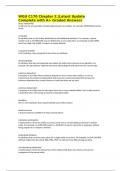
WGU C170 Chapter 2.|Latest Update Complete with A+ Graded Answers
WGU C170 Chapter 2.|Latest Update Complete with A+ Graded Answers binary relationship An ER term for an association (relationship) between two entities. For example, PROFESSOR teaches CLASS. cardinality An attribute that can be further subdivided to yield additional attributes. For example, a phone number such as may be divided into an area code (615), an exchange number (898), and a four-digit code (2368). Compare to simple attribute. composite identifier In ER modeling, a key composed of more than one attribute. derived attribute An attribute that does not physically exist within the entity and is derived via an algorithm. For example, the Age attribute might be derived by subtracting the birth date from the current date. existence-dependent A property of an entity whose existence depends on one or more other entities. In such an environment, the existence-independent table must be created and loaded first because the existence-dependent key cannot reference a table that does not yet exist. existence-independent A property of an entity that can exist apart from one or more related entities. Such a table must be created first when referencing an existence-dependent table. identifiers One or more attributes that uniquely identify each entity instance. iterative process A process based on repetition of steps and procedures. mandatory participation A relationship in which one entity occurrence must have a corresponding occurrence in another entity. For example, an EMPLOYEE works in a DIVISION. (A person cannot be an employee without being assigned to a company's division.) multivalued attributes An attribute that can have many values for a single entity occurrence. For example, an EMP_DEGREE attribute might store the string "BBA, MBA, PHD" to indicate three different degrees held. non-identifying relationship A relationship in which the primary key of the related entity does not contain a primary key component of the parent entity.
Información del documento
- Subido en
- 28 de mayo de 2024
- Número de páginas
- 3
- Escrito en
- 2023/2024
- Tipo
- Examen
- Contiene
- Preguntas y respuestas