
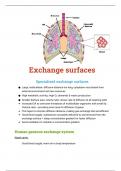
Exchange surfaces
Specialised exchange surfaces
● Large, multicellular: diffusion distance too long, cytoplasm very distant from
external environment and raw resources
● High metabolic activity: high O₂ demands & waste production
● Smaller Surface area: volume ratio: slower rate of diffusion to all respiring cells
➔ Increased SA to overcome limitations of multicellular organisms with small Sa:
Volume ratio = providing more area for diffusion of gases
➔ Thin layers to shorten diffusion distance, making gas exchange fast and efficient
➔ Good blood supply: substances constantly delivered to and removed from the
exchange surface = steep concentration gradient for faster diffusion
➔ Good ventilation to maintain a concentration gradient
Human gaseous exchange system
Nasal cavity
Good blood supply: warm air to body temperature
, 2
Moist surfaces increase humidity of inhaled air and reducing evaporation
Hairy lining secreting mucus: trap dust and bacteria to protect lung tissue from
irritation and infection
Trachea
Incomplete rings of cartilage (strong and flexible):
- Prevent tube from collapsing
- Allow neck to bend and flex as we breathe
- Food can easily pass down the oesophagus
Ciliated epithelium with goblet cells that secrete mucus to trap dust and
microorganisms, which cilia beat and move mucus away from lungs
Bronchi
Similar in structure to trachea but narrower
Supported by cartilage rings
Lined with ciliated epithelium
Bronchioles
Smooth muscle to regulate air flow into lungs by contracting when less air is needed
and relaxing when more air is needed
Thin layer of flattened epithelium allows some gas exchange in narrower bronchioles
Alveoli
○ Elastic fibres in walls stretch as air is drawn in and spring back to their
original shape to help to force out air out of lungs through elastic recoil
= increases surface area
○ Walls made up of a single layer of flattened/squamous epithelium
= short diffusion distance
○ Extensive network of capillaries = good blood supply for steep
concentration gradient btw air in alveoli and blood in capillaries

