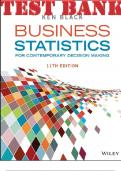
,Business Statistics, 11e (Black)
Chapter 1 Introduction to Statistics
1) Virtually all areas of business use statistics in decision making.
Answer: TRUE
Diff: 1
Response: See section 1.1 Basic Statistical Concepts
Learning Objective: 1.1: List quantitative and graphical examples of statistics within a business
context.
2) Statistics can be used to predict business in the future.
Answer: TRUE
Diff: 1
Response: See section 1.1 Basic Statistical Concepts
Learning Objective: 1.1: List quantitative and graphical examples of statistics within a business
context.
3) Statistics are used to market vitamins.
Answer: TRUE
Diff: 1
Response: See section 1.1 Basic Statistical Concepts
Learning Objective: 1.1: List quantitative and graphical examples of statistics within a business
context.
4) A list of final grades in an introductory class in business is an example of statistics.
Answer: FALSE
Diff: 1
Response: See section 1.1 Basic Statistical Concepts
Learning Objective: 1.1: List quantitative and graphical examples of statistics within a business
context.
5) A graph of purchases made from one store location would be an example of statistics within a
business context.
Answer: TRUE
Diff: 1
Response: See section 1.1 Basic Statistical Concepts
Learning Objective: 1.1: List quantitative and graphical examples of statistics within a business
context.
6) The complete collection of all entities under study is called the sample.
Answer: FALSE
Diff: 1
Response: See section 1.1 Basic Statistical Concepts
Learning Objective: 1.2: Define important statistical terms, including population, sample, and
parameter, as they relate to descriptive and inferential statistics.
1
,7) A portion or subset of the entities under study is called the statistic.
Answer: FALSE
Diff: 1
Response: See section 1.1 Basic Statistical Concepts
Learning Objective: 1.2: Define important statistical terms, including population, sample, and
parameter, as they relate to descriptive and inferential statistics.
8) A descriptive measure of the population is called a parameter.
Answer: TRUE
Diff: 1
Response: See section 1.1 Basic Statistical Concepts
Learning Objective: 1.2: Define important statistical terms, including population, sample, and
parameter, as they relate to descriptive and inferential statistics.
9) A census is the process of gathering data on all the entities in the population.
Answer: TRUE
Diff: 1
Response: See section 1.1 Basic Statistical Concepts
Learning Objective: 1.2: Define important statistical terms, including population, sample, and
parameter, as they relate to descriptive and inferential statistics.
10) Statistics is commonly divided into two branches called descriptive statistics and summary
statistics.
Answer: FALSE
Diff: 1
Response: See section 1.1 Basic Statistical Concepts
Learning Objective: 1.2: Define important statistical terms, including population, sample, and
parameter, as they relate to descriptive and inferential statistics.
11) A descriptive measure of the sample is called a statistic.
Answer: TRUE
Diff: 1
Response: See section 1.1 Basic Statistical Concepts
Learning Objective: 1.2: Define important statistical terms, including population, sample, and
parameter, as they relate to descriptive and inferential statistics.
12) Gathering data from a sample to reach conclusions about the population from which the
sample was drawn is called descriptive statistics.
Answer: FALSE
Diff: 2
Response: See section 1.1 Basic Statistical Concepts
Learning Objective: 1.2: Define important statistical terms, including population, sample, and
parameter, as they relate to descriptive and inferential statistics.
2
, 13) Calculation of population parameters is usually either impossible or excessively time
consuming and costly.
Answer: TRUE
Diff: 1
Response: See section 1.1 Basic Statistical Concepts
Learning Objective: 1.2: Define important statistical terms, including population, sample, and
parameter, as they relate to descriptive and inferential statistics.
14) The basis for inferential statistics is the ability to make decisions about population
parameters without having to complete a census of the population.
Answer: TRUE
Diff: 1
Response: See section 1.1 Basic Statistical Concepts
Learning Objective: 1.2: Define important statistical terms, including population, sample, and
parameter, as they relate to descriptive and inferential statistics.
15) A variable is a numerical description of each of the possible outcomes of an experiment.
Answer: TRUE
Diff: 2
Response: See section 1.1 Basic Statistical Concepts
Learning Objective: 1.3: Explain the difference between variables, measurement, and data.
16) Variables and measurement data are interchangeable terms.
Answer: FALSE
Diff: 2
Response: See section 1.1 Basic Statistical Concepts
Learning Objective: 1.3: Explain the difference between variables, measurement, and data.
17) Measurements occur when a standard process is used to assign numbers to attributes or
characteristics of a variable.
Answer: TRUE
Diff: 2
Response: See section 1.1 Basic Statistical Concepts
Learning Objective: 1.3: Explain the difference between variables, measurement, and data.
18) One piece of data includes a variety of variables.
Answer: FALSE
Diff: 2
Response: See section 1.1 Basic Statistical Concepts
Learning Objective: 1.3: Explain the difference between variables, measurement, and data.
19) A variable can take on different values.
Answer: TRUE
Diff: 1
Response: See section 1.1 Basic Statistical Concepts
Learning Objective: 1.3: Explain the difference between variables, measurement, and data.
3