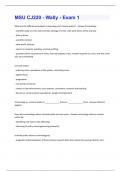
MSU CJ220 - Wally - Exam 1 Questions and Answers with complete solution
What are the differences between criminology and criminal justice? - Answer-Criminology: - scientific study of crime and criminals, etiology of crime: who what where when and why - theory driven - scientific method - ideal world, abstract - careers in research, teaching, criminal profiling - questions about recurrence of crime, how law impacts crime, societal response to crime, and why some acts are criminalized Criminal Justice: - reducing crime, operations of the system, controlling crime - applied focus - pragmatism - real world constraints - careers in law enforcement, court systems, corrections, research and teaching - focuses on criminal justice populations, design and implement Criminology vs. criminal justice is _____________ focus vs. _____________ focus - Answer-abstract; applied How does criminology inform criminal justice and vise versa - Answer-criminology informs criminal justice by: - identifying risk factors with offending - informing CJ policy and programming (research) criminal justice informs criminology by: - pragmatic problematization of theory driven research (tells them when they cant go that far, etc.)Moral entrepreneurs - Answer-the groups who decide what should be considered a crime; determine our laws who exactly are they? - those who have access to resources ($/lobbying), the elite Laws are not ________________, they are _____________ - Answer-objective; moral Formal sanctions vs. Informal sanctions - Answer-formal sanctions: written rule (jail, punishment, probation) informal sanctions: even if never caught, may not get hired somewhere because you're an avid drug user in the community Comte's progression of Knowledge - Answer-comte was describing how the explanations of criminal activity have changed. its gone from a spiritual explanation, to a metaphysical (philosophy) one, to a scientific view Where does criminology currently stand? (on comte's progression) - Answer-it is being studied scientifically Understand the key rationale underlying why certain behaviors are crimes and others aren't - Answer-it depends on society's views and how interprets the morality of the law Evaluating the strength of a theory includes... - Answer-- Scope - Parsimony - Testability - TautologyScope (in regards to strength of a theory) - Answer-range of phenomena that a theory seeks to explain (a theory is better if it is able to explain more; explain more = stronger theory) Parsimony (in regards to strength of a theory) - Answer-the consciousness and abstractness of a set of concepts and propositions (it is best to use as few concepts and propositions as possible to explain the widest range of phenomena) Testability (in regards to strength of a theory) - Answer-ability to be tested by objective, repeatable evidence (has ability to be subject to empirical falsification) Empirical falsification - Answer-findings that may counter or disprove a theory Tautology - Answer-saying the same thing but in different words (when you use x to explain y, but y is the same thing as x) Uniform Crime Report - Answer-official crime statistics of reported criminal activity - trends - measure of crime prevalence in the US strengths: - provides specific details about crime and arrests in communities - anyone has access - uniformity limitations: - didn't track rapes against men - only tracks crimes where a suspect has been found (no cold or unsolved cases) - does not account for unreported crimes - underestimates crime prevalenceSelf-report Surveys - Answer-asks individuals to report how many and what types of crime they have committed over a certain period of time - collects "dark figure of crime" - measures other types of noncriminal self-reported deviance - correlations of crime strengths: - good validity (you ask people directly and get their opinions) - captures information on underestimated population (young adults) limits: - people may not feel comfortable answering honestly - low response rates Dark figure of crime - Answer-the amount of unreported or undiscovered crime The National Crime Victimization Survey - Answer-measures prevalence of victimization and key consequences of victimization in the United States - U.S. households randomly sampled twice per year strengths: - provides data on unreported crime - high response rate and accurate - publicly available limits: - does not track crime that impacts American youth - only collects information about specific criminal conduct - sampling errorsValidity vs. Reliability - Answer-Validity: degree to which your data/instrument claims that it is measuring what it intends to measure Reliability: degree to which your data/findings are replicable Types of validity - Answer-- face - construct - content - criterion
Información del documento
- Subido en
- 21 de mayo de 2024
- Número de páginas
- 10
- Escrito en
- 2023/2024
- Tipo
- Examen
- Contiene
- Preguntas y respuestas