

International management
Lecture 1
Introduction: Porter
Course aims
• To expose you to various theories and tools that can be employed to formulate strategies for
international competitiveness,
• To develop in you the analytical skills to assess differences in strategic market conditions and
institutional environments between countries.
How companies gain
global
competitiveness
Resources: human
talent,
competitiveness.
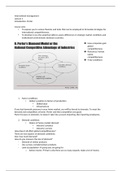
4 key conditions
1. Factor conditions
• Nation’s position in factors of production
• Skilled labor
• Infrastructure
If you feel domestic pressure in your home market, you will be forced to innovate. To meet the
demand and competition at home. Porter said that competition was good.
Porter focuses on domestic, he doesn’t take into account importing, like importing employees.
2. Demand conditions
• Nature of home-market demand
• Industry’s product
• Industry’s service
How does it all affect global competitiveness?
There are two aspects of demand conditions:
Size: how much demand?
How do you measure the size of demand?
- Demand of similar products
- Use a proxy; complementary products
- Look at population group you are going for
o Action movies that is why there are so many sequels; make a lot of money
, 3. Related and supporting industries
• Presence or absence in the nation of internationally competitive
• Supplier industries
• Other related industries
Reliable suppliers.
4. Firm strategy, structure, and rivalry
• Conditions in the nation governing how companies are
• Created
• Organized
• Managed
• Nature of domestic rivalry
Rivalry
In the Netherlands there are only 10 camera types
In Japan more than 200
Competition difference
Answer: B.
Global covers the world every part of the world
International can be your neighbouring country.
Some countries don’t fit in this model anymore. Such as software and pharmaceutical companies.
They don’t have a large demand at home, but do abroad.
,The five forces
1. The Threat of New Entrants:
• Economies of scale
• Product differentiation
• Capital requirements
• Switching costs
• Access to distribution channels
• Cost disadvantages independent of scale
2. The Bargaining Power of Buyers:
• Concentrated or large volume purchases (relative to sales)
• Undifferentiated products
• Low switching costs
• Threat of backward integration
• Low profit
3. The Bargaining Power of Suppliers:
• Industry dominated by few suppliers
• Suppliers sell to several industries
• Suppliers’ input is critical to buyer’s business
• Differentiated products
• Threat of forward integration
4. The Threat of Substitute Products and Services
5. The Intensity of Rivalry among Competitors in an Industry :
• Numerous or equally balanced rivals
• Slow industry growth
• High fixed or storage costs
• Lack of differentiation or switching costs
• High exit barriers
You can combine different frameworks, but you should always include competition in your analysis.
How many competitors do you have and how competitive are they.
High exit barriers social pressure government does not want the company to exit because of a
loss of jobs.
, Bike company, green, E.
Political vs. Legal
Role of government on people vs. rules that are there to enforce the policies.
L = laws and legislations.
Availability of supportive systems = government support
Market size -> population -> S.
Q: In which model and in which ways does this report fit? Why?
India China Taiwan Sri Lanka Hong Kong Pakistan
Results
Market Size* 117,471 143,255 2,509 2,195 756 17,558
(1,065,070,067) (1,298,847,624) (22,749,838) (19,905,165) (6,855,125) (207,774,550)
Tech Savvy NRI Score: 4.03 NRI Score: 4.35 NRI Score: NRI NRI NRI Score:
Rank: 48 Rank: 36 5.30 Score:3.81 Score: 5.19 3.54
Rank: 6 Rank: 66 Rank: 12 Rank: 88
Availability Medium Medium High Low Medium Low
of
Supportive
Systems
Market High Medium High Low High Low
Rivalry
Political Risk CPI: 42 CPI: 40 CPI: 63 CPI: 36 CPI: 77 CPI: 32
80/180 countries 79/180 31/180 95/180 13/180 117/180
countries. countries. countries. countries. countries.
4.9%
7.7% 5.1% 7.1% 6% 7.1%
Reachability India China Taiwan Sri Lanka Hong Kong Pakistan
of
Consumers LPI: 3.42 LPI: 3.66 LPI: 3.70 LPI: N/A LPI:4.07 LPI: 2.92
Rank 35 Rank 27 Rank 25 Rank N/A Rank 9 Rank 68
Lecture 1
Introduction: Porter
Course aims
• To expose you to various theories and tools that can be employed to formulate strategies for
international competitiveness,
• To develop in you the analytical skills to assess differences in strategic market conditions and
institutional environments between countries.
How companies gain
global
competitiveness
Resources: human
talent,
competitiveness.
4 key conditions
1. Factor conditions
• Nation’s position in factors of production
• Skilled labor
• Infrastructure
If you feel domestic pressure in your home market, you will be forced to innovate. To meet the
demand and competition at home. Porter said that competition was good.
Porter focuses on domestic, he doesn’t take into account importing, like importing employees.
2. Demand conditions
• Nature of home-market demand
• Industry’s product
• Industry’s service
How does it all affect global competitiveness?
There are two aspects of demand conditions:
Size: how much demand?
How do you measure the size of demand?
- Demand of similar products
- Use a proxy; complementary products
- Look at population group you are going for
o Action movies that is why there are so many sequels; make a lot of money
, 3. Related and supporting industries
• Presence or absence in the nation of internationally competitive
• Supplier industries
• Other related industries
Reliable suppliers.
4. Firm strategy, structure, and rivalry
• Conditions in the nation governing how companies are
• Created
• Organized
• Managed
• Nature of domestic rivalry
Rivalry
In the Netherlands there are only 10 camera types
In Japan more than 200
Competition difference
Answer: B.
Global covers the world every part of the world
International can be your neighbouring country.
Some countries don’t fit in this model anymore. Such as software and pharmaceutical companies.
They don’t have a large demand at home, but do abroad.
,The five forces
1. The Threat of New Entrants:
• Economies of scale
• Product differentiation
• Capital requirements
• Switching costs
• Access to distribution channels
• Cost disadvantages independent of scale
2. The Bargaining Power of Buyers:
• Concentrated or large volume purchases (relative to sales)
• Undifferentiated products
• Low switching costs
• Threat of backward integration
• Low profit
3. The Bargaining Power of Suppliers:
• Industry dominated by few suppliers
• Suppliers sell to several industries
• Suppliers’ input is critical to buyer’s business
• Differentiated products
• Threat of forward integration
4. The Threat of Substitute Products and Services
5. The Intensity of Rivalry among Competitors in an Industry :
• Numerous or equally balanced rivals
• Slow industry growth
• High fixed or storage costs
• Lack of differentiation or switching costs
• High exit barriers
You can combine different frameworks, but you should always include competition in your analysis.
How many competitors do you have and how competitive are they.
High exit barriers social pressure government does not want the company to exit because of a
loss of jobs.
, Bike company, green, E.
Political vs. Legal
Role of government on people vs. rules that are there to enforce the policies.
L = laws and legislations.
Availability of supportive systems = government support
Market size -> population -> S.
Q: In which model and in which ways does this report fit? Why?
India China Taiwan Sri Lanka Hong Kong Pakistan
Results
Market Size* 117,471 143,255 2,509 2,195 756 17,558
(1,065,070,067) (1,298,847,624) (22,749,838) (19,905,165) (6,855,125) (207,774,550)
Tech Savvy NRI Score: 4.03 NRI Score: 4.35 NRI Score: NRI NRI NRI Score:
Rank: 48 Rank: 36 5.30 Score:3.81 Score: 5.19 3.54
Rank: 6 Rank: 66 Rank: 12 Rank: 88
Availability Medium Medium High Low Medium Low
of
Supportive
Systems
Market High Medium High Low High Low
Rivalry
Political Risk CPI: 42 CPI: 40 CPI: 63 CPI: 36 CPI: 77 CPI: 32
80/180 countries 79/180 31/180 95/180 13/180 117/180
countries. countries. countries. countries. countries.
4.9%
7.7% 5.1% 7.1% 6% 7.1%
Reachability India China Taiwan Sri Lanka Hong Kong Pakistan
of
Consumers LPI: 3.42 LPI: 3.66 LPI: 3.70 LPI: N/A LPI:4.07 LPI: 2.92
Rank 35 Rank 27 Rank 25 Rank N/A Rank 9 Rank 68

