
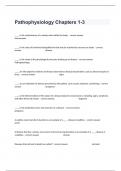
Pathophysiology Chapters 1-3 Assessment Questions And Answers 100% Verified/2024.
____ is the maintainence of a steady state within the body. - correct answer homeostasis ____ is the state of functional disequilibrium that may be resolved by recovery or death. - correct answer disease ____ is the study of the physiological processes leading up to disease. - correct answer Pathophysiology ____ are the objective evidence of disease observed on physical examination, such as abnormal pulse or fever. - correct answer signs ____ are an indication of disease perceived by the patient, such as pain, dizziness, and itching. - correct answer symptoms ____ is the determination of the nature of a disease based on many factors, including, signs, symptoms, and often times lab results. - correct answer diagnosis ____ is the predicted course and outcome of a disease. - correct answer prognosis A sudden onset and short duration is an example of a ____ disease/condition. - correct answer acute A disease that has a slower, less severe onset and a long duration in an example of a ____ disease or condition. - correct answer chronic Diseases that will end in death are called? - correct answer terminal ____ is the period of chronic disease when signs and symptoms subside. - correct answer remission ____ is when signs and symptoms recur in all their severity. - correct answer exacerbation A ____ is when a disease returns weeks or months after its apparent cessation. - correct answer relapse A ____ is a disease or other abnormal state that develops in a person already suffering from a disease. - correct answer complication ____ is a measure of the number of deaths attributed to a disease over a given period of time in a given population. - correct answer mortality ____ is a measure of the disability and extend of illness caused by a disease. - correct answer morbidity ____ is the studyof occurrence, transmission, distribution, and control of a disease. - correct answer epidemiology ____ is the cause of disease. - correct answer etiology If the cause of the disease is unknown it is said to be ____. - correct answer idiopathic A treatment is said to be ____, when it is designed to manage or relieve symptom. - correct answer palliative Immunity - correct answer the ability of the body to defend itself against infections Phagocytosis - correct answer means cell eating or swallowing Leukocytes - correct answer white blood cells Fever - correct answer raised body temperature, a sign of infection fighting Neutrophils - correct answer specialized WBC's that engulfs cell debris in injured tissue Histamine - correct answer damaged tissue releases this substance that causes capillary walls to become more permeable Leukocytosis - correct answer excessive production of WBC's Monocytes - correct answer follows the neutrophils in the process of clearing debris Pyogenic - correct answer pus forming bacteria Lymphocytes - correct answer WBC produced by the lymph nodes, responds to bacteria Antigen - correct answer specific immunity against antigens antibodies Humoral immunity - correct answer specific immunity that includes antibodies Autoimmunity - correct answer occurs when individuals develop antibodies called autoantibodies Lupus - correct answer chronic inflammatory disease that can affect various parts of the body Scleroderma - correct answer autoimmune disease of the connective tissue AIDS - correct answer destroys the individual's immune system, making the patient very susceptible to infection HIV - correct answer a retrovirus, it carries its genetic information as RNA rather than DNA Active immunity - correct answer the patient receives immunity through a vaccine Passive immunity - correct answer patient receives immunity through a dose of preformed antibody From page 29 in the textbook name 5 of the 11 recommended immunizations scheduled for Children ages 0-6 - correct answer Rotavirus From page 29 in the textbook name 5 of the 11 recommended immunizations scheduled for Children ages 0-6 - correct answer Pneumococcal From page 29 in the textbook name 5 of the 11 recommended immunizations scheduled for Children ages 0-6 - correct answer varicella From page 29 in the textbook name 5 of the 11 recommended immunizations scheduled for Children ages 0-6 - correct answer meningococcal From page 29 in the textbook name 5 of the 11 recommended immunizations scheduled for Children ages 0-6 - correct answer Measles, Mumps, Rubella Pathogen - correct answer disease-causing organism Contagious - correct answer diseases transmitted by human contact Noncommunicable - correct answer diseases that cannot be transmitted directly person to person Epidemiology - correct answer study of the transmission, occurrence, distribution of disease Endemic - correct answer when a disease always occurs at low levels in a population Epidemic - correct answer when a disease occurs in unusually large numbers over a specific area Pandemic - correct answer when an epidemic has spread to include several large areas worldwide
Información del documento
- Subido en
- 4 de mayo de 2024
- Número de páginas
- 6
- Escrito en
- 2023/2024
- Tipo
- Examen
- Contiene
- Preguntas y respuestas

