

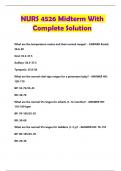
NURS 4526 Midterm With
Complete Solution
What are the temperature routes and their normal ranges? - ANSWER Rectal:
36.6-38
Oral: 35.5-37.5
Axillary: 36.5-37.5
Tympanic: 35.8-38
What are the normal vital sign ranges for a premature baby? - ANSWER HR:
120-170
BP: 55-75/35-45
RR: 40-70
What are the normal VS ranges for infants (1-12 months)? - ANSWER HR:
110-160 bpm
BP: 70-105/35-55
RR: 30-60
What are the normal VS ranges for toddlers (1-3 y)? - ANSWER HR: 70-110
BP: 90-105/55-70
RR: 20-30
,What are the normal VS ranges for 3-6 years? - ANSWER HR: 65-110
BP: 95-110/60-75
RR: 20-25
What are the normal VS ranges for 6-12 years? - ANSWER HR: 60-95
BP: 100-120/60-75
RR: 14-22
What are the normal VS ranges for 12+ years? - ANSWER HR: 55-85
BP: 110-135/65-85
RR: 12-18
What type of endotracheal tube (cuffed or uncuffed) is best for children?
Why? - ANSWER Uncuffed tubes are better as children have a natural funnel
shape to their airway so they don't need the cuff to prevent leaking (as it's
not likely)
What is the difference between Day and Night Croup symptoms? - ANSWER -
Day: Mild cold-like symptoms
- Night: Wake up, agitated, barking cough, can't breath properly
What are the key interventions to remember with epiglottis? - ANSWER -
keep child calm
- safeguard their airway
- IV antibiotics
How is Croup treated (simplified)? - ANSWER - steroids and epinephrine
,- hydration
- monitor respiratory status
What is used to manage and/or treat bronchiolitis? - ANSWER - Salbutamol
(if works; especially with Hx. of asthma)
- Epinephrine
- Hypertonic Saline (7-8%): used for CF pt.; help to mobilize secretions and
cough up mucous (may cause bronchospasm)
- Antibiotics (only if pneumonia or)
What do the three different parts of the PAT triangle mean? - ANSWER
Appearance, Work of Breathing, Circulation to Skin
What does a fully highlighted PAT triangle indicate? - ANSWER
Cardiopulmonary failure (concern fro imminent cardiopulmonary arrest)
What is the difference in the presentation of compensated and
decompensated shock with the PAT triangle? - ANSWER - Compensated:
circulation to the skin is affected
- Decompensated: Appearance and circulation to the skin are affected
How is respiratory failure indicated by the PAT triangle? - ANSWER Issues
with appearance and work of breathing
What are the parts of primary survey (according to the textbook)? - ANSWER
ABCD
- Airway
- Breathing
, - Circulation
- Disability
What are the parts of secondary survey? - ANSWER EFGHI
- Exposure and Environmental Control
- Full Set of Vitals and Family
- Get Resuscitation Adjuncts (Five Interventions)
- History and Head-to-Toe
- Inspect the Posterior Surfaces
What are the 5 interventions for when someone is unstable (LMNOP)? -
ANSWER - L: LABS
(CGC, lytes, Glucose, Renal functions, Coag profile. Specific: Extended lytes,
Liver and Cardiac enzymes, ABGs/VBGs)
- M: Continuous Cardiac MONITORING
- N: NASOGASTRIC tubes, caatheters
- O: Continuous OXYGEN Saturation (SaO2)
- P: PAIN Assessment
What does SSHA stand for? - ANSWER - Stop, Stay, Help, Actions (Nursing)
- For when pt. becomes unstable
What are the parts for assessing Disability? (what do each do?) - ANSWER
Assess Neuro Status
- GCS
Complete Solution
What are the temperature routes and their normal ranges? - ANSWER Rectal:
36.6-38
Oral: 35.5-37.5
Axillary: 36.5-37.5
Tympanic: 35.8-38
What are the normal vital sign ranges for a premature baby? - ANSWER HR:
120-170
BP: 55-75/35-45
RR: 40-70
What are the normal VS ranges for infants (1-12 months)? - ANSWER HR:
110-160 bpm
BP: 70-105/35-55
RR: 30-60
What are the normal VS ranges for toddlers (1-3 y)? - ANSWER HR: 70-110
BP: 90-105/55-70
RR: 20-30
,What are the normal VS ranges for 3-6 years? - ANSWER HR: 65-110
BP: 95-110/60-75
RR: 20-25
What are the normal VS ranges for 6-12 years? - ANSWER HR: 60-95
BP: 100-120/60-75
RR: 14-22
What are the normal VS ranges for 12+ years? - ANSWER HR: 55-85
BP: 110-135/65-85
RR: 12-18
What type of endotracheal tube (cuffed or uncuffed) is best for children?
Why? - ANSWER Uncuffed tubes are better as children have a natural funnel
shape to their airway so they don't need the cuff to prevent leaking (as it's
not likely)
What is the difference between Day and Night Croup symptoms? - ANSWER -
Day: Mild cold-like symptoms
- Night: Wake up, agitated, barking cough, can't breath properly
What are the key interventions to remember with epiglottis? - ANSWER -
keep child calm
- safeguard their airway
- IV antibiotics
How is Croup treated (simplified)? - ANSWER - steroids and epinephrine
,- hydration
- monitor respiratory status
What is used to manage and/or treat bronchiolitis? - ANSWER - Salbutamol
(if works; especially with Hx. of asthma)
- Epinephrine
- Hypertonic Saline (7-8%): used for CF pt.; help to mobilize secretions and
cough up mucous (may cause bronchospasm)
- Antibiotics (only if pneumonia or)
What do the three different parts of the PAT triangle mean? - ANSWER
Appearance, Work of Breathing, Circulation to Skin
What does a fully highlighted PAT triangle indicate? - ANSWER
Cardiopulmonary failure (concern fro imminent cardiopulmonary arrest)
What is the difference in the presentation of compensated and
decompensated shock with the PAT triangle? - ANSWER - Compensated:
circulation to the skin is affected
- Decompensated: Appearance and circulation to the skin are affected
How is respiratory failure indicated by the PAT triangle? - ANSWER Issues
with appearance and work of breathing
What are the parts of primary survey (according to the textbook)? - ANSWER
ABCD
- Airway
- Breathing
, - Circulation
- Disability
What are the parts of secondary survey? - ANSWER EFGHI
- Exposure and Environmental Control
- Full Set of Vitals and Family
- Get Resuscitation Adjuncts (Five Interventions)
- History and Head-to-Toe
- Inspect the Posterior Surfaces
What are the 5 interventions for when someone is unstable (LMNOP)? -
ANSWER - L: LABS
(CGC, lytes, Glucose, Renal functions, Coag profile. Specific: Extended lytes,
Liver and Cardiac enzymes, ABGs/VBGs)
- M: Continuous Cardiac MONITORING
- N: NASOGASTRIC tubes, caatheters
- O: Continuous OXYGEN Saturation (SaO2)
- P: PAIN Assessment
What does SSHA stand for? - ANSWER - Stop, Stay, Help, Actions (Nursing)
- For when pt. becomes unstable
What are the parts for assessing Disability? (what do each do?) - ANSWER
Assess Neuro Status
- GCS

