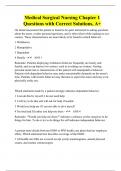
Medical Surgical Nursing Chapter 1 Questions with Correct Solutions, A+
On initial assessment the patient is found to be quiet interested in asking questions about the nurse, evades personal questions, and is often silent while making no eye contact. These characteristics are more likely to be found in which behavior: 1 Withdrawn 2 Manipulative 3 Dependent 4 Hostile - ANS 1 Rationale: Patients displaying withdrawn behavior frequently are lonely and fearful, and set up barriers for contact, such as avoiding eye contact. Getting personal needs met is characteristic of the patient with manipulative behavior. Patients with dependent behavior may make unreasonable demands on the nurse's time. Patients with hostile behavior may threaten to report the nurse and may even physically strike out. Which statement made by a patient strongly indicates dependent behavior: 1 I can do this by myself, I do not need help 2 I will try to do this and will ask for help if needed 3 Would you help me if I am not able to do it myself 4 I'm tired and I'd rather you help me dress - ANS 4 Rationale: "Would you help me dress?" indicates a reliance on the caregiver to do things for him. To do or try to do things for self indicates independent behavior. A patient must decide between HMO or PPO health care plans that her employee offers. Which statement best describes coverage of the HMO: 1 All health care bills are covered except yearly mammograms, annual physical exams, and routine colonoscopies 2 Patients can only see physicians hired by the HMO whenever a visit or treatment is required, no exceptions 3 I will have to pay a fixed monthly fee and a copayment for each doctor's visit is required, no exceptions 4 I will have to pay charges as I leave the doctor's office and send the bill to the HMO for reimbursement - ANS 3 Rationale: When joining an HMO, patients pay a fixed fee that covers all needed care. HMOs encourage prevention of disease by practicing preventive medicine. This in turn saves the HMO money. For an extra fee, patients can see a physician outside the HMO group of physicians. HMOs charge a yearly fee that is paid monthly or quarterly. This fee covers all medical expenses for that year. Which condition is not paid for by Medicare if it develops after hospitalization: 1 Hypokalemia 2 Heart attack 3 Hip Fracture 4 Meningitis - ANS 3 Rationale: In an effort to save millions of tax dollars every year, starting in 2009, Medicare does not cover the costs of "preventable" conditions, mistakes, and infections resulting from a hospital stay. The cost of treatment of a fractured hip that occurred while hospitalized would be the responsibility of the hospital. The other conditions listed would not be covered by Medicare. If the nurse is caring for a patient with an indwelling urinary catheter, which task can be delegated to the nursing assistant: 1 Providing perineal care each morning and evening 2 Collecting a urine specimen for laboratory testing 3 Irrigating the catheter to ensure patency 4 Instilling antibiotics for a urinary infection - ANS 1 Rationale: Perineal care requires the use of medical asepsis (clean technique). Nursing assistants learn principles of medical asepsis. Collecting a urine specimen, irrigating, or instilling antibiotics for a patient with an indwelling urinary catheter requires sterile technique, and nursing assistants do not learn principles of sterile technique. In caring for patients with pressure ulcers, which task would be most appropriate to delegate to the nursing assistant: 1 Providing assistance in making dietary choices, including fruits 2 Participating in determining the appropriate type of wound care 3 Repositioning the patient every 2 hours 4 Describing conditions of the wound and any drainage - ans 3 Rationale: Repositioning of patients is included in the nursing assistant program and changing position every 2 hours helps to avoid pressure on body parts that would contribute to the development of another pressure ulcer. Licensed nurses learn the nutrients needed to assist in healing skin breakdown, can decide wound care system to be used for a pressure ulcer situation, and can evaluate the effectiveness of chosen wound care system. The nurse finds a confused patient with a history of falls attepting to get out of bed. To maintain the patient's self-esteem and safety, the nurse's intervention should be to: 1 Apply physical restraints to keep the patient in bed 2 Administer sedatives per doctor's order 3 Installing a bed alarm to notify staff 4 Discover what the patient is searching for - Ans 4 Rationale: Alarm systems alert staff of patient's continual attempts to get out of bed. Administering sedatives requires a physician's order, and applying physical restraints requires an order within 24 hours after a restraint is applied. Applying restraints and administering sedatives are medically ordered interventions. Because of the patient's confusion, getting to the reason for the patient's attempts to get out of bed is important. She could be interrupting a previous ritual, like calling her husband after supper each time he is away to let her know she is ok. After providing discharge instructions to a patient following knee replacement, which statement by the patient indicates a need for further teaching 1 I will wash my hands before changing my dressing 2 I will be on strict bed rest to allow my knee to heal 3 I will take analgesics before the pain gets worse 4 I will be able to eat and drink as usual - Ans 2 Rationale: Washing the hands is appropriate medical asepsis before changing a dressing. Patient teaching includes the need to take pain medication when pain is first experienced and not to wait until the pain escalates. There are no dietary restrictions associated with knee replacement, unless a medical condition requires a special diet.
Información del documento
- Subido en
- 2 de mayo de 2024
- Número de páginas
- 11
- Escrito en
- 2023/2024
- Tipo
- Examen
- Contiene
- Preguntas y respuestas