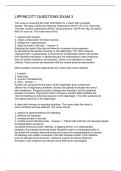
Lippincott Questions Exam 3
The nurse is reviewing the chart information for a client with increased ascites. The data include the following: temperature 98.9°F (37.2°C), heart rate 118 bpm, shallow respirations 26/min, blood pressure 128/76 mm Hg, and SpO2 89% on room air. The nurse should first: 1. assess heart sounds. 2. obtain a prescription for blood cultures. 3. prepare for a paracentesis. 4. raise the head of the bed. - Answer- 4. Elevating the head of the bed will allow for increased lung expansion by decreasing the ascites pressing on the diaphragm. The client requires reassessment. A paracentesis is reserved for symptomatic clients with ascites with impaired respiration or abdominal pain not responding to other measures such as sodium restriction and diuretics. There is no indication for blood cultures. Heart sounds are assessed with the routine physical assessment. Which position would be appropriate for a client with severe ascites? 1. Fowler's 2. side-lying 3. reverse Trendelenburg 4. Sims - Answer- 1. Ascites can compromise the action of the diaphragm and increase the client's risk of respiratory problems. Ascites also greatly increases the risk of skin breakdown. Frequent position changes are important, but the preferred position is Fowler's. Placing the client in Fowler's position helps facilitate the client's breathing by relieving pressure on the diaphragm. The other positions do not relieve pressure on the diaphragm. A client with cirrhosis is receiving lactulose. The nurse notes the client is more confused and has asterixis. The nurse should: 1. assess for gastrointestinal (GI) bleeding. 2. withhold the lactulose. 3. increase protein in the diet. 4. monitor serum bilirubin levels. - Answer- 1. Clients with cirrhosis can develop hepatic encephalopathy caused by inc
Información del documento
- Subido en
- 1 de mayo de 2024
- Número de páginas
- 11
- Escrito en
- 2023/2024
- Tipo
- Examen
- Contiene
- Preguntas y respuestas