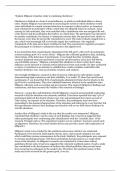
“Explain Milgram’s baseline study in explaining obedience.”
Obedience is defined as a form of social influence, in which an individual follows a direct
order. Stanley Milgram was interested in measuring the extent to which obedience would
cause individuals to commit extreme behaviour in response to direct orders. 40 American
men volunteered to participate within a study that was allegedly based on memory. Upon
arriving to Yale university, they were matched with a confederate who was assigned the role
of the learner and the participant the teacher, in a fixed draw. The participant was instructed
by another confederate, the learner, to administer electric fake, but perceived real, shocks to
the learner every time he incorrectly remembered a word. The scale of shocks ranged from 0-
450, which was assumingly kill or seriously impair the confederate, who regularly
complained of the pain and a heart condition he had. The experimenter regularly prompted
the participant to continue to administer shocks to the highest level.
It was found that 65% of participants administered the full 450V, with 100% of participants
at least reaching 300V of a “severe shock.” Milgram also collected qualitative data, including
observations of the behaviour of participants- it was found that they trembled, shook,
sweated, displayed outward expressions of anxiety and discomfort, and 3 had “full-blown,
uncontrollable seizures.” Milgram concluded that obedience to direct orders had a large
influence on the decision to commit certain behaviours from such results. He later conducted
a variety of variations in an attempt to establish how certain variables would affect this
baseline obedience rate, such as proximity, location, and uniform.
One strength of Milgram’s research is that it has been replicated to yield similar results,
demonstrating high consistency and thus reliability. In a reality TV show that used French
participants, it was found that 80% of participants administered false electric shocks to the
450V level to confederates. They also exhibited behaviour identical to the qualitative data
Milgram collected, such as sweating and nervousness. This supports Milgram’s findings and
conclusions, and thus increases the validity of his research accordingly.
However, a major flaw and limitation of both Milgram’s research and potentially replicating
research is that the situation was extremely artificial. It has been reported that only 75% of
participants believed the electric shocks were real, and participants have been accused of
“play-acting” in response to the situation. Therefore, the participants may have been
responding to the demand characteristics of the situation and behaving in a way that they felt
the experimenter desired. Such findings may therefore tell us very little about obedience in
real-life situations.
Another flaw of Milgram’s study is the way that the results were interpreted. Milgram
concluded that obedience was the cause of such findings, but, it has been suggested that
rather participants were conforming after identification with the “scientific aims” of the
research. Prompts such as “the experiment requires you to continue” may have caused such
an alignment. Therefore, the social identity theory may provide a more valid explanation of
Milgram’s.
Milgram’s study is too, limited by the unethical nature upon which it was conducted.
Participants were deceived, believing the shocks, draw, and research situation was real,
which could have serious consequences in the study. Similarly, the participants were exposed
to extreme psychological harm, with three participants having seizures as a result of the
stress of the situation. As Milgram’s research was conducted at a time where ethical
guidelines did not exist, it has been suggested the extremely unethical nature of such a study
has contributed to the development of modern-day ethical guidelines that prevent harm
from occurring to participant in the modern day. Therefore, the unethical nature of this
study may have occurred for the greater good, so to say.
Obedience is defined as a form of social influence, in which an individual follows a direct
order. Stanley Milgram was interested in measuring the extent to which obedience would
cause individuals to commit extreme behaviour in response to direct orders. 40 American
men volunteered to participate within a study that was allegedly based on memory. Upon
arriving to Yale university, they were matched with a confederate who was assigned the role
of the learner and the participant the teacher, in a fixed draw. The participant was instructed
by another confederate, the learner, to administer electric fake, but perceived real, shocks to
the learner every time he incorrectly remembered a word. The scale of shocks ranged from 0-
450, which was assumingly kill or seriously impair the confederate, who regularly
complained of the pain and a heart condition he had. The experimenter regularly prompted
the participant to continue to administer shocks to the highest level.
It was found that 65% of participants administered the full 450V, with 100% of participants
at least reaching 300V of a “severe shock.” Milgram also collected qualitative data, including
observations of the behaviour of participants- it was found that they trembled, shook,
sweated, displayed outward expressions of anxiety and discomfort, and 3 had “full-blown,
uncontrollable seizures.” Milgram concluded that obedience to direct orders had a large
influence on the decision to commit certain behaviours from such results. He later conducted
a variety of variations in an attempt to establish how certain variables would affect this
baseline obedience rate, such as proximity, location, and uniform.
One strength of Milgram’s research is that it has been replicated to yield similar results,
demonstrating high consistency and thus reliability. In a reality TV show that used French
participants, it was found that 80% of participants administered false electric shocks to the
450V level to confederates. They also exhibited behaviour identical to the qualitative data
Milgram collected, such as sweating and nervousness. This supports Milgram’s findings and
conclusions, and thus increases the validity of his research accordingly.
However, a major flaw and limitation of both Milgram’s research and potentially replicating
research is that the situation was extremely artificial. It has been reported that only 75% of
participants believed the electric shocks were real, and participants have been accused of
“play-acting” in response to the situation. Therefore, the participants may have been
responding to the demand characteristics of the situation and behaving in a way that they felt
the experimenter desired. Such findings may therefore tell us very little about obedience in
real-life situations.
Another flaw of Milgram’s study is the way that the results were interpreted. Milgram
concluded that obedience was the cause of such findings, but, it has been suggested that
rather participants were conforming after identification with the “scientific aims” of the
research. Prompts such as “the experiment requires you to continue” may have caused such
an alignment. Therefore, the social identity theory may provide a more valid explanation of
Milgram’s.
Milgram’s study is too, limited by the unethical nature upon which it was conducted.
Participants were deceived, believing the shocks, draw, and research situation was real,
which could have serious consequences in the study. Similarly, the participants were exposed
to extreme psychological harm, with three participants having seizures as a result of the
stress of the situation. As Milgram’s research was conducted at a time where ethical
guidelines did not exist, it has been suggested the extremely unethical nature of such a study
has contributed to the development of modern-day ethical guidelines that prevent harm
from occurring to participant in the modern day. Therefore, the unethical nature of this
study may have occurred for the greater good, so to say.