

CWRU BIOL 214 Exam 1(Graded A+ actual test)
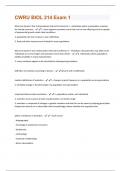
What are darwin's first 3 observations that led to Inference 1 - individuals within a population compete for limited resources - 1. most organisms produce more than one or two offspring and are capable of exponential growth under ideal conditions 2. populations do not increase in size indefinitely 3. food and other resources are limited for most populations What are darwin's last 2 observations that led to Inference 2 - hereditary characteristics may allow some individuals to survive longer and reproduce more than others - 4. individuals within populations exhibit variability in many characteristics 5. many variations appear to be inherited bu subsequent generations definition of evolution according to darwin - descent with modification modern definitions of evolution - 1. changes in gene frequency in a population across generations 2. heritable change in the phenotype of a population over generations important features about evolution - 1. populations evolve, not individuals 2. evolution occurs across at least one generation, not within single 3. evolution = composed of changes in genetic variation and that this can be seen by studying gene/allele frequencies directly or in observable traits (morphology) whose variation has a genetic basis pillars of evidence of evolution - - fossil record - biogeography - homology of anatomical structures - biodiversity - embryology - molecular relationships - direct observationsfossil record - - generally simple to complex - evidence of speciation - transitional fossils what kinds of rocks are fossils found in? - - igneous (molten lava cools and solidifies) - sedimentary (sediments are deposited) - metaphorphic (rocks transformed by heat) how are the ages of fossils determined? - radiometric dating (compares to different chemical isotopes) biogeography (only makes sense in light of evolution) - - plate tectonics - convergent evolution (flightless birds that evolved independently of one another on different continents- not from a single direct ancestor who was also flightless) - wallace line definition of homology - - evolutionary predicts that related organisms will share similarities that are derived from common ancestor - similar characteristics due to relatedness are known as homologies - homologies can be revealed by comparing the anatomies, embryological development, gene sequences or by studying vestigial structures within individual organisms homology of anatomical structures - - vestigial structures (structures that are no longer helpful due to evolution, but were once helpful... wisdom teeth in humans) - homologous structures (similar structures in different animals that are not closely related and may not serve same purposes or functions) Ex of homology - forelimb bones of vertebrates, where the wings of bats, the arms of primates, front flippers of whales, and the forelegs of horse are all derived from the same ancestral tetrapod structurebiodiversity - the variety of life in the world or in a particular habitat or ecosystem embryology - mammalian embryological stages are built on those of fishes, amphibians, and reptiles - only makes sense in light of evolution molecular relationships - more similar the amino acid (protein) or nucleotide (DNA) sequences, the more recently the organisms shared a common ancestor
Información del documento
- Subido en
- 23 de abril de 2024
- Número de páginas
- 7
- Escrito en
- 2023/2024
- Tipo
- Examen
- Contiene
- Preguntas y respuestas

