Metallic and Ionic Solids
25 September 2017 15:29
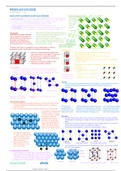
BASIC CRYSTALLOGRAPHY & METALLIC BONDING Atomic Arrangement of NaCl
• Crystalline materials by definition have a regular arrangement of atoms and/or molecules. Crystal lattice -
• Any crystal will have tens to many thousands of atoms in a regular array, often called the a lot of systems
crystal lattice, the smallest regular repeating volume is called the unit cell. with 1:1 ratio
• If you cool e.g. CO2 to a low enough temperature, will form crystals. cation:anion
• A crystal structure is a name given to the unit cell and it's atomic contents adopt this
• A structure type is a defined arrangement of atoms, e.g. the NaCl structure type is found structure
for many different AX atom combinations and all have the same atomic arrangement.
The Unit Cell • These are the 125 atoms that would be found in a
A unit cell is the smallest imaginary 1.2x1.2x1.2nm piece of NaCl weighing 1.5 x 10⁻²¹g
volume element with all opposite • 1g of NaCl would contain 8.3x10²²
sides parallel to each other that, by • In the unit cell, Na13Cl14 which is NaCl1.0769. It isn't
replication and translation, can Na1Cl1 as expected because some of the atoms Not a unit cell
produce the entire 3-dimensional aren't completely within the unit cell, they are as if replicate to
array of spheres/atoms in a structure. shared with other unit cells. the left you are
putting two green and two
Translation exits where it is possible to move an original figure or motif in a yellow atoms together
defined direction by a certain distance to produce an exact image. Atom Counting
• Unit cell is a convenient way to represent the a. 8 unit cells share this atom on the corner of the unit cell so
larger crystal lattice as the regular arrangement contributes 1/8th to the unit cell
of spheres/atoms is found in the unit cell. b. 4 unit cells share this atom on the edge of the unit cell so
• The lattice extends indefinitely in all directions contributes 1/4 to the unit cell
from the unit cell c. 2 unit cells share this atom on the face of the unit cell so contributes
• Preferred to choose the smallest unit cell 1/2 to the unit cell
exhibiting the greatest symmetry
• A lattice point in the body of a cell belongs entirely to that cell and
Crystal systems counts as 1.
• Unit cells are defined by three vectors (a, b and c) and the angles (α, β, γ) Example (NaCl):
• There are 7 crystal systems, possible shapes of unit cells with respect to • Na: edges 12x1/4 = 3, inside 1x1 = 1
fixed relationships of unit cell edges (a, b, and c) and angles (α, β, γ). Only 2 3+1=4
are necessary for this section of the course. α is between b and c • Cl: corners 8x1/8 = 1, faces 6x1/2 = 3
β is between a and c 1+3=4
γ is between a and b • Now NaCl has a 1:1 atom ratio
Centring
• Unit cells may have translational symmetry that applies to all atoms within it known as
centring. Centring automatically generates new atom positions linked by the
symmetry.
(view from above)
Highly symmetrical cubic Hexagonal with a=b≠c and α=β=90o γ=120o
with a=b=c and α=β=γ=90o
Close packing of spheres
• Absence of directional covalent bonds (px, py, pz) so the electrically neutral
metal atoms will pack as efficiently as possible in space i.e. as closely as
geometry allows. A Primitive cell A Body Centred Cell (symbol I) has atoms A Face Centred Cell (symbol
• Hard, non-deformable spheres of identical radii form close-packed layers (symbol P) has no shifted by 1/2 in all directions in the cell. F) has atoms shifted by 1/2
centring. Atoms are So if there is an atom at (m) then another along a and b, 1/2 along a
Each sphere is touching 6 other only on the corners. atom (n) will appear 1/2 along a, b, c and c and 1/2 along b and c
spheres in a layer - this is just
an extract of a layer. 2nd layer
has to pack to maximise Plan views
contact between spheres - if • In a plan view all of the atoms in the structure are projected onto one plane, normally
2nd layer is in contact with something like the ab-plane or bc-plane so that one unit cell axis is perpendicular to the
spot 1, each sphere touches 1 plane.
sphere from the 2nd layer, if • Numbers next to atoms indicate how "high up" they are using fractions of a unit cell. If
spot 2, each sphere touches 2, there are no numbers the atom is assumed to be height 0
if spot 3, each sphere touches • Any atom at 0 must also be at 1, any at 1/2 must also be at 1 1/2 etc.
3.
• 3rd layer can overlap layer 1
or 2 (spot 1 sits directly above
sphere from layer 1, spot 2
does not sit directly above
sphere from layer 1).
• There is geometrically no
P=Primitive Cubic body centred Face centred cell e.g. NaCl
difference between 1 or 2,
none are favoured. • Centred lattices are sometimes preferred to primitive as the full structural symmetry of
the cell is more apparent.
Hexagonal Close Packing (HCP)
• Packing sequence 1, the third layer sits directly over the first
layer and the spheres occupy 74% of the total volume (so 26%
empty space - but not really empty space as electron density of
an atom does not end as abruptly as sphere model suggests)
• Arrangement is usually referred to as "ABA" layer repeat
Top view Side view
Cubic Close Packing (CCP) Side View with spheres reduced for clarity The HCP unit
• Packing sequence 2, the third layer
Inorganic Chemistry I Page 1
25 September 2017 15:29
BASIC CRYSTALLOGRAPHY & METALLIC BONDING Atomic Arrangement of NaCl
• Crystalline materials by definition have a regular arrangement of atoms and/or molecules. Crystal lattice -
• Any crystal will have tens to many thousands of atoms in a regular array, often called the a lot of systems
crystal lattice, the smallest regular repeating volume is called the unit cell. with 1:1 ratio
• If you cool e.g. CO2 to a low enough temperature, will form crystals. cation:anion
• A crystal structure is a name given to the unit cell and it's atomic contents adopt this
• A structure type is a defined arrangement of atoms, e.g. the NaCl structure type is found structure
for many different AX atom combinations and all have the same atomic arrangement.
The Unit Cell • These are the 125 atoms that would be found in a
A unit cell is the smallest imaginary 1.2x1.2x1.2nm piece of NaCl weighing 1.5 x 10⁻²¹g
volume element with all opposite • 1g of NaCl would contain 8.3x10²²
sides parallel to each other that, by • In the unit cell, Na13Cl14 which is NaCl1.0769. It isn't
replication and translation, can Na1Cl1 as expected because some of the atoms Not a unit cell
produce the entire 3-dimensional aren't completely within the unit cell, they are as if replicate to
array of spheres/atoms in a structure. shared with other unit cells. the left you are
putting two green and two
Translation exits where it is possible to move an original figure or motif in a yellow atoms together
defined direction by a certain distance to produce an exact image. Atom Counting
• Unit cell is a convenient way to represent the a. 8 unit cells share this atom on the corner of the unit cell so
larger crystal lattice as the regular arrangement contributes 1/8th to the unit cell
of spheres/atoms is found in the unit cell. b. 4 unit cells share this atom on the edge of the unit cell so
• The lattice extends indefinitely in all directions contributes 1/4 to the unit cell
from the unit cell c. 2 unit cells share this atom on the face of the unit cell so contributes
• Preferred to choose the smallest unit cell 1/2 to the unit cell
exhibiting the greatest symmetry
• A lattice point in the body of a cell belongs entirely to that cell and
Crystal systems counts as 1.
• Unit cells are defined by three vectors (a, b and c) and the angles (α, β, γ) Example (NaCl):
• There are 7 crystal systems, possible shapes of unit cells with respect to • Na: edges 12x1/4 = 3, inside 1x1 = 1
fixed relationships of unit cell edges (a, b, and c) and angles (α, β, γ). Only 2 3+1=4
are necessary for this section of the course. α is between b and c • Cl: corners 8x1/8 = 1, faces 6x1/2 = 3
β is between a and c 1+3=4
γ is between a and b • Now NaCl has a 1:1 atom ratio
Centring
• Unit cells may have translational symmetry that applies to all atoms within it known as
centring. Centring automatically generates new atom positions linked by the
symmetry.
(view from above)
Highly symmetrical cubic Hexagonal with a=b≠c and α=β=90o γ=120o
with a=b=c and α=β=γ=90o
Close packing of spheres
• Absence of directional covalent bonds (px, py, pz) so the electrically neutral
metal atoms will pack as efficiently as possible in space i.e. as closely as
geometry allows. A Primitive cell A Body Centred Cell (symbol I) has atoms A Face Centred Cell (symbol
• Hard, non-deformable spheres of identical radii form close-packed layers (symbol P) has no shifted by 1/2 in all directions in the cell. F) has atoms shifted by 1/2
centring. Atoms are So if there is an atom at (m) then another along a and b, 1/2 along a
Each sphere is touching 6 other only on the corners. atom (n) will appear 1/2 along a, b, c and c and 1/2 along b and c
spheres in a layer - this is just
an extract of a layer. 2nd layer
has to pack to maximise Plan views
contact between spheres - if • In a plan view all of the atoms in the structure are projected onto one plane, normally
2nd layer is in contact with something like the ab-plane or bc-plane so that one unit cell axis is perpendicular to the
spot 1, each sphere touches 1 plane.
sphere from the 2nd layer, if • Numbers next to atoms indicate how "high up" they are using fractions of a unit cell. If
spot 2, each sphere touches 2, there are no numbers the atom is assumed to be height 0
if spot 3, each sphere touches • Any atom at 0 must also be at 1, any at 1/2 must also be at 1 1/2 etc.
3.
• 3rd layer can overlap layer 1
or 2 (spot 1 sits directly above
sphere from layer 1, spot 2
does not sit directly above
sphere from layer 1).
• There is geometrically no
P=Primitive Cubic body centred Face centred cell e.g. NaCl
difference between 1 or 2,
none are favoured. • Centred lattices are sometimes preferred to primitive as the full structural symmetry of
the cell is more apparent.
Hexagonal Close Packing (HCP)
• Packing sequence 1, the third layer sits directly over the first
layer and the spheres occupy 74% of the total volume (so 26%
empty space - but not really empty space as electron density of
an atom does not end as abruptly as sphere model suggests)
• Arrangement is usually referred to as "ABA" layer repeat
Top view Side view
Cubic Close Packing (CCP) Side View with spheres reduced for clarity The HCP unit
• Packing sequence 2, the third layer
Inorganic Chemistry I Page 1