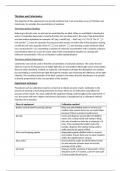
Titration and Colorimetry
The objective of this experiment is to provide evidence that I can accurately carry out Titration and
Colorimetry to calculate the concentration of solutions.
The theory behind Titration:
Referring to the pH scale, an acid can be neutralised by an alkali. When an acid/alkali is dissolved in
water it completely dissociates, meaning that the ions are dispersed in the water. Take hydrochloric
❑ −¿¿
acid and sodium hydroxide for example: HCl (aq) + NaOH (aq) →NaCl (aq) + H 2❑O (l). The Cl ❑❑
+¿¿
ions and Na ❑❑ ions are spectator ions because they remain on either side of the equation, leaving
+¿¿ −¿¿
us with the net ionic equation of the H ❑❑ ions and OH ❑❑ ions forming a water molecule which
has a neutral pH of 7. So, neutralising a solution of unknown concentration with a solution of known
concentration allows us to use the molar ratio of the neutralisation equation to calculate the
unknown concentration. This use of titration is called standardisation.
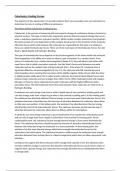
The theory behind Colorimetry:
Colorimetry can only be used to find the concentration of coloured solutions. The colour that we
observe is due to the frequencies of visible light that are transmitted. When light waves meet matter,
they are either absorbed, emitted, or scattered. Colorimeters calculate the absorption of a solution
by transmitting a monochromatic light through the solution and measuring the difference of the light
intensity. The combined principle of the Beer-Lambert's law states that the absorbance of a solution
is directly proportional to the concentration of the solution.
Experiment technique:
Procedures such as calibration must be carried out to obtain accurate results. Calibration is the
process of checking a measuring instrument to ensure there are no faults that could affect the
accuracy of the results. You must calibrate the equipment being used throughout the experiment; if
not, the results will have a higher uncertainty. Each piece of equipment has a calibration method
individual to its function:
Piece of equipment Calibration method
Beaker/conical flask/measuring cylinder Rinse out with distilled water to remove any
residue. Also, ensure there are no cracks/chips
because if there is product could be lost.
Burette Invert and dispense around 20ml of distilled
water. Use a clamp stand and clamp to hang
this over a beaker to drain for a minimum of 3
mins. Then, keeping the beaker under the
burette, dispense the solution being used to
make sure the jet space is filled.
Glass and dropping pipette Repeatedly pipette distilled water to remove
any residue. Ensure there are no water droplets
within the pipette before using it.
2d.p scales Ensure that the scales are 00.00 when turned
on and measure a known mass to test the
accuracy of the scales.
pH meter Prepare 3 buffer solutions of known pH’s. There
should be a pH of 7 (water), a pH of 4 and a pH
of 10 to create the pH curve.
, 1) Ensure the pH meter is switched on and
rinse the pH probe.
2) Place the pH meter into a buffer
solution and press the calibrate button
to get a reading.
3) Repeat this for the other solutions.
4) Plot a graph of the buffer pH against
the measured ph. If the pH meter is
accurate the line of best fit should be a
straight line from the origin.
Colorimeter Roughly fill a cuvette to ¾ with distilled water,
place the cuvette in the colorimeter and close
the lid. Select a wavelength/colour filter, press
the CAL button on the colorimeter and release
the button when it starts flashing red. If the
colorimeter is working the absorbance reading
should be 0.0000.
❑ ❑
Task One: Prepare a standard solution of sodium carbonate (Na 2❑CO 3❑). Use this solution to
standardise a hydrochloric acid (HCl) solution of unknown concentration. Then use this
standardised solution of hydrochloric acid to standardise an unknown concentration of a sodium
hydroxide (NaOH) solution.
❑ ❑
Part one: Preparing a standard solution of Na 2❑CO 3❑
A standard solution is simply a solution of a precisely known concentration. It is required to
standardise the unknown concentration of the HCl solution. I am going to prepare 250cm ❑3❑ of 0.1M
❑ ❑
Na 2❑CO 3❑ solution. So, I need to calculate the mass of sodium carbonate required:
Moles (n) = concentration (moldm−3 3
❑❑ ) × volume (dm❑❑) →Moles = 0.1 × (250÷ 1000) = 0.025
Mass (g) = moles × RFM →RFM = (23×2) + 12 + (16×3) = 106 →Mass = 0.025 × 106 = 2.65
Apparatus:
Anhydrous sodium carbonate
Spatula
Weighing bottle
2d.p mass balance
Beaker
Distilled water
Wash bottle
Glass rod
Conical flask
Funnel
Dropping Pipette
Risk Assessment:
Substance Hazard Comment
Sodium Carbonate Irritant Can cause serious eye
The objective of this experiment is to provide evidence that I can accurately carry out Titration and
Colorimetry to calculate the concentration of solutions.
The theory behind Titration:
Referring to the pH scale, an acid can be neutralised by an alkali. When an acid/alkali is dissolved in
water it completely dissociates, meaning that the ions are dispersed in the water. Take hydrochloric
❑ −¿¿
acid and sodium hydroxide for example: HCl (aq) + NaOH (aq) →NaCl (aq) + H 2❑O (l). The Cl ❑❑
+¿¿
ions and Na ❑❑ ions are spectator ions because they remain on either side of the equation, leaving
+¿¿ −¿¿
us with the net ionic equation of the H ❑❑ ions and OH ❑❑ ions forming a water molecule which
has a neutral pH of 7. So, neutralising a solution of unknown concentration with a solution of known
concentration allows us to use the molar ratio of the neutralisation equation to calculate the
unknown concentration. This use of titration is called standardisation.
The theory behind Colorimetry:
Colorimetry can only be used to find the concentration of coloured solutions. The colour that we
observe is due to the frequencies of visible light that are transmitted. When light waves meet matter,
they are either absorbed, emitted, or scattered. Colorimeters calculate the absorption of a solution
by transmitting a monochromatic light through the solution and measuring the difference of the light
intensity. The combined principle of the Beer-Lambert's law states that the absorbance of a solution
is directly proportional to the concentration of the solution.
Experiment technique:
Procedures such as calibration must be carried out to obtain accurate results. Calibration is the
process of checking a measuring instrument to ensure there are no faults that could affect the
accuracy of the results. You must calibrate the equipment being used throughout the experiment; if
not, the results will have a higher uncertainty. Each piece of equipment has a calibration method
individual to its function:
Piece of equipment Calibration method
Beaker/conical flask/measuring cylinder Rinse out with distilled water to remove any
residue. Also, ensure there are no cracks/chips
because if there is product could be lost.
Burette Invert and dispense around 20ml of distilled
water. Use a clamp stand and clamp to hang
this over a beaker to drain for a minimum of 3
mins. Then, keeping the beaker under the
burette, dispense the solution being used to
make sure the jet space is filled.
Glass and dropping pipette Repeatedly pipette distilled water to remove
any residue. Ensure there are no water droplets
within the pipette before using it.
2d.p scales Ensure that the scales are 00.00 when turned
on and measure a known mass to test the
accuracy of the scales.
pH meter Prepare 3 buffer solutions of known pH’s. There
should be a pH of 7 (water), a pH of 4 and a pH
of 10 to create the pH curve.
, 1) Ensure the pH meter is switched on and
rinse the pH probe.
2) Place the pH meter into a buffer
solution and press the calibrate button
to get a reading.
3) Repeat this for the other solutions.
4) Plot a graph of the buffer pH against
the measured ph. If the pH meter is
accurate the line of best fit should be a
straight line from the origin.
Colorimeter Roughly fill a cuvette to ¾ with distilled water,
place the cuvette in the colorimeter and close
the lid. Select a wavelength/colour filter, press
the CAL button on the colorimeter and release
the button when it starts flashing red. If the
colorimeter is working the absorbance reading
should be 0.0000.
❑ ❑
Task One: Prepare a standard solution of sodium carbonate (Na 2❑CO 3❑). Use this solution to
standardise a hydrochloric acid (HCl) solution of unknown concentration. Then use this
standardised solution of hydrochloric acid to standardise an unknown concentration of a sodium
hydroxide (NaOH) solution.
❑ ❑
Part one: Preparing a standard solution of Na 2❑CO 3❑
A standard solution is simply a solution of a precisely known concentration. It is required to
standardise the unknown concentration of the HCl solution. I am going to prepare 250cm ❑3❑ of 0.1M
❑ ❑
Na 2❑CO 3❑ solution. So, I need to calculate the mass of sodium carbonate required:
Moles (n) = concentration (moldm−3 3
❑❑ ) × volume (dm❑❑) →Moles = 0.1 × (250÷ 1000) = 0.025
Mass (g) = moles × RFM →RFM = (23×2) + 12 + (16×3) = 106 →Mass = 0.025 × 106 = 2.65
Apparatus:
Anhydrous sodium carbonate
Spatula
Weighing bottle
2d.p mass balance
Beaker
Distilled water
Wash bottle
Glass rod
Conical flask
Funnel
Dropping Pipette
Risk Assessment:
Substance Hazard Comment
Sodium Carbonate Irritant Can cause serious eye