

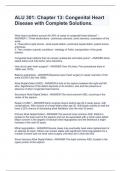
ALU 301: Chapter 13: Congenital Heart Disease with Complete Solutions.
What heart conditions account for 80% of cases of congenital heart disease? - ANSWER-1. Three obstructions - pulmonary stenosis, aortic stenosis, coarctation of the aorta. 2. Three left-to-right shunts - atrial septal defect, ventricular septal defect, patent ductus arteriosus. 3. Two complex cyanotic conditions - tetralogy of Fallot, transposition of the great arteries. Congenital heart defects that can remain undetected until adult years? - ANSWER-Atrial septal defect and mild aortic valve disorders. How old is open heart surgery? - ANSWER-Over 50 years. First procedures done in 1960s and 1970s. Balloon angioplasty - ANSWER-Replaced open heart surgery to repair coarction of the aorta (COA) in the mid 1990s. Atrial Septal Defect (ASD) - ANSWER-A hole in the septum between the right and left atria. Significance of the defect depends on its location, size and the presence or absence of other congenital heart lesions. Secundum Atrial Septal Defect - ANSWER-The most common ASD, occurring in the center of the septum. Repair of ASD? - ANSWER-Early surgical closure before age 20 is rarely assoc. with complications. With closure of a large defect after age 20, individuals usually do well but have a 25% chance of developing atrial fibrillation over the next 30 years. Primum Atrial Septal Defect - ANSWER-The second most common ASD. Defect is located in the lower part of the septum and can be associated with a mitral valve defect. Major concern is the degree of residual mitral regurgitation and the likelihood it might increase in the next 30 years. Mitral regurgitation - ANSWER-Severe cases may eventually need valve replacement or an attempt at repair. Others can remain stable with significant mitral regurgitation for a number of years and not need valve surgery until they are in their late 40s. Sinus Venosus Atrial Septal Defect - ANSWER-The least common ASD, located in the
Información del documento
- Subido en
- 8 de abril de 2024
- Número de páginas
- 5
- Escrito en
- 2023/2024
- Tipo
- Examen
- Contiene
- Preguntas y respuestas

