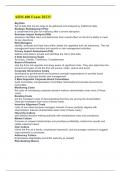
ARM 400 Exam 2023!!
ARM 400 Exam 2023!! Big Data Set of data that are too large to be gathered and analysed by traditional data. Strategic Redeployment Plan a comprehensive plan for resiliency after a severe disruption Business Impact Analysis (BIA) assesses identified risks and determines their overall effect on the firm's ability to meet its key objectives Risk Managers identify, evaluate and treat risks within stated risk appetites and risk tolerances. The risk management team monitors and reports on risk management activities. Privacy Impact Assessment (PIA) defines what data is private and identifies the risk to that data. 4 Data Governance Goals Accuracy; Validity; Timeliness; Completeness Board of Directors sets the firms risk appetite and stays aware of significant risks. They also determine the amount and types of risk the firm will pursue, retain, reduce and avoid. Corporate Governance Codes developed by governments and business oversight organisations to provide broad guidance to corporate boards and management. 3 Most Important Corporate Board Committees Audit Committee; Compensation Committee; Nominations/Corporate Governance Committee Monitoring Costs the costs of overseeing corporate decision makers (shareholders bear most of these costs) Bonding Costs are the managers costs of demonstrating that they are serving the shareholders interests (managers bear most of these costs) Incentive Alignment Costs costs of lost value because managers interest of never perfectly aligned with shareholders' interest (shareholders bear most of these costs) Hierarchy Culture well defined decision making authority with standardized rules and procedures Market Culture Focuses on outward relationships and prioritizes profitability, bottom-line results and stable customer bases Clan Culture Views the firm as a family, emphasizes teamwork, and encourages workers to suggest improvements to processes Adhocracy Culture Emphasizes adaptability and shifts authority as needed Risk-Seeking (Naive) This attitude anticipates positive results, often underemphasising a risk's potential negative effects Risk-Avoiding (Risk Obsessed) This attitude anticipates negative results, avoid innovation and transfer risk wherever possible Risk-Optimizing (Risk Managed) This attitude evaluates a risk's potential positive and negative outcomes and choose risk carefully Delegating Management Style Sets broad, strategic goals for all stakeholders and lets individual stakeholders decide how to meet those goals Directive Management Style Tells stakeholders exactly how to meet their goals and limits the flow of information Supportive Management Style Explains the thinking behind strategic goals and then encourages stakeholders to pursue related goals, send feedback to managers, and to set up their own communication networks 5 Techniques for Treating Risks Avoidance; Modification; Transfer; Retention; Optimize/Exploit Three Major Ways to Classify Risk Pure/Speculative; Subjective/Objective; Diversifiable/Non-Diversifiable Risk Management Assessment Process Scan; Identify; Analyse; Treat; Monitor 5 Benefits of Holistic Risk Management Tolerable Uncertainty; Profitability and Growth; Legal and Compliance; Social Responsibility; Reduced Deterrent Effects 4 Components of Holistic Risk Management Reduced Downside Risk; Earnings Stability; Identification of Emerging Risks; Continuity of Operations Risktech goes beyond insurtech by expanding its focus on how to make risk financing more efficient to include how to prevent and mitigate risk in a variety of industries. Hazard Risks arise from property, liability, or personnel loss exposures and are generally the subject of insurance (pure) Operational Risk arise from people or failure in processes, systems or controls including those involving information technology (pure) Financial Risk arise from the effect of market forces on financial assets or liabilities and include market risk, credit risk, liquidity risk and price risk (speculative) Strategic Risk arise from trends in the economy and society, including changes in the economic, political and competitive environments (speculative) Smart Product An innovative item that uses sensors; wireless sensor networks; and data collection, transmission, and analysis to further enable the item to be faster, more useful, or otherwise improved. Internet of Things (IoT) A network of objects that transmit data to and from each other without human interaction. Cloud Computing Information, technology, and storage services contractually provided from remote locations, through the internet or another network, without a direct server connection. Blockchain A distributed digital ledger that facilitates secure transactions without the need for a third party. Telematics The use of technological devices in vehicles with wireless communication and GPS tracking that transmit data to businesses or government agencies; some return information for the driver. Text Mining Obtaining information through language recognition. Risk Appetite Amount of risk an organization is willing to take on in order to achieve an anticipated result or return. Value at risk (VaR) A technique to quantify financial risk by measuring the likelihood of losing more than a specific dollar amount over a specific period of time. Cost of risk The total cost incurred by an organization because of the possibility of accidental loss. Exposure Any condition that presents a possibility of gain or loss, whether or not an actual loss occurs. Volatility Frequent fluctuations, such as in the price of an asset. Likelihood A qualitative estimate of the certainty with which the outcome of a specific event can be predicted. Consequences The effects, positive or negative, of an occurrence. Time Horizon Estimated duration. Correlation A relationship between variables. Pure Risk A chance of loss or no loss, but no chance of gain Speculative Risk A chance of loss, no loss, or gain. Credit Risk
Información del documento
- Subido en
- 4 de abril de 2024
- Número de páginas
- 8
- Escrito en
- 2023/2024
- Tipo
- Examen
- Contiene
- Preguntas y respuestas